
South Korean authorities vowed to stabilise Seoul’s volatile stock market following sharp declines in November 2026, but posts falsely claimed the ruling Democratic Party planned to ban investors from selling shares. In fact, the move is aimed at controlling shareholders who deliberately keep their firms’ stock prices low to help their family bypass higher rates of tax when they inherit the shares.
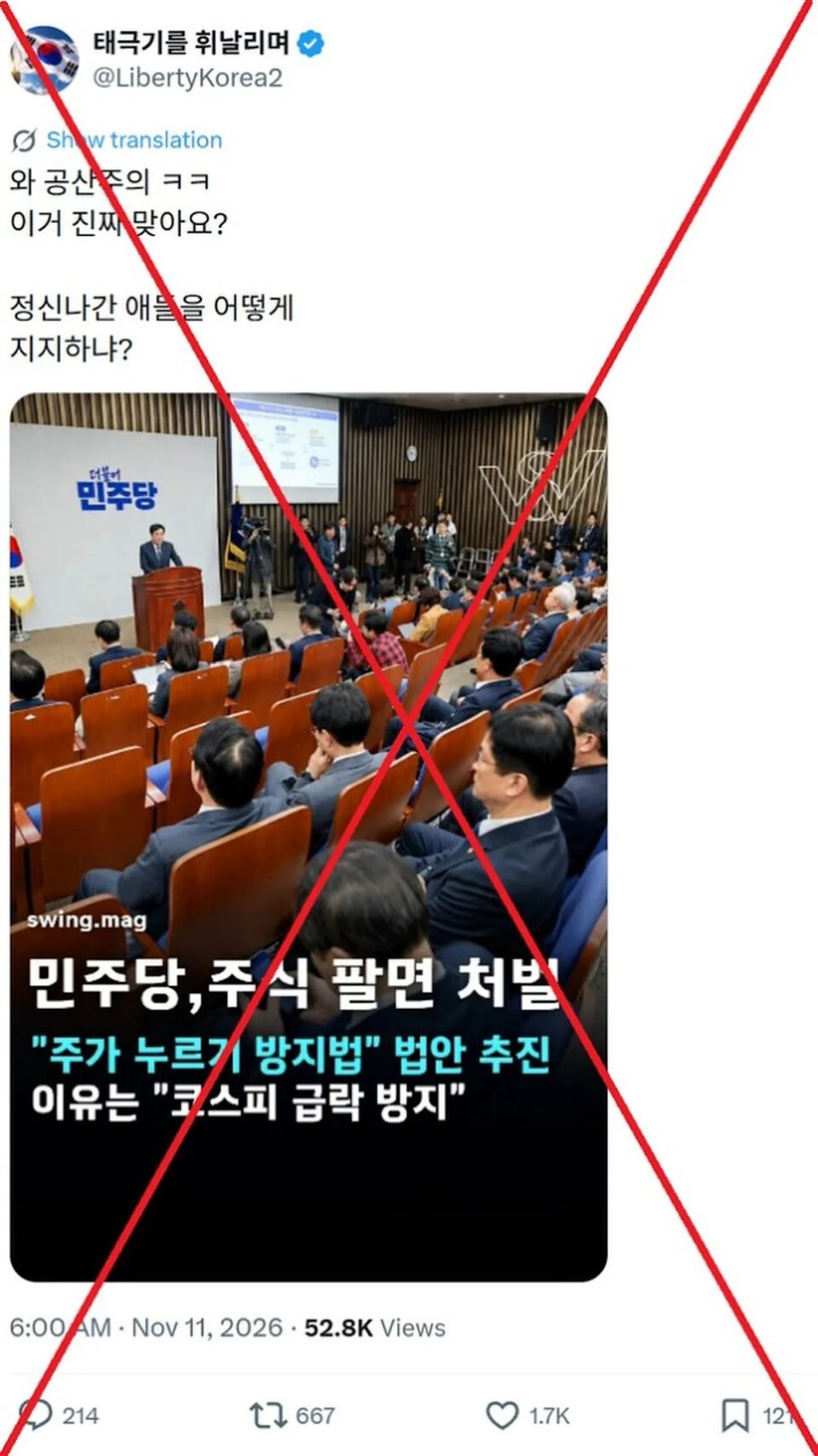
“Wow communism… is this really true? How can one support such insane people?” says the Korean-language caption of a X graphic shared on November 11, 2026.
The graphic features a photo of centre-left Democratic Party lawmakers meeting, overlaid with text that reads: “The Democratic Party will punish those who sell stocks. Pushing for the ‘Stock Price Suppression Prevention’ legislation.”
The superimposed text adds the proposed legislation aims to prevent the plummeting of South Korea’s main stock market index, the Kospi.

It circulated as plunging technology shares dragged the benchmark Kospi to a seven-month low in early November, as scepticism grew over sustainability of the global AI boom ( archived link).
Global demand for AI chips earlier in 2026 sent South Korean stock markets soaring, with shares of local tech giants Samsung Electronics and SK Hynix — whose advanced memory chips are crucial to sustaining AI infrastructure — reaching new highs.
Seoul’s financial authorities have vowed to take measures to calm the volatile markets, including the introduction of a stock stabilisation fund (archived here, here).
Similar claims were also shared in Facebook, Threads and X posts by social media users who accused Seoul of “sacrificing” ordinary stock investors to bolster the markets.
“Punishing people for selling stocks… this is communism,” reads a comment on one of the posts, while another says: “Who’s going to buy stocks if they can’t sell them at will? It’ll make the market collapse even further.”
But the proposed law does not ban individual investors from selling their stock holdings.
Stock inheritance law
The ‘Stock Price Suppression Prevention’ legislation mentioned in the false posts refers to efforts to revise South Korea’s taxation law, which has been pushed by the Democratic Party as a priority policy ( archived link).
The revision aims to prevent controlling shareholders of listed companies from deliberately keeping their stock prices low before transferring shares to children or other family members in order to reduce inheritance or gift taxes.
Under the current law, these taxes are calculated based on the average stock price two months before and after the share transfer ( archived link).