
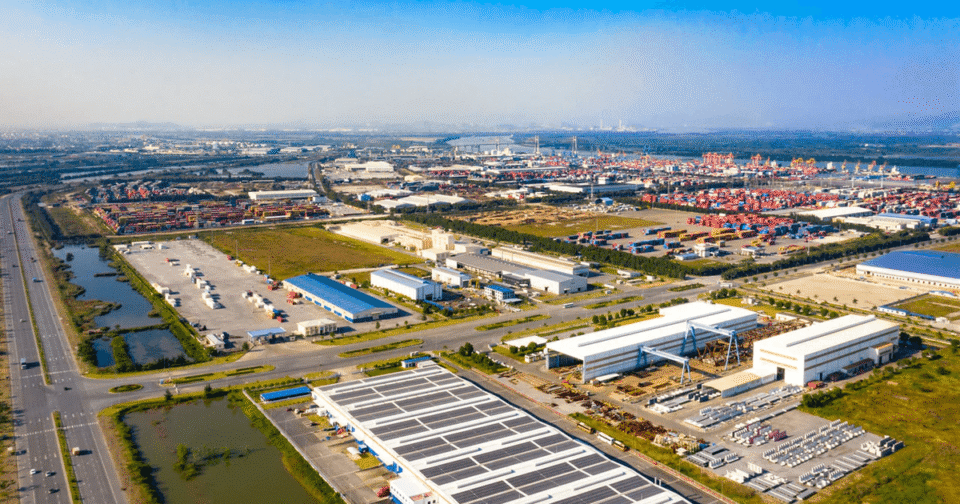

In the process of industrialization coupled with green growth, the industrial real estate market in Hai Phong is undergoing a significant shift in development direction. Instead of primarily subdividing and leasing undeveloped land for a one-time payment, major industrial park infrastructure developers in the city are now focusing on constructing multi-story factories and smart warehouses ready for lease, while simultaneously integrating green standards.
This approach not only helps to use land more efficiently but also meets the increasingly stringent environmental protection requirements of the new generation of foreign investors.
Greening pressure from global supply chains
According to data from the Foreign Investment Agency ( Ministry of Finance ), nearly 500 industrial parks have been established nationwide, with a total industrial land area of nearly 102,000 hectares. Of these, more than 300 industrial parks are already in operation.
In the North alone, a report by Cushman & Wakefield indicates that by the end of Q3 2026, the total industrial park land area in key markets including Hai Phong, Bac Ninh , Ninh Binh, and Phu Tho will reach 25,455 hectares, an increase of 7.4% compared to the same period in 2025.
During the same period, the supply of ready-built factory space in the North reached approximately 6.1 million m², an increase of 19.1% compared to the same period last year. Nearly 700,000 m² of new factory space was put into operation in the first nine months of the year.
The supply of ready-built factory space is rapidly increasing due to demand from high-tech industries such as electronics, semiconductors, and modern logistics. Besides location and rental price, secondary investors are increasingly focusing on environmental, social, and governance criteria when evaluating supply chains.
Notably, from January 1, 2026, the European Union’s Carbon Border Adjustment Mechanism officially enters the application phase for many key export product groups such as iron and steel, aluminum, cement, and electricity. This requires manufacturing businesses to control emissions and provide transparent energy consumption data right at the factory.
According to Mr. Hoang Dai, Vice Chairman of the Hai Phong Real Estate Association, seizing this trend, major infrastructure developers in Hai Phong such as the DEEP C Industrial Complex, VSIP Hai Phong, Nam Dinh Vu Industrial Park, Nam Cau Kien Industrial Park, and Trang Due Industrial Park are focusing on investing in new generation ready-built factory complexes.
The projects are comprehensively invested in, from construction materials, lighting systems, and natural ventilation to rooftop solar power and a recirculating wastewater treatment system. Many projects aim to achieve international green building certifications such as LEED from the US or Lotus from Vietnam. At the same time, the industrial parks are directly connected to the Lach Huyen deep-water port system.
The reality at DEEP C Hai Phong 1 industrial park demonstrates the concrete effectiveness of this development model. After participating in the Global Eco-Industrial Park Program since 2020, the industrial park has completed 52 out of 64 targets according to the International Eco-Industrial Park Framework.
Here, 15 secondary businesses have implemented 65 cleaner production and resource-efficient solutions. As a result, they save more than 4.8 million kWh of electricity, more than 79,000 m³ of water, and reduce over 3,000 tons of CO₂ equivalent emissions annually.
Assessing the attractiveness of this segment in Hai Phong, Mr. Hoang Dai said that the strategic port connectivity and synchronized investment attraction policies create favorable conditions for the development of ready-built factory projects. For example, in the DEEP C industrial park, factories with flexible areas starting from 3,000 m², achieving LEED Silver certification, help investors shorten project implementation time.
Instead of spending 1-2 years completing legal procedures and constructing a factory, businesses renting factory space can install production lines and start manufacturing operations in just a few months.
Optimizing the efficient use of land and capital.
Shifting from leasing undeveloped land to developing ready-built factories that meet green standards also helps Hai Phong improve the efficiency of industrial land use.

Instead of building single-story factories with sprawling floor areas that occupy a lot of land, the city encourages investors to develop multi-story factories, from 3 to 5 stories or higher, suitable for light industries and electronic component assembly.
Financially, the factory leasing model provides investors with a regular and stable income stream, rather than a one-time payment for land lease. Once the legal framework for real estate finance in Vietnam is perfected, these assets that generate regular cash flow can be pooled into real estate investment trusts to raise capital from the public market.
This is a financial tool that helps industrial park infrastructure developers recover their capital quickly, reducing the pressure of tied-up capital in the medium and long term, thereby freeing up resources to continue investing in new eco-industrial parks.
According to Dr. Nguyen Van Khoi, Chairman of the Vietnam Real Estate Association (VNREA), industrial real estate needs to be closely linked to the goal of making Vietnam a developed country with a modern industrial base by 2045. Industrial real estate development should not only focus on expanding the area or increasing the number of industrial parks, but also on efficient exploitation, creating physical space for production, research, and innovation, thereby generating higher added value for the economy .
Besides the clear competitive advantages, developing green factories in Hai Phong also places high demands on management capacity and financial balance for investors. A truly green factory goes beyond simply installing rooftop solar power or increasing green space density; it requires a comprehensive technical solution throughout the building’s lifecycle, from architectural design and energy consumption management to waste sorting and reuse.

Besides the benefits, investing in green-certified factories also presents some challenges. Initial construction costs and maintenance of technical systems are often higher than traditional factories. Meanwhile, the cost savings in operation take a long time to offset the initial investment.
Green standards cannot replace fundamental requirements regarding legal compliance, construction quality, occupational safety, and fire prevention and control. This model is only effective when the investor ensures stable operation and has a transparent system for monitoring and supervising environmental indicators to facilitate the inspection and evaluation of the supply chain of businesses leasing factory space.
With synchronized investment in technical infrastructure, coupled with effective environmental management solutions, industrial zones in Hai Phong will have better conditions to increase the value of land exploitation per hectare, meeting the requirements of ecological and sustainable industrial development in the future.
THU HANG