
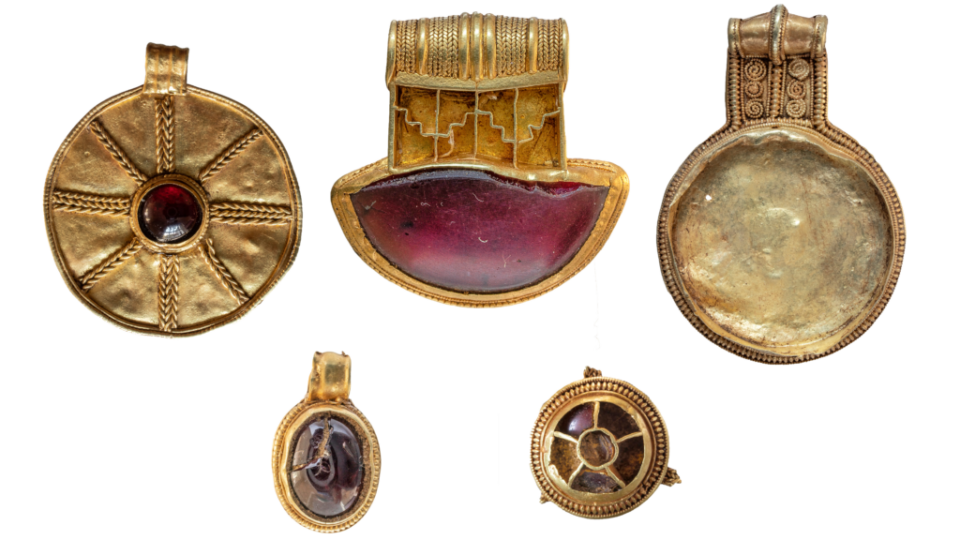
In 2025 the Beecroft Bequest supported Lincoln Museum’s acquisition of a remarkable group of gold and garnet jewellery. The work of Anglo-Saxon goldsmiths in 7th century England, the five pieces are spectacular, visually striking and highly wearable even today.
The unique group of five includes a domed garnet-set boss, probably from a brooch, and four pendants from high-status necklaces usually found in the graves of elite women. The jewellery was discovered near Donington on Bain, Lincolnshire, buried in plough soil on farmland by two metal detectorists.
Lisa Brundle, Lincolnshire’s finds liaison officer (Portable Antiquities Scheme), suggests that because of the absence of other burial goods the set may have been part of a goldsmith’s stash, a ritual deposit, or simply valuables hidden but never retrieved.
The pieces are remarkably well preserved with only minor damage and loss. The combination of garnet and gold is typical of this time, and the design of the largest pendant is extraordinary – the unusually large scallop-shaped garnet and cloisonné-stepped cells represent extremely fine workmanship. The disc-shaped pendant retains its central garnet setting, with intricately plaited gold filigree. The gold and garnet boss may be from a composite disc brooch, which is an extremely rare find in Lincolnshire.
The group will join other star archaeological finds in Lincoln’s award-winning museum – home to artefacts and stories from Lincolnshire’s earliest inhabitants to contemporary art. The repository for the county’s archaeological project archives, as well as individual chance finds, Lincoln Museum holds over two million archaeological objects.
People are at the centre of the museum displays, from selecting the stone from which to craft a polished axehead in the Neolithic, to the wealth and influence of the nobility living in Lincolnshire’s medieval manor houses.
Dawn Heywood, the museum’s senior collections development officer, said: “This stunning jewellery, which spent over a thousand years buried in the earth, will be the centrepiece of new displays in our permanent archaeology gallery.
“Currently in redevelopment, the displays will highlight the human stories behind the objects, with a focus on everyday life and cultural connection between audiences and our ancestors – fostering connection to place, identity and heritage, particularly for our local Lincolnshire communities who may feel overlooked in national narratives.
“Securing the group in our public collection, rather than in private hands, will protect it for future generations as well as supporting community engagement – the find spot within East Lindsey, one of Arts Council England’s Priority Places 2021-2027, makes this acquisition particularly welcome.”
The quality and completeness of the jewellery provide many possibilities for display themes and engagement, especially as the Lincoln Museum collection includes several other Anglo-Saxon gold pieces with garnet, gemstone and glass settings.
Lincolnshire has a wealth of collections from Anglo-Saxon cemeteries and every find, like these from Donington on Bain, increases our knowledge and builds up a picture of burial practice, craftsmanship and society in the early medieval period.
Image courtesy of Lincoln Museum