
The semiconductor industry operates on a foundation of specialised materials, each serving precise functions in the manufacturing of advanced electronic components. Among these materials, certain platinum group metals have emerged as indispensable elements in the production of high-performance computing systems. As global demand for data processing capabilities intensifies, the supply chain challenges supporting these critical materials face unprecedented pressures that extend far beyond traditional industrial applications.
Ruthenium, a silvery-white precious metal belonging to the platinum group, possesses unique properties that make it essential for specific technological applications. Its exceptional resistance to corrosion, coupled with its ability to maintain stability under extreme conditions, positions this element as a cornerstone in the manufacturing of components that enable our digital infrastructure.
When big ASX news breaks, our subscribers know first
Fundamental Properties Driving Industrial Demand
The magnetic properties of ruthenium have established its critical role in data storage technology. Within hard disk drives, this metal forms essential magnetic layers that enable high-density information storage. The expansion in data center capacity has directly translated to increased hard disk drive production, where manufacturers rely on ruthenium’s magnetic characteristics to achieve the storage densities required by modern computing applications.
Enterprise storage systems demand materials capable of withstanding continuous operation under demanding thermal conditions. Ruthenium’s thermal stability ensures consistent performance in environments where traditional materials might degrade, making it particularly valuable for applications where reliability cannot be compromised.
Key Applications in Modern Technology:
• High-density magnetic recording layers in enterprise hard drives
• Semiconductor chip resistor manufacturing processes
• Chemical processing equipment requiring corrosion resistance
• Advanced thin-film technologies in electronic components
The semiconductor industry utilises ruthenium in specialised resistor applications where precise electrical properties are essential. Furthermore, as chip architectures become increasingly complex, the demand for materials that can maintain consistent electrical characteristics across varying operational conditions has grown substantially alongside mining innovation trends.
Supply Chain Constraints and Geographic Concentration
The global supply of ruthenium faces structural limitations that fundamentally distinguish it from other precious metals markets. Unlike gold or silver, which can be extracted as primary mining targets, ruthenium is produced exclusively as a by-product of platinum group metal mining operations. This dependency creates inherent constraints on supply responsiveness to price signals.
South Africa dominates global ruthenium production, with mining operations concentrated in specific geological formations. Platinum group metals output in South Africa declined by 3.8% year-over-year in January 2025, according to official statistics, highlighting the vulnerability of global supply chains to regional production challenges.
Market Price Evolution:
| Period | Price (USD/gram) | Key Market Drivers |
|---|---|---|
| March 2025 | $17.98 | Baseline industrial demand |
| December 2025 | $35.67 | Early AI infrastructure investment |
| March 2026 | $56.21 | Supply constraints meet demand surge |
The limited investment in new platinum group metal mining projects over the past two decades has created a production environment where increasing output requires significant lead times and capital commitments. Mining companies have noted that expanding production capacity involves complex geological and technical challenges that cannot be quickly resolved through market mechanisms alone.
Processing ruthenium from raw materials requires specialised refining capabilities that exist in only a limited number of facilities globally. This concentration of processing capacity creates additional bottlenecks in the supply chain, where disruptions at individual facilities can impact global availability.
Artificial Intelligence Infrastructure and Data Storage Demands
The rapid expansion of artificial intelligence applications has created unprecedented demand for data storage and processing capabilities. Modern AI systems require vast amounts of storage capacity to handle training datasets, model parameters, and real-time processing requirements. This demand directly translates to increased production of hard disk drives and related storage technologies where ruthenium plays a critical role.
Data centres supporting cloud computing and AI workloads represent one of the fastest-growing segments of global infrastructure investment. These facilities require storage systems capable of handling massive data volumes whilst maintaining high reliability standards. The magnetic recording technologies that depend on ruthenium have become essential components in meeting these requirements.
Enterprise storage capacity expansion has accelerated as organisations implement AI-driven analytics and machine learning applications across their operations. The transition from traditional business computing to AI-enabled systems has fundamentally altered storage capacity requirements, driving increased demand for high-density storage solutions.
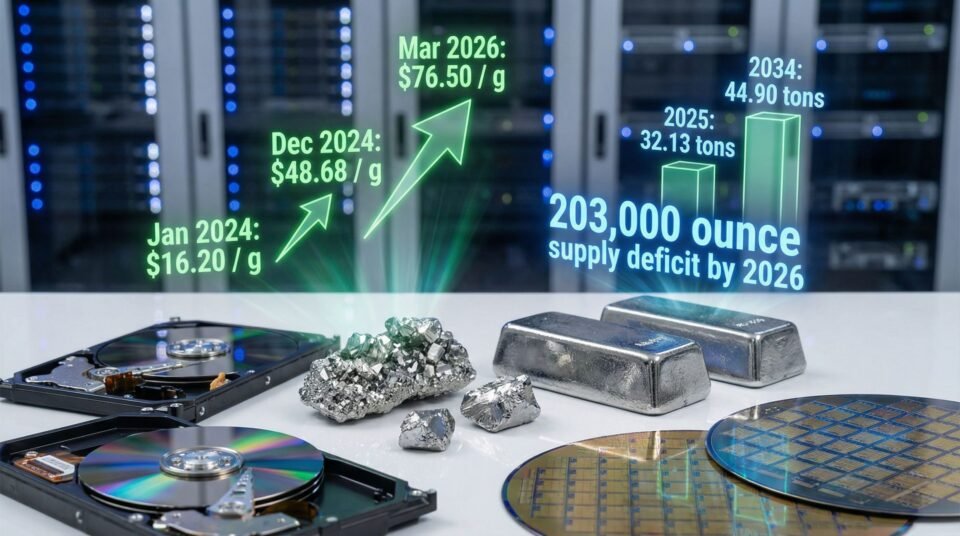
Market analysts project a ruthenium supply deficit of 203,000 ounces in 2026, as demand from AI-driven data storage applications outpaces available supply from existing production sources.
Factors Driving Technology Demand:
• Cloud computing infrastructure scaling to support AI workloads
• Enterprise data storage expansion for machine learning applications
• High-performance computing requirements for AI model training
• Increased production of specialised semiconductor components
The semiconductor manufacturing sector has experienced parallel demand growth as AI applications require increasingly sophisticated processing capabilities. Advanced microprocessors and specialised AI chips utilise ruthenium in specific manufacturing processes, creating additional demand pressure beyond traditional storage applications.
Market Dynamics and Price Volatility
Ruthenium prices artificial intelligence infrastructure demands have experienced dramatic appreciation, rising from approximately $560 per ounce in March 2025 to $1,750 per ounce by March 2026, representing a 212% increase within a single year. This price movement reflects the intersection of constrained supply with rapidly expanding demand from artificial intelligence infrastructure development.
The limited liquidity in ruthenium markets amplifies price movements as relatively small changes in supply or demand can generate significant price responses. Unlike more established precious metals markets, ruthenium trading occurs within a narrow market structure where major industrial consumers and specialised dealers dominate trading activity.
Investment positioning around AI infrastructure themes has contributed to market volatility as investors seek exposure to metals that serve as proxies for artificial intelligence development. In addition, market participants have expanded their positioning in ruthenium as recognition of its role in AI infrastructure has grown among financial market participants.
Market Volatility Factors:
• Limited trading liquidity amplifying price movements
• Industrial restocking cycles in electronics manufacturing
• Speculative positioning around AI infrastructure investment themes
• Supply disruption sensitivity due to concentrated production
The procurement strategies of major electronics manufacturers significantly influence market dynamics as these industrial consumers typically operate with lean inventory models. When production schedules accelerate, the concentrated purchasing required to rebuild inventory levels can create substantial short-term demand spikes.
Alternative Applications Beyond Electronics
Whilst electronics and semiconductor applications dominate current demand, ruthenium serves critical functions in chemical processing industries where its catalytic properties enable specific industrial processes. These applications provide a baseline demand floor that exists independently of technology sector cycles.
The chemical industry utilises ruthenium as a catalyst in specialised processes where its resistance to chemical degradation allows for efficient operation under harsh conditions. These applications, whilst smaller in volume than electronics uses, represent stable demand sources that support long-term market fundamentals.
Emerging applications in fuel cell technology represent a potential growth area as global energy systems transition toward hydrogen-based solutions. Ruthenium’s catalytic properties make it valuable for fuel cell electrode applications, though these markets remain in early development stages compared to established electronics applications.
Industrial Application Categories:
• Chemical processing catalyst applications
• Fuel cell electrode manufacturing
• Advanced materials research initiatives
• Specialised manufacturing process requirements
Research into advanced battery technologies has identified ruthenium as a potential component in next-generation energy storage systems. However, whilst these applications remain largely experimental, successful development could create additional demand sources beyond current market drivers alongside the broader critical minerals energy transition.
The next major ASX story will hit our subscribers first
Investment Considerations and Risk Assessment
The ruthenium market presents unique challenges for both industrial consumers and financial market participants. Limited availability of traditional hedging instruments means that price risk management requires specialised approaches that differ from other precious metals markets.
Physical procurement strategies have become increasingly important for electronics manufacturers as supply chain reliability concerns have grown. Companies are evaluating longer-term supply contracts and strategic inventory positions to ensure production continuity amid price volatility and supply constraints.
The concentration of production in South Africa creates geopolitical risk exposure that extends beyond typical commodity market considerations. Political developments, regulatory changes, and infrastructure challenges in the region can significantly impact global supply availability, particularly where critical raw materials supply chains are concerned.
Risk Management Strategies:
• Strategic inventory management for critical applications
• Supplier diversification across available sources
• Long-term supply contract negotiations
• Alternative material research and development
Investment vehicles offering ruthenium exposure remain limited compared to other precious metals, requiring market participants to evaluate specialised commodity funds or direct physical ownership arrangements. The illiquid nature of the market means that position sizing requires careful consideration of potential exit challenges.
Future Market Outlook and Demand Projections
The intersection of constrained supply with expanding technological applications suggests continued market tightness through the remainder of this decade. Data centre capacity expansion shows no signs of slowing as AI applications become increasingly integrated into business operations across industries.
Semiconductor technology advancement continues to drive demand for specialised materials capable of supporting increasingly complex chip architectures. As processor designs evolve to meet AI computational requirements, the materials supporting these technologies face corresponding demand pressure, particularly following recent executive order on minerals initiatives.
Long-term Market Drivers:
| Factor | Impact Timeline | Demand Influence |
|---|---|---|
| AI infrastructure expansion | 2026-2030 | High |
| Data centre capacity growth | Ongoing | High |
| Semiconductor advancement | Continuous | Moderate |
| Alternative material development | 2028+ | Variable |
The potential for alternative material development represents the primary long-term risk to sustained demand growth. Research into substitute materials that could perform similar functions in electronics applications continues, though the timeline for commercial implementation remains uncertain.
Supply diversification initiatives may eventually reduce dependence on South African production, but the geological constraints that concentrate platinum group metal deposits limit the near-term potential for significant geographic expansion of mining operations. Consequently, understanding what ruthenium represents in the broader precious metals market remains crucial for investors.
Disclaimer: The information presented in this analysis is based on publicly available market data and industry reports. Precious metals markets are subject to significant volatility and risk. Potential investors should conduct independent research and consult with qualified financial advisors before making investment decisions. Past performance does not guarantee future results, and all investments carry the risk of loss.
Discovery Alert’s proprietary Discovery IQ model delivers instant notifications on significant ASX mineral discoveries, including critical technology metals that power our digital infrastructure. Start your 14-day free trial today to gain immediate access to market-moving discovery alerts and position yourself ahead of the broader market.