
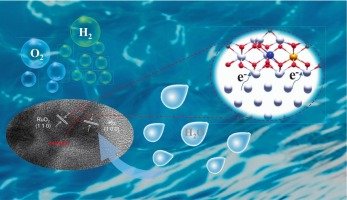
Electrochemical water splitting powered by renewable electricity offers a compelling pathway to sustainable hydrogen production [1]. However, scalable industrial deployment remains constrained by substantial energy inefficiencies arising from sluggish kinetics of both the cathodic hydrogen evolution reaction (HER) and the anodic oxygen evolution reaction (OER) [2]. Consequently, the development of highly efficient bifunctional electrocatalysts capable of operating at low overpotentials for both HER and OER within a single electrolyte is imperative [3]. In comparison with alkaline systems, acidic electrolytes afford superior protonic conductivity and diminished ohmic losses; nonetheless, their highly corrosive milieu, coupled with insufficient electrocatalyst stability under acidic OER conditions, markedly impedes reaction kinetics [4]. Ruthenium-based materials (e.g., RuO2) have emerged as economically viable alternatives to precious Pt/Ir catalysts owing to their analogous electronic structures [5,6]. Nonetheless, monometallic RuO2 exhibits pronounced performance degradation during prolonged OER operation, primarily due to over-oxidation that induces lattice oxygen loss and ruthenium dissolution [7]. Furthermore, the semiconducting nature of RuO2 engenders substantial charge-transfer resistance, further compromising catalytic efficiency [8]. These challenges underscore the critical need to design robust ruthenium-based catalysts with optimized electronic configurations and stabilized active sites to enable durable acidic OER.
 O bonds, thereby suppressing lattice oxygen participation during OER and mitigating structural degradation [13]. In contrast, Cu doping contributes electrons to Ru d-orbitals owing to its lower electronegativity (Cu = 1.90; Ru = 2.20), effectively reducing the oxidation state of surface Ru species and weakening RuO binding, which facilitates OO intermediate formation such as *OOH [14]. However, single-metal dopants often present an activity–stability trade-off, arising from dissolution or insufficient electronic modulation. This underscored the necessity for dual-metal synergistic designs that can achieve balanced performance [15]. The fundamental reason behind this trade-off is that single dopants often modulate the electronic structure in a unilateral manner. For instance, Co doping primarily enhances stability by strengthening the metal‑oxygen bonds, but may over-stabilize intermediate adsorption, thus compromising activity [16,17]. Conversely, Cu doping optimizes activity by facilitating intermediate desorption, yet might weaken the overall structural integrity [18]. Dual-metal doping offers a route to mitigate these limitations while reducing noble-metal content and enhancing intrinsic activity [19]. The integration of dual-metal doping with heterointerface engineering presents a synergistic framework to address these challenges. Theoretical studies suggest that Co and Cu co-doping can concurrently stabilize oxygen vacancies and optimize intermediate adsorption strength, while the Ru/RuO2 heterointerface facilitates rapid charge transfer [20]. However, experimental realization of such bimetallic doped RuO2@Ru heterostructures, especially those custom-designed for acidic overall water splitting, has not yet been fully explored.
In this work, we reported a cobalt and copper co-doped RuO2@Ru heterostructured catalyst synthesized via a hydrothermal-ion exchange strategy, engineered to enhance both the HER and OER in acidic environments. Benefiting from the optimized electronic state of the Ru sites, the Co, Cu-RuO2@Ru catalyst exhibits exceptional activity under acidic conditions. Specifically, for OER, it delivers an ultralow overpotential of 182 mV at 10 mA cm−2, surpassing most reported Ru-based electrocatalysts. For HER, it requires only 217 mV to reach 250 mA cm−2, outperforming benchmark Pt/C. Characterization and electronic analyses indicate that the Ru/RuO2 heterostructure, combined with Co and Cu co-doping, promotes the emergence of low-oxidation-state Ru within RuO2 and the formation of electron-deficient Ru metal. Density functional theory (DFT) calculations further reveal that the reduced Ru oxidation state and the electron-deficient Ru core optimize the adsorption energetics of hydrogen and oxygenated intermediates, thereby enhancing the kinetics of both HER and OER.