
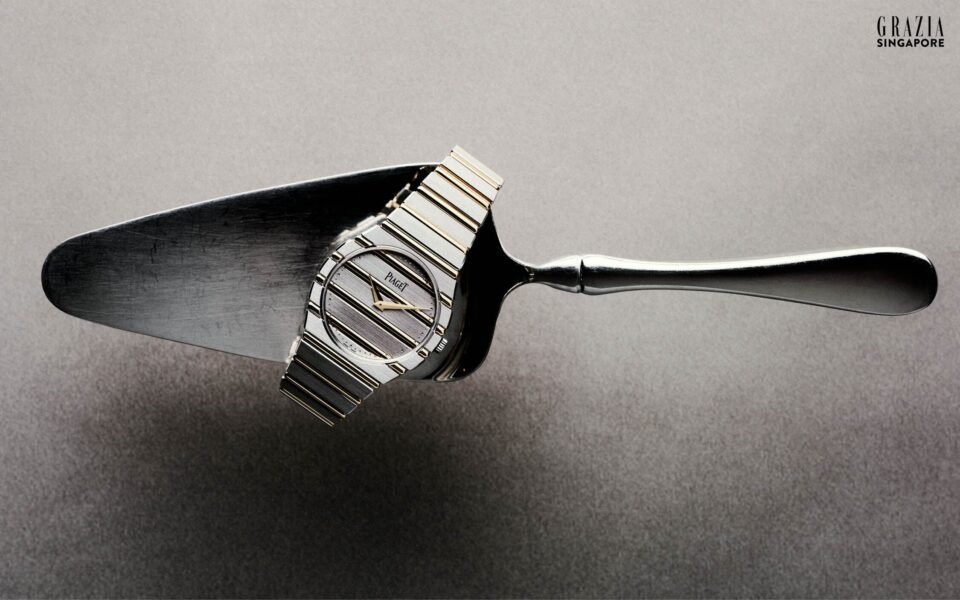

There is a particular kind of confidence that defines the great watch designs of the late 1970s—an assurance that luxury need not be quiet to be refined. The Piaget Polo, introduced in 1979, had it in abundance: all-gold, architecturally bold, its signature horizontal gadroons sweeping across the case, bracelet and dial in one unbroken gesture. It was a watch that understood the assignment, as they say.
Now, in its third reissued iteration, the Polo 79 Two-Tone makes the case that some designs don’t just survive revival—they improve with it. The logic of the two-tone is straightforward, and that is precisely its strength.
Following the yellow gold reissue of 2024—launched for Piaget’s 150th anniversary—and the cooler, more understated white gold version of 2025, the combination of both metals was always the natural next move.
What makes this edition more than a predictable commercial step is Piaget’s refusal to take the easier route. There is no steel here. The case remains entirely in precious metals: a white gold body set against polished yellow gold gadroons, the contrast sharpening the watch’s architectural lines rather than softening them into something merely pretty.
It is worth noting that the two-tone is not new territory for the Polo. The original was produced in both white gold and several two-tone variations during its first run, which means this latest execution reads less as an invention than a homecoming—a return to a design language that was always part of the watch’s DNA. That context matters. It explains why the Polo 79 Two-Tone feels so resolved, so free of the self-consciousness that haunts lesser heritage revivals.

On the wrist, the effect is considered and precise. The case measures 38mm in diameter and just 7.45mm thick—slim enough to disappear beneath a cuff, present enough to hold its own without one. The dial continues the case’s visual logic: brushed white gold surfaces alternating with polished yellow gold lines, a dotted minute track at the edge, dauphine hands in yellow gold completing the display. Legibility has never been the Polo’s primary concern, and the Two-Tone does nothing to change that.
The bracelet—fully integrated, featuring brushed white gold links separated by polished yellow gold interlinks—extends the same rhythm across the wrist, the whole thing functioning not as a watch on a bracelet but as a single, unbroken object.
Inside is Piaget’s in-house calibre 1200P1, an ultra-thin automatic with a micro-rotor measuring just 2.35mm thick. It is what keeps the profile as lean as it is, running at 3Hz with approximately 44 hours of power reserve. The uncoated gold micro-rotor—left warm-toned, as if the movement itself understood the assignment—is visible through the sapphire caseback.
The Polo 79 Two-Tone is not a limited edition, though production will remain constrained by the nature of working in precious metals. The timing of this watch is not accidental. Across fashion, the design codes of the late 1970s and early 1980s are everywhere: warm gold tones, graphic structure, a preference for surfaces that reward close attention. The Polo 79 Two-Tone arrives into a moment that was already halfway towards it. For a watch defined entirely by form, finish and presence—one that has always asked to be noticed first and understood later—the added contrast of two golds is not a cosmetic update. It is the watch, finally, at its most itself.
This story first appeared on GRAZIA Singapore’s April 2026 issue.
Photography Sherman See-Tho
Art Direction Marisa Xin
Photography Assistant Goh Chiang Yang
READ MORE