
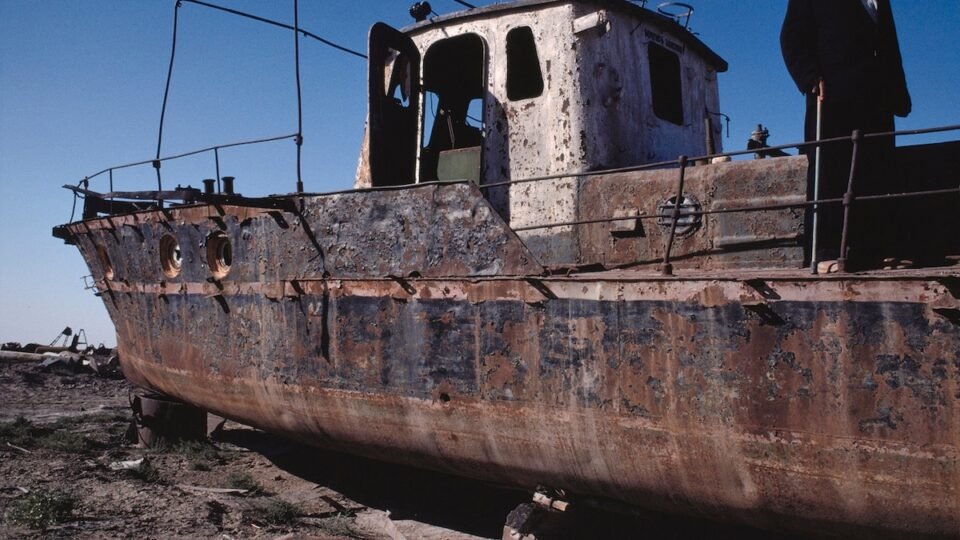
The plight of the Aral is widely mourned in the Soviet Union now, for it has been adopted as a cause célèbre by environmental activists. But it is in Uzbekistan that people care the most. They care enough to erect large signs in the streets, such as the one in the city of Nukus that reads, “The Aral Will Live Again.” And the words chalked on the rusting hull of a large fishing boat sitting now on the dry bed of the sea: “Forgive us Aral. Please come back.”
Such sentiments, however, are not enough for a person with the fires of social protest raging inside. “You cannot fill the Aral with tears,” said Mukhammed Salikh, a young poet who lives in the Uzbek capital of Tashkent. “The measures taken by the government to correct the problem are insufficient. First of all the government should acknowledge that cotton is the reason for what has happened to the Aral Sea. Once they do that, they can start to develop concrete proposals for doing all that can possibly be done.”

Brimming with water and life, the Aral Sea seen in a 1960s photograph no longer laps at the harbor at Muynak. The Aral Sea fishery, which once supported some 60,000 jobs, has been obliterated. David C. Turnley, National Geographic Image Collection
Salikh sits in an office in the Uzbek Writers Union building, under a portrait of an obscure Soviet poet who, he said, “suffered under the oppression of Stalin.” As a member of a committee of scientists and writers organized to work for survival of the Aral, he devotes much of his time to speaking and writing about the tragedy.
“Even to be able to do that is something,” he told me. “Before, it was almost impossible to publicize the problem, but everyone knew about it. Some say nothing was done because of discrimination, because this is happening in Muslim Uzbekistan. I can’t say if that is true, but certainly there is a lack of official interest. For example, I can’t understand why it is so difficult for foreign journalists to get permission to go to the sea.”
Following months of waiting for permission, a National Geographic team was allowed to travel to the Aral. We came upon it from the south, by way of the former fishing center of Muynak, now a landlocked, forlorn town more than 20 miles from the water. Less than 25 years ago Muynak sat at the edge of the sea.