
By Kevin Armstrong
Remember when there was concern that the appeal of a Cybertruck would die down because there would be too many stainless steel beasts on the road? True story. If there was a concern, it appears to have been handled with wraps; not only Tesla’s wraps but more customized wraps are showing up on social media daily.
More Tesla Wraps
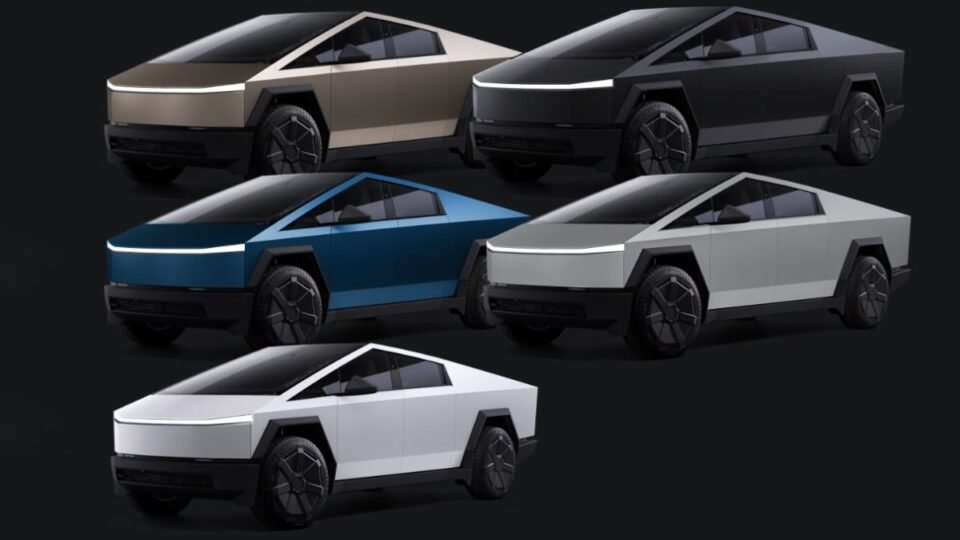
Firstly, Tesla has expanded its palette of Cybertruck wrap options, introducing three vibrant new colors. The chic Satin Rose Gold, the deep Satin Abyss Blue, and the sleek Slip Grey are joined in the lineup alongside the classic Satin Stealth Black and Satin Ceramic White. However, several Cybertruck owners are not waiting for Tesla wraps as more unique Cybertruck wraps are showing up on social media.
Priced at $6,000, while the newly introduced Satin Rose Gold and Satin Abyss Blue wraps are slightly pricier at $6,500. This differentiation in pricing reflects the unique appeal and quality of the new wrap colors.
Tesla outlines several key features and advantages of their Cybertruck color paint film, including:
-
A self-healing, urethane-based film that is significantly more durable and twice as thick as the average vinyl wrap, ensuring superior protection against scratches.
-
An environmentally friendly alternative to traditional vinyl wraps, covering all exterior stainless-steel surfaces of the Cybertruck, enhancing its aesthetic appeal and resilience.
Customized Wraps are Taking Off
Since Tesla wraps were introduced, the company has been criticized for the price point being far too high, while consumers can go to other wrap companies and get their own customized look. Even the unique wraps spotted on the Cybertruck before the delivery event are unavailable. But that is not stopping consumers.
Tiffany Blue Cybertruck? 💍 pic.twitter.com/4PhPHmZUG0
— Nic Cruz Patane (@niccruzpatane) February 22, 2024
It was after Investor Day in 2023 that Morgan Stanley’s managing director, Adam Jonas, a well-known figure within the investment community and someone who has been dubbed a Tesla Bull. Jonas outlined several reasons why he believed the Cybertruck might not fulfill the grand visions held by Elon Musk and the Tesla team, describing it as potentially becoming a “financial side-show,” a marker of cultural zeitgeist, and a niche product for enthusiasts.
Jonas argued that the Cybertruck, with its avant-garde design, might not align with this broader affordability mission. He believed that the unique aspects of Cybertruck would be lost and that “indescribable something,” when several were on the street,
📐 Cybertruck Air Suspension 🎥
EXTRACT mode to LOW pic.twitter.com/RopmpybpZj— DennisCW | wen cybertruck (@DennisCW_) February 20, 2024
Yet, the landscape around the Cybertruck and Tesla’s position within it has continued to evolve. Contrary to concerns, the burgeoning market for custom and aftermarket wraps for the Cybertruck tells a different story. This vibrant ecosystem of personalization options highlights the vehicle’s position as a mode of transportation and a canvas for individual expression.
Blue Tesla Cybertruck looks stunning 🤩 pic.twitter.com/Z20DhrwYgj
— Dima Zeniuk (@DimaZeniuk) February 18, 2024
The concern that the uniqueness of the Cybertruck could diminish with its popularity overlooks the creative solutions that owners and enthusiasts have embraced. From bespoke wraps that offer myriad designs outside of Tesla’s offerings to the DIY spirit that has taken hold among the Cybertruck community, it’s clear that individuality remains a cornerstone of the Cybertruck experience.
Ordering a New Tesla?
Use our referral code and get 3 months free of FSD or $1,000 off your new Tesla.
By Karan Singh
Tesla’s official Europe and Middle East account on X has just announced that FSD (Supervised) has officially been approved in the Netherlands and will begin rolling out to customers in the country shortly.
De toekomst van mobiliteit is aangebroken
FSD Supervised has been approved in the Netherlands 🇳🇱 & will begin rolling out in the country shortly!
Trained on billions of kilometers of real-world driving data, it can drive you almost anywhere under your supervision – from… pic.twitter.com/M5Vv02YHUE
— Tesla Europe, Middle East & Africa (@teslaeurope) April 10, 2026
This marks a monumental regulatory victory for the automaker and potentially is the beginning of a much wider rollout across the continent.
The Future of Mobility Arrives in Europe
The announcement began with the Dutch phrase “De toekomst van mobiliteit is aangebroken,” which translates to “The future of mobility has arrived.”
For years, Tesla owners across Europe have been restricted to vastly scaled-back Autopilot features due to strict United Nations Economic Commission for Europe (UNECE) regulations governing advanced driver assistance systems. Breaking through that regulatory red tape is a massive milestone.
Bringing True Autonomy to Europe
As noted in the announcement, the Dutch rollout will bring the true FSD Supervised experience to the country. Powered by end-to-end neural networks trained on billions of kilometers of real-world driving data, FSD is capable of navigating complex city streets, residential areas, roundabouts, and highways.
While the driver must remain fully attentive and ready to take over at any moment, the localized FSD build will allow Dutch drivers to experience the same advanced routing and decision-making capabilities that North American owners have been testing for years. Highlighting the competitive advantage of this rollout, Tesla confidently stated in the post that “no other vehicle can do this.”
The First Domino to Fall
The approval in the Netherlands could serve as the crucial first domino for a broader European expansion. The European Union has notoriously been one of the toughest regulatory environments for Tesla’s autonomy team to crack, requiring extensive localization and validation testing.
Achieving full approval in the Netherlands proves that Tesla’s vision-based approach can satisfy strict European safety regulators. The official X account ended the announcement on an incredibly optimistic note, stating that Tesla is excited to bring FSD Supervised to more European countries soon.
Rollout Details
While an exact launch date was not provided, the initial wave of the rollout will likely target vehicles equipped with Tesla’s latest AI4 hardware. These early adopters are expected to receive a localized version of FSD v14.2, as this was the specific build utilized during the regulatory testing phase, rather than the newly released to early access v14.3.
Owners with older HW3 vehicles are expected to not be included in the initial release, but could eventually receive the software via Tesla’s specialized v14-Lite architecture.
European drivers can expect several unique Europe-specific UI features, including tailored on-screen visualizations designed to comply with strict local display and safety regulations.
By Nehal Malik
Tesla is teaching its vehicles to better understand who exactly is sitting behind the wheel. In a fascinating discovery hidden within the latest software code, it appears that Tesla’s cabin cameras are now being trained to estimate a driver’s age.
The find was shared by well-known Tesla hacker @greentheonly, who frequently digs into the car’s backend to see what features are being developed behind the scenes. According to Green, software update 2026.8.6 introduced this new capability.
More Than Just a Selfie Camera
While the 2026.8.6 release notes focus on public-facing additions like anti-dooring warnings for the Cybertruck and Comfort Braking for the refreshed Model Y, the age-checking code hints at a much smarter driver monitoring system. Tesla hasn’t activated any specific user features based on this data yet, but the potential applications for safety and security are massive.
For instance, Tesla could use age recognition as a secondary lock to prevent underage drivers from shifting the car into drive or activating Full Self-Driving (Supervised). It could also allow the car to tailor its driving style; FSD could theoretically choose to drive more conservatively if it detects an elderly driver who may prefer smoother transitions and more cautious lane changes.
Enforcing the Robotaxi Rules
This technology could be particularly vital for the upcoming Cybercab. Tesla’s specialized robotaxi features an even larger cabin camera than the current consumer lineup, and the company has already established minimum age requirements for riders using the Robotaxi network. Without a human driver to check IDs, an automated age-verification system would be the only way to ensure that young children aren’t hailing autonomous rides without adult supervision.
Beyond age, this type of biometric monitoring could eventually evolve into a “health check.” Future iterations of the cabin camera might detect if a driver is having a medical emergency based on facial cues or posture, allowing the car to autonomously pull over and call for help. It could also be used to automatically apply parental controls, such as limiting top speed or acceleration when a teenager is detected in the driver’s seat.
A New Era of Biometric Safety
As Tesla moves toward a future where the car is more of a living space than a machine, understanding the occupant’s profile becomes essential. Whether it’s adjusting the driver monitoring sensitivity based on risk factors associated with different age groups or simply ensuring the right person is in the right seat, biometric data is the next frontier.
While some might find the idea of their car “guessing” their age a bit intrusive, the safety benefits of preventing unauthorized use or optimizing FSD for different demographics are hard to ignore. As Tesla continues to iterate on FSD with v14 and v15, we expect this “driver age” checking to move out of the code and into the official release notes.