
A new study reports a breakthrough in sustainable energy materials by transforming biomass into a high-performance catalyst that could replace expensive platinum in fuel cells and metal-air batteries.
Researchers have developed a cobalt-based multicomponent catalyst embedded in nitrogen-doped biochar that delivers strong performance in the oxygen reduction reaction, a key process that limits the efficiency of many clean energy systems. The work demonstrates how renewable materials can be engineered into advanced electrocatalysts with both high activity and long-term stability.
“The oxygen reduction reaction is one of the biggest bottlenecks in energy conversion technologies,” said one of the study’s authors. “Our goal was to design a catalyst that is not only efficient, but also affordable and sustainable.”
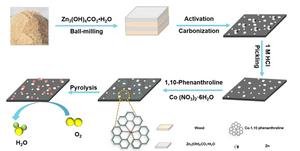
The study, published in Biochar, describes a scalable method to produce the catalyst using wood-derived biomass, cobalt salts, and a nitrogen-rich compound known as 1,10-phenanthroline. During high-temperature processing, these components form a porous carbon structure embedded with cobalt species and nitrogen functional groups, which together create highly active catalytic sites.
Unlike traditional platinum-based catalysts, which are costly and limited in supply, the new material relies on abundant and renewable resources. At the same time, it overcomes common limitations of biochar-based catalysts, such as low conductivity and insufficient active sites.
The optimized catalyst demonstrated a half-wave potential of 0.81 volts and a limiting current density of 4.95 milliamps per square centimeter in alkaline conditions, performance metrics comparable to many state-of-the-art materials. These results indicate efficient electron transfer and strong catalytic activity during oxygen reduction.
The material also showed excellent durability, retaining more than 92 percent of its activity after prolonged operation, as well as strong resistance to methanol interference. This is particularly important for real-world applications, where catalysts must maintain performance over time and under complex chemical environments.
According to the researchers, the catalyst’s performance stems from its unique structure. The biochar framework provides a hierarchical pore network that improves mass transport and prevents metal particle aggregation. Meanwhile, nitrogen doping introduces active sites that enhance oxygen adsorption and electron transfer. The embedded cobalt species, including Co-Nx and cobalt oxides, further boost catalytic efficiency through synergistic interactions.
Electrochemical analysis revealed that the catalyst primarily follows a four-electron reaction pathway, which is the most desirable mechanism for energy applications because it directly converts oxygen into water without producing harmful peroxide intermediates.
“This combination of structure and chemistry allows us to achieve both high activity and stability,” the authors noted. “It provides a clear pathway for designing next-generation catalysts from renewable resources.”
Beyond fuel cells and metal-air batteries, the approach could be extended to other energy and environmental applications, including hydrogen production and carbon dioxide reduction. The use of biomass as a starting material also aligns with broader efforts to develop carbon-neutral technologies and circular resource systems.
The researchers suggest that future work will focus on improving performance in acidic environments and exploring other biomass sources to further enhance scalability and versatility.
By demonstrating that low-cost, biomass-derived materials can rival traditional catalysts, the study highlights a promising direction for sustainable energy innovation.
===
Journal Reference: Cheng, Y., Ding, J., Pan, H. et al. Cobalt-based multicomponent embedded in biomass-derived porous biochar as a highly efficient oxygen reduction reaction electrocatalyst. Biochar 7, 40 (2025).
https://doi.org/10.1007/s42773-025-00427-5
===
About Biochar
Biochar (e-ISSN: 2524-7867) is the first journal dedicated exclusively to biochar research, spanning agronomy, environmental science, and materials science. It publishes original studies on biochar production, processing, and applications—such as bioenergy, environmental remediation, soil enhancement, climate mitigation, water treatment, and sustainability analysis. The journal serves as an innovative and professional platform for global researchers to share advances in this rapidly expanding field.
Disclaimer: AAAS and EurekAlert! are not responsible for the accuracy of news releases posted to EurekAlert! by contributing institutions or for the use of any information through the EurekAlert system.