
Inspired by the molecular machinery of biological systems, chemists have developed a number of synthetic molecules that can perform tasks from translational or rotational motion when triggered by various external chemical or physical stimuli.1,2,3,4,5,6,7 Based on diverse mechanically active synthetic units, artificial molecular machines exhibit a wide variety of functions such as muscles,8,9 pumps,10,11,12,13,14 transporters,15 synthesizers,16,17,18,19,20,21 molecular scissors,22 elevators,23 walkers,24,25 nanovehicles,26,27,28 and gears,29,30,31,32,33,34 to name a few. In particular, rotary molecular motors have attracted much attention for their capacity to convert chemical, light, or electric energy into a unidirectional rotation movement, leading to the production of work1,2,3,4,5,6,7,35,36 recoverable up to the macroscopic scale.37,38,39,40,41 Controlled directional and repetitive rotation has been triggered on entire single molecules located in an anisotropic environment42,43,44,45 or on submolecular fragments incorporated in diverse chemical architectures.46,47,48,49,50,51,52,53,54
In this context, an azimuthal molecular motor based on a ruthenium(II) piano-stool complex was proposed in 2013 and investigated on a Au(111) surface in ultra-high vacuum at the single-molecule scale.42 The upper pentaarylcyclopentadienyl ligand acts as a five-arm rotor undergoing favored rotation over the ruthenium ion, which behaves as a single-atom pivot. The second ligand, a hydrotris(indazolyl)borate scorpionate, acts as a stator with a dual role: it lifts up the ruthenium ball-bearing from the surface thanks to its tripodal shape and, most importantly, it precludes molecular diffusion thanks to specific functionalization with three thioether groups allowing a tight anchoring on gold.55 At low temperature (down to 5 K), when random thermal motion is suppressed, controlled rotation of the pentaarylcyclopentadienyl subunit is triggered by supplying electrical energy with a submolecular resolution using the tip of a scanning tunneling microscope (STM). The resulting motion is unidirectional and reversibility has been evidenced, with a direction of rotation depending on the nature of the rotor fragment located under the STM tip during the inelastic electron tunneling process.42
However, the drastic conditions of STM, namely ultra-high vacuum and low temperature conditions, limit potential applications. To accelerate the development of complex and automated machineries that can be operated on surfaces or in macroscopic materials,6,38,40 it is desirable to investigate the behavior of such machines in solution and ambient conditions. Furthermore, an important question like can the motor still rotate when loaded? remains unanswered.
Here, we used atomic force microscopy (AFM)-based single-molecule force spectroscopy (SMFS) to detect the free rotary oscillations of the rotor subunit around the single ruthenium atom under mechanical load in molecular motor prototypes and directly probe at the single-molecule scale the work required to block the oscillations and work performed by the molecules against the mechanical load. SMFS is now widely used to probe processes at the scale of a few tens of nanometers in biomacromolecules and has proved efficacious in deciphering mechanistic information of individual biomolecular machines and in quantifying their force response to external stress.56,57 However, only a few investigations on intramolecular processes and single-molecule mechanics have been realized on small synthetic molecules, successful examples including molecular recognition pairing,58 helical structures,59 knots,60 and artificial molecular machine prototypes.61,62,63,64,65,66 The rarity of such studies stems from the difficulty in developing the proper tools and preparing appropriate molecules that can be interfaced with SMFS techniques due to the very small amplitude of the involved motions compared with the ones observed in previously studied larger biological systems or polymers, especially when probing conformational changes of synthetic small molecules interconverting between rotamers under Brownian fluctuations.
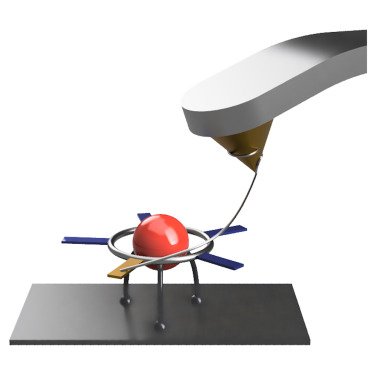
To this aim, molecular motor prototypes based on ruthenium heteroleptic complexes were designed, so as to incorporate in the rotor subunit a long poly(ethylene oxide) (PEO) chain able to physisorb onto the AFM tip for pulling and monitoring the rotor’s movements. A series of molecules displaying structurally different arms were synthesized and bridged between a gold substrate and a gold-coated AFM tip (Figure 1). The mechanical response of this series of molecules bearing various rotor subunits was investigated in solution (N,N-dimethylformamide) and at room temperature.