
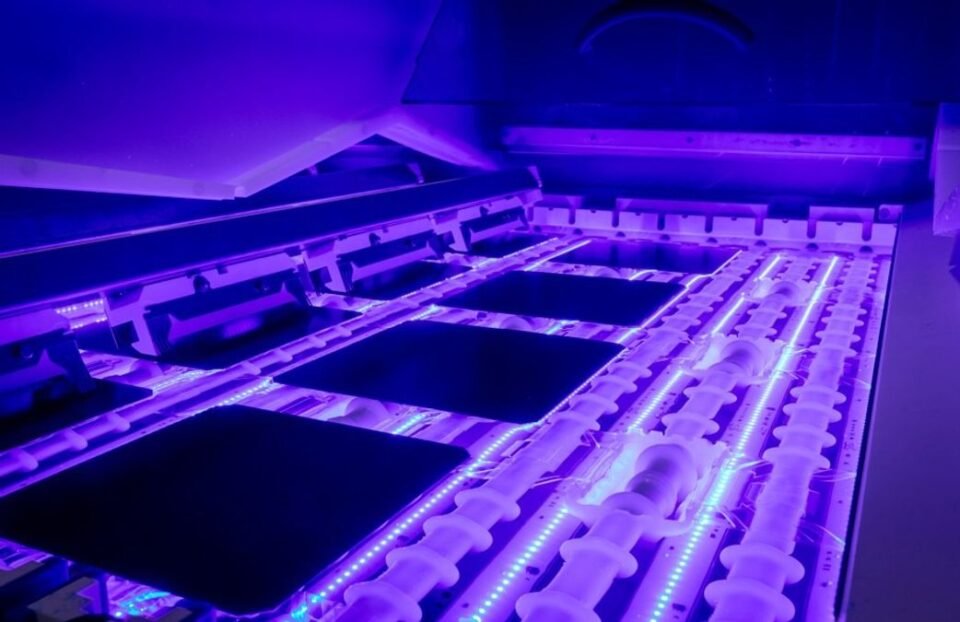
Scientists at the Fraunhofer Institute for Solar Energy Systems ISE have succeeded in reducing the silver consumption of TOPCon solar cells to 1.1 milligrams per watt peak. Currently, TOPCon solar cells require an average of 10 to 12 milligrams of silver per watt peak. To the reduction, they tested an electroplating-based inline metallization process on pilot systems developed by RENA Technologies GmbH. By combining ultrashort UV laser structuring with the electrochemical deposition of nickel, copper, and silver, the research team produced M10-sized TOPCon solar cells with an efficiency of 24 percent. Compared to PERC solar cells, TOPCon solar cells have higher silver consumption, hence solar cell manufacturers are under particular cost pressure to reduce it.
Why TOPCon Cells Matter
While silicon heterojunction and IBC solar cells are already successfully metallized with printed silver-copper or pure copper contacts, printed copper metallization for TOPCon solar cells is still in the testing phase. At the same time, this is currently the most widely produced cell type and the one with particularly high silver consumption. Electroplated copper contacts have the potential to almost completely replace the silver requirements of TOPCon solar cells. Nickel serves as a diffusion barrier against copper migration into the cell, copper handles the electrical conduction, and a minimal amount of silver remains as oxidation protection.
“So-called nickel/copper electroplating could be firmly established in the photovoltaic market within two to three years,” says Dr. Sven Kluska, group leader for electrochemical processes at Fraunhofer ISE. “It would offer many advantages for solar cell manufacturers, even if they have to integrate electroplating equipment into their production process as an initial investment.”
Working in a consortium with the equipment manufacturer RENA Technologies GmbH, the scientists demonstrated in the research projects “EURO” and “SHINE PV” that electroplating metallization is technically feasible and can be implemented on an industrial scale. They metallized several batches of M10 TOPCon solar cells on an inline electroplating system, achieving efficiencies of 24 percent. This corresponds to the efficiency of the reference solar cells, whose silver contacts were applied using the conventional screen-printing process. To verify compliance with low contact resistance and high fill factors, they demonstrated a fill factor of 82.1 ± 0.3 percent for a batch of 186 TOPCon solar cells. The solar modules manufactured with the solar cells demonstrated very good stability in degradation tests according to IEC61215.
“Metallization via electroplating could also lead to significantly less dependence on China than is currently the case with silver pastes for the screen-printing metallization commonly used today,” said Dr. Florian Clement, Head of the Metallization and Structuring Technologies Department at Fraunhofer ISE. “Equipment and chemicals for copper electroplating come from European and American manufacturers; there is a global market for raw copper, without a concentration on Chinese suppliers. At the same time, we at Fraunhofer ISE are working intensively to establish European, resilient supply chains for copper-based screen-printing metallization.”
In the screen-printing process as well, there is the option of replacing silver pastes with hybrid silver-copper or pure copper pastes. However, implementation on TOPCon solar cells is considerably more difficult compared to silicon heterojunction solar cells with a TCO layer (transparent conductive oxide layer), which acts as a copper diffusion barrier; this is why researchers worldwide are also further developing electroplating metallization for TOPCon solar cells.