
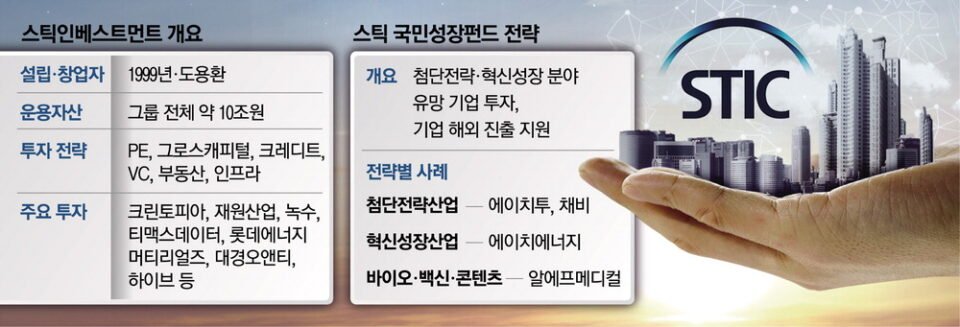

Stick Investment, which has represented the domestic alternative investment industry for 27 years since its establishment in 1999, is establishing itself as a “high-tech strategic industry ecosystem management company” in the era of the 150 trillion won National Growth Fund. △ Advanced strategic industry △ Innovative growth industry △ Differentiated investment strategies based on triangular axes such as bio, vaccine, and content, and long-term partnerships with the Korea Development Bank, are combined to widen the gap with competitors.
According to the investment bank (IB) industry on the 5th, Stick was selected as one of the four consignment managers (GP) in the mid-sized field of the “Small and Medium-sized Export Regional-led Growth Fund in the First Half of 2026” that the Export-Import Bank of Korea colluded with.
If Mercury invests 50 billion won in four locations, Stick will form a blind fund of at least 250 billion won. IBK Industrial Bank also received an investment pledge (LOC) worth 80 billion won on the premise of forming a national growth fund.
The reason why this selection is drawing attention is that the National Growth Fund is not just a policy fund. The National Growth Fund will be created jointly by the public and private sectors to cope with competition for hegemony between the U.S. and China and the decline in competitiveness of Korea’s major industries. The scale alone amounts to 150 trillion won, including 75 trillion won in high-tech funds and 75 trillion won in the private sector. Over the next five years, it will be implemented in four ways: direct investment, indirect investment, infrastructure investment financing, and low-interest loans. More than 40% of the total is distributed to the non-metropolitan area.
Stick’s strength lies in its 27-year accumulation of full-line investment platforms. Currently, the management assets (AUM) are worth 7.6 trillion won and the group as a whole is worth 10 trillion won, with 15 blind funds and 9 project funds being managed simultaneously.

It encompasses all six asset groups, including private equity investment (PE), growth capital, credit, venture capital (VC), real estate, and infrastructure.
The core competitiveness is OPG (Management Committee), an organization dedicated to enhancing value established in 2008, and solid professional management personnel, including partners with more than 20 years of average investment experience.
The key to differentiating it from other management companies is the three-dimensionality of investment strategies. It has decided to invest in growth capital (gross capital) in promising companies in high-tech strategic and innovative growth industries that are expected to grow high amid competition for technological hegemony.
On top of that, it is seeking a “Value-Add” strategy that practically supports companies’ localization in North America and Europe and the establishment of overseas bases to preempt global supply chain reorganization opportunities.
In the field of high-tech strategic industries, H2 and Chaebi investments are representative. With an investment of 12 billion won, H2 is the only company in Korea to commercialize vanadium flow battery (VFB). When listed in 2028, the expected MOIC (recover of principal) is 2.9 times.
Daegu-based electric vehicle fast charging company Chaebi recorded an 83% increase compared to its initial public offering price on the first day of listing on KOSDAQ in April this year, proving Stick’s investment capability.
At the level of innovative growth industries, renewable energy and circular economy form a portfolio axis. H Energy (investment of 25.1 billion won, MOIC 2.31 times), located in Pohang, Gyeongsangbuk-do, operates the largest roof solar power plant in Korea.
On the bio, vaccine, and content axis, RF Medical (investment of 26.8 billion won, MOIC 2.1 times), a small and medium-sized medical device company, is increasing its competitiveness in the high-frequency surgical device market. The recovery target is four times the unit price of investment. An industry official said, “Stick’s track record of OPG and professional management personnel is supporting the trust of policy fund investors (LPs).” He added, “The difference that Stick puts forward in the era of the National Growth Fund is that it aims to invest in companies, regions, and countries that grow together beyond simple capital supply.”
[Reporter Woo Soo Min]