
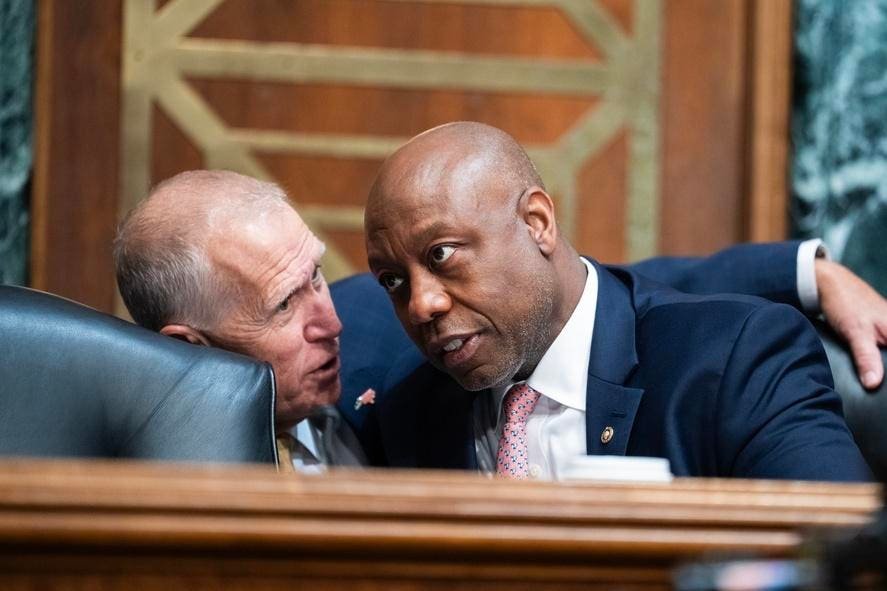

Senate Banking Chairman Tim Scott, R-S.C., right, talks with Sen. Thom Tillis, R-N.C., in Dirksen building on Tuesday, April 21, 2026. (Tom Williams/CQ-Roll Call, Inc via Getty Images)
CQ-Roll Call, Inc via Getty Images
The Senate’s long‑stalled digital‑asset overhaul is finally moving — and the stablecoin deal that once looked impossible is now locked. What’s not locked is the ethics fight that could still derail the CLARITY Act in the next 30 days, a clash that now matters as much to markets as the substance of the bill itself.
A first-term Democratic senator from Maryland and a seasoned North Carolina Republican without a reelection to manage just told the banking lobby enough is enough. The CLARITY Act (the short title of which is now the “Digital Asset Market Clarity Act,” with Title I separately titled the “Lummis-Gillibrand Responsible Financial Innovation Act of 2026”) has climbed up the rough side of the mountain for years to get to this markup moment, and whether it peaks with its public-interest mission intact — or whether the industry’s hard-fought progress gets sacrificed for an ethics impasse — will be decided in the next 30 days.
The CLARITY Act stablecoin compromise locked in this week in three stages. On May 1, the Section 404 compromise text became public. On May 4, in response to continued pushback from banking trade groups, Sen. Thom Tillis, R-N.C., posted on X a joint statement on behalf of himself and Sen. Angela Alsobrooks, D-Md., to make clear that the “Section 404 deal” is final and that they “respectfully agree to disagree” with continued banking industry lobbying. By May 7, journalist Eleanor Terrett reported the Senate Banking Committee was preparing to formally notice the markup for May 14. On May 12, the committee released the full bill text two days before that vote.
What The Deal Actually Does
Section 404 prohibits stablecoin issuers and the digital asset service providers who work with them (namely, exchanges, brokers and affiliated entities) from offering yield directly or indirectly on stablecoin balances if that yield is the functional or economic equivalent of bank interest.
Yield is the broader umbrella term — any return generated on a stablecoin balance simply by holding it, whether that return comes from interest payments, lending fees, staking rewards or a share of the income the issuer earns on the U.S. Treasurys and other reserves backing the token.
Bank interest is one narrow form of yield: a predictable rate paid by a federally regulated depository institution to its account holders. Anti-evasion language is built in, but activity-based rewards remain permitted. Examples include cash back on payments, transaction-based incentives and rewards tied to actually using stablecoins in commerce.
The Securities and Exchange Commission, the Commodity Futures Trading Commission and the Treasury Department will have 12 months after enactment to write the joint rules. In simple terms: “parking” stablecoins earns nothing; spending them earns rewards.
How The Alsobrooks–Tillis Deal Came Together
The substance of the deal will get most of the coverage, but the bipartisan craft that produced it deserves more attention than it is getting. First-term Sen. Alsobrooks is only the third Black woman ever elected to the U.S. Senate, and her brokering this compromise with a North Carolina Republican is precisely the template the rest of the CLARITY Act needs to clear 60 votes on the Senate floor.
Tillis brings his own asymmetry: after announcing in June 2025 that he would not seek reelection following his break with President Trump on the One Big Beautiful Bill Act, he has openly pushed ethics provisions to prevent senior officials from profiting from the digital asset sector.
Why The Banking Lobby Is Splintering
The united banking front, meanwhile, appears to be fracturing. Terrett reported that big banks with consumer-facing arms have taken issue with the language, banks without them are more amenable and some community banks are quietly signaling support — even as the Independent Community Bankers of America continues its opposition.
The American Bankers Association escalated over the weekend with an emergency letter to bank CEOs demanding congressional engagement to block stablecoin provisions ahead of Thursday’s markup.
Coinbase Chief Policy Officer Faryar Shirzad called the deposit-flight argument “a fabrication and wildly overstated,” noted that fully reserved stablecoins are “plainly not the same as fractionally-reserved bank deposits,” and pointed out that parties now complaining about loopholes directly participated in negotiating the final language and then boycotted the stablecoin rewards discussions.
Sen. Bernie Moreno, R-Ohio, characterized the ABA mobilization as the “banking cartel … in full panic mode” and confirmed his markup vote in favor. Section 404 protects the deposit base of large consumer-facing banks. Whether it also protects community banks is a separate question the compromise does not resolve.
The Ethics Fight That Could Blow Up The Bill
The yield fight is functionally over. The ethics fight is the part of the climb still ahead.
President Trump’s $TRUMP and $MELANIA meme coins, launched days before his 2025 inauguration through CIC Digital LLC — a Trump Organization affiliate that, together with Fight Fight Fight LLC, retained roughly 80% of the token supply— stood to generate roughly $8 billion in token value for Trump-linked businesses.
Forbes estimates that the Trump family’s broader crypto ventures, including World Liberty Financial, have added roughly $1.4 billion to the family’s net worth over the past year.
That is the backdrop against which Sen. Kirsten Gillibrand, D-N.Y., drew her line at Consensus Miami, according to CoinDesk: “There will be no one voting for this bill if we don’t have an ethics provision. We cannot allow members of Congress, senior administration officials, presidents, or vice presidents to get rich off of these industries because of their insider status.”
The White House counter-position, articulated by Patrick Witt of the President’s Council of Advisors for Digital Assets, is that the administration will accept ethics rules applying “across the board, from the president all the way down to the brand new intern,” but will reject anything that singles out “anyone’s family, any one particular politician.”
The structural implication: the 18 U.S.C. 208 conflict-of-interest statute and the Office of Government Ethics rules the CLARITY Act bill text already preserves apply to executive branch employees and officials, not to a sitting president’s adult family members operating private crypto ventures.
A uniform federal-employee rule covers what is already covered. The agencies that would implement that framework — the SEC under Chair Paul Atkins, the Office of the Comptroller of the Currency under Comptroller Jonathan Gould and the Treasury under Secretary Scott Bessent, the regulatory team installed in early 2025 — would do so under the same administration whose family-affiliated entities the ethics negotiations have made central.
That structural alignment is what has shifted the ethics fight onto what the statute itself names rather than what it leaves to administrative interpretation.
The Calendar That Determines Everything
The next 10 weeks have hard deadlines stacked on top of each other. May 14 brings the Senate Banking Committee markup, with Chair Tim Scott telling Fox Business he is “in the red zone” and wants 13 of 13 Republicans on board.
June, per the White House, brings a Senate floor vote, with Witt targeting July 4 for full congressional passage as a 250th-anniversary symbol. August 10 is the Senate recess deadline, and Gillibrand predicts a final vote “the first week of August, if we’re lucky.”
Polymarket sits at roughly 65% for 2026 enactment, up from the mid-40s in April but well below February’s 82% peak. Even after committee clearance, three procedural milestones still remain: clearing the Senate Agriculture Committee’s jurisdiction over digital commodities, 60 votes on the Senate floor and reconciliation with the House version that passed 294-134 in July.
The Choice Congress Now Faces
This bill has come a long way to get to this markup; through years of regulation-by-enforcement, a January 2026 markup that collapsed when Coinbase pulled its support and months of bipartisan brokering under sustained pressure from every side.
The road has been long because the United States has been woefully behind. The European Union has fully implemented the Markets in Crypto-Assets regulation. Bermuda has operated an integrated digital asset framework for eight years. Singapore, Hong Kong, the UAE and South Africa have built licensing regimes that have attracted billions in capital. Ghana and Nigeria enacted comprehensive virtual asset legislation in late 2025. And Brazil codified its virtual assets law. Section 404 is the U.S. catch-up, not leadership.
That makes the ethics fight all the more consequential, not less. The industry’s best interest is durable rules that survive across administrations and political cycles — rules that other jurisdictions can recognize as legitimate.
The executive’s self-interest, as the structure of the proposed ethics frame makes plain, is a bill that ships without reaching the family’s $1.4 billion crypto fortune. Those are not the same interests.
The next 30 days will determine whether the United States produces a statute that can stand the test of time at home and abroad, or one shadowed by ethical controversies before it is signed.