
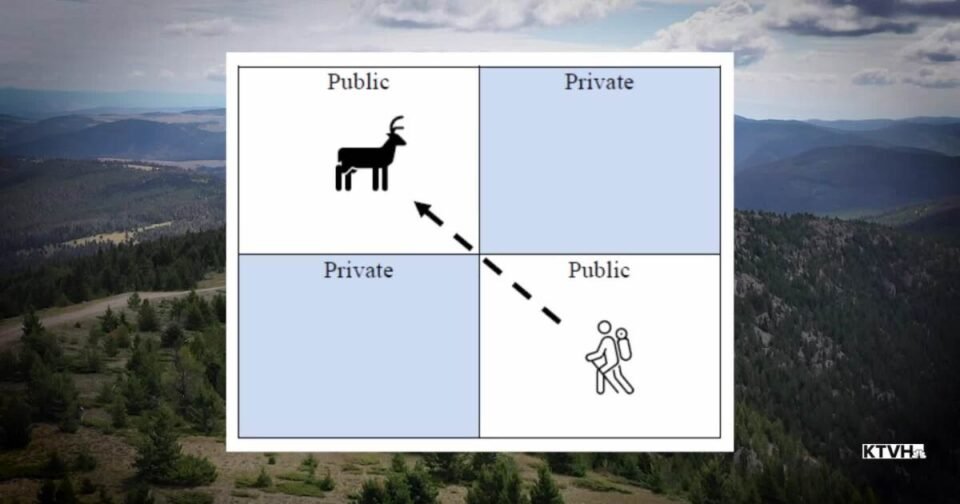
HELENA — The debate over “corner crossing” in Montana has drawn increased attention in recent months following federal court rulings in a Wyoming case. On Wednesday, Lt. Govern Kristen Juras, R-Mont., addressed state lawmakers on the issue in Big Sky Country.
“The question I want to discuss with you today, ‘Is that a trespass, or is a lawful way to access public land?’” Juras told the Environmental Quality Council, which is comprised of state legislators and members of the public.
(WATCH: Montana elected leaders discuss “corner crossing”)
Montana elected leaders discuss “corner crossing”
According to data from onX, there are around 1.5 million acres of public lands locked behind private property in the Treasure State. About 871,000 acres of public land in Montana is “corner locked.”
Corner crossing is the act of stepping from adjoining corners of public land without stepping on the adjacent private land.
Montana Fish, Wildlife and Parks, under the Gianforte administration, has stated that corner crossing remains unlawful in Montana, and people should obtain permission from the adjoining landowners before crossing corners. Wardens have been instructed to use their discretion to cite individuals for trespassing if caught corner crossing.
“Property law is vested in large part in the states,” Juras explained. “By and large, it is the states that determine what is a trespass and what are property rights.'”

MTN News
Juras previously taught property law at the University of Montana and cited statutes and legal principles to defend the state’s position at the meeting. One of the principles she discussed was the ad coelum doctrine (“whoever’s is the soil, it is theirs up to the sky and down to the depths”), which is a widely accepted U.S. property law principle.
“It is important to note this, even though the trespasser causes no damage whatsoever to the property, a trespass still occurs because what you’re protecting is the damage to that right to exclude,” she testified.
Modern laws on the state and federal levels have placed significant limitations on the ad coelum doctrine, such as mineral rights and FAA airspace. However, the U.S. Supreme Court ruled in United States v. Causby (1946) that effectively landowners own as much airspace above the ground as they can reasonably occupy, while not blocking public air travel.
Mike Volesky, a former FWP chief of operations who has alleged his removal from the department was politically motivated, disagreed with Juras’ assessment of the matter at the hearing.
“The administration here is attempting to make up new law full cloth, backed by no legislative authority. By executive fiat, they would make corner crossing illegal,” he testified.
Much of the recent debate on corner crossing has followed developments last year in a Wyoming corner crossing case.
In October, the U.S. Supreme Court declined to hear an appeal from the 10th District Court of Appeals on Iron Bar Holdings v. Cape. The case stems from a land access dispute in Wyoming. In 2022, the ranch, owned by pharmaceutical executive Fred Eshelman, sued a group of hunters who used a ladder to corner cross onto public land that was locked in by Eshelman’s property. The suit alleged that the hunters trespassed when they passed through the airspace over the private property.
(WATCH: Corner Crossing explained in Montana)
Corner crossing in Montana explained
A federal district judge agreed with the hunters, stating that nothing they did violated federal law. When the 10th District Court of Appeals took up the case, it ruled a property owner could not create an obstacle that would limit free passage over public lands.
Since the Supreme Court did not take the case up, the ruling effectively became case law. However, that ruling only impacts states in the 10th Circuit; Montana is in the 9th Circuit.
There is no state law or case law directly addressing corner crossing in Montana.
MTN has spoken with several lawyers, including a prosecutor, about the issue of corner crossing. They agreed to provide background as long as it was off-camera due to the clients they represent. The consensus from the lawyers was that most county attorneys don’t pursue corner crossing trespassing cases. Juras also testified she was not aware of a true corner crossing trespass case that had gone to trial.
MTN
Public comments on Wednesday were divided on the issue of legality, but many agreed that there needs to be a clearer legal definition on corner crossing in Montana.
“It isn’t necessarily clear. And as private landowners like my membership, we want to know what the law is, too. And we do want clarity,” testified Karli Johnson with the Montana Farm Bureau Federation.
Johnson noted the Montana Farm Bureau Federation’s position is that corner crossing is unlawful, and encourages people to work with property owners for access.
There is proposed legislation from a pair of Democratic legislators – State Sen. Ellie Boldman, D-Missoula and State Rep. Joshua Seckinger, D-Bozeman – that would firmly legalize the act of corner crossing.
But a lot can happen between now and the next legislative session in January.