
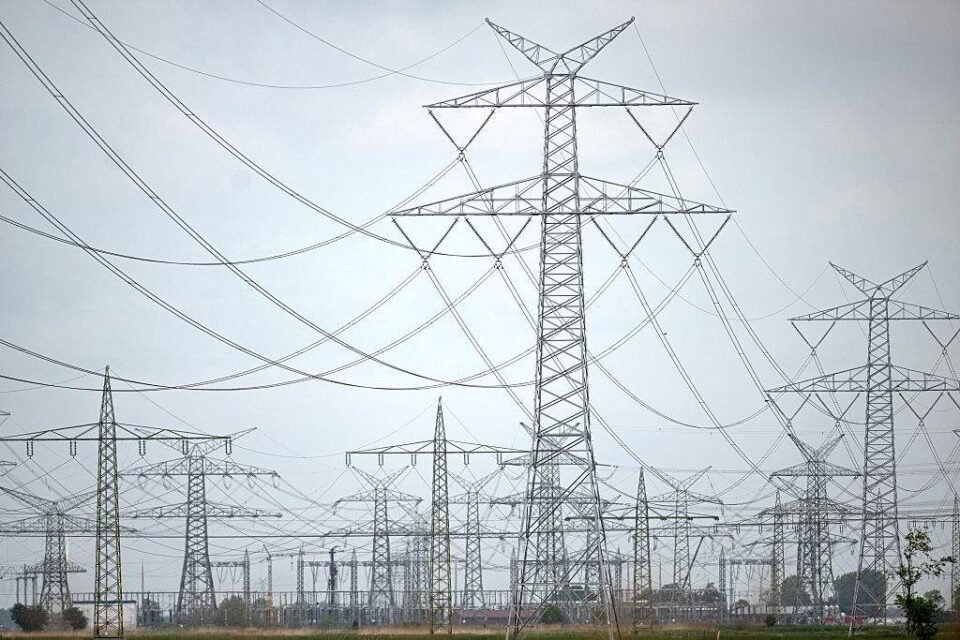

High-voltage pylons and power lines. As electricity generation has normalised, the next challenge is stable electricity trading platforms.
Sina Schuldt/picture alliance via Getty Images
There is growing confidence among mainstream institutional investors that renewable energy trading and market infrastructure are becoming investable asset classes in their own right, writes Chris Yelland.
For more financial news, visit News24 Business.
Africa’s energy transition is increasingly evolving beyond simply building renewable energy projects.
The next phase is about creating the financial, trading and market infrastructure needed to move electricity efficiently across borders, attract private capital at scale, and support economic growth in regions long constrained by inadequate power systems.
Against this backdrop, the announcement on 22 May that Sanlam Alternative Investments has taken a 10% equity stake in Africa GreenCo Group is significant well beyond the immediate transaction itself.
According to the companies, Sanlam Alternative Investments has invested $10 million into GreenCo, becoming its first private institutional shareholder. The investment aims to support the further scaling of GreenCo’s renewable energy trading and offtake platform across Southern Africa.
The transaction reflects growing recognition that one of the biggest barriers to renewable energy development in Africa is no longer necessarily technology or generation costs, but rather market structure, bankable offtake arrangements, credit risk and regional electricity trading capability.
GreenCo has emerged as one of the most prominent new market intermediaries operating within the Southern African Power Pool (SAPP).
The company acts as an electricity trader, aggregator and creditworthy intermediary buyer, purchasing electricity from independent renewable-power producers and selling it onward to utilities, mines and commercial customers across the region. It is currently licensed in Zambia, Zimbabwe, Namibia and South Africa, with licensing underway in the Democratic Republic of Congo.
This model is particularly important in African electricity markets, where many utilities face severe financial stress and struggle to provide the long-term payment certainty required to underpin private renewable energy investment. By acting as an intermediary with diversified customers and regional trading capability, GreenCo aims to reduce single-buyer risk and improve the bankability of projects.
The significance of this approach is becoming increasingly evident in South Africa’s evolving electricity market.
Eskom’s earlier generation crisis, rising electricity tariffs, grid constraints and deteriorating municipal finances have accelerated demand for private renewable energy procurement, wheeling and electricity trading. Businesses are increasingly seeking alternatives to traditional utility supply, while renewable energy developers are looking for flexible routes to market beyond conventional long-term bilateral power purchase agreements.
Incomplete reforms
At the same time, South Africa’s electricity market reforms remain incomplete. The South African Wholesale Electricity Market (SAWEM) is still under development, electricity trading rules are not yet fully finalised, and transmission constraints continue to slow project deployment, particularly in the Northern, Eastern and Western Cape.
Yet despite these uncertainties, the market is steadily evolving toward a more decentralised and competitive structure.
In this changing environment, electricity traders and aggregators are becoming increasingly important. Rather than connecting a single generator to a single customer, traders can aggregate multiple renewable generators and multiple customers into flexible portfolios that better manage intermittency, balancing requirements and commercial risk.
This trend is already emerging strongly in South Africa. Companies such as Discovery Green, NOA Group, SOLA Group, Red Rocket, EXSA and others are building increasingly sophisticated wheeling and energy trading platforms aimed at corporate and industrial customers. GreenCo’s expansion into South Africa positions it directly within this rapidly developing market segment.
Regional focus
What differentiates GreenCo from some market participants is its regional focus. The Southern African Power Pool remains one of Africa’s most advanced regional electricity trading systems, allowing electricity to be traded across interconnected national grids. However, cross-border electricity trade has historically been dominated by state utilities and constrained by limited market liquidity, weak utility finances and inadequate transmission infrastructure.
GreenCo’s model seeks to leverage the SAPP more actively as a commercial renewable energy trading platform. The company says it has traded more than 2 TWh of electricity to date and now holds the largest purchase-side market share in the Southern African Power Pool’s competitive markets.
The broader economic implications could be substantial. Reliable electricity supply remains one of the most important constraints on economic growth, industrialisation and investment across much of Southern Africa. Mining companies, manufacturers, data centres and commercial businesses increasingly require a stable, lower-carbon electricity supply to remain competitive internationally.
At the same time, many African governments face severe fiscal constraints and are unable to fund the enormous scale of new generation and transmission investment required. This has increased focus on mobilising private and institutional capital into the sector.
The involvement of Sanlam Alternative Investments is therefore notable. The company says it has deployed more than R17 billion into 40 sustainable infrastructure projects across Africa over the past decade, while the broader Sanlam Investments business manages more than R1 trillion in assets.
Sanlam’s investment into GreenCo signals growing confidence among mainstream institutional investors that renewable energy trading and market infrastructure are becoming investable asset classes in their own right.
Chris Yelland is managing director of EE Business Intelligence.
News24 encourages freedom of speech and the expression of diverse views. The views of columnists published on News24 are therefore their own and do not necessarily represent the views of News24.