
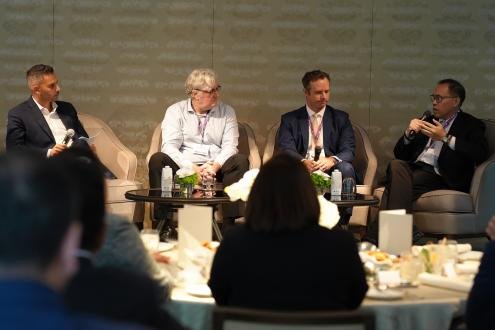
Hubbis and our exclusive partner for the events, BNY Investments, hosted two private forums for senior investment professionals, wealth managers, family offices and asset managers in Bangkok and Kuala Lumpur in May 2026. The Bangkok luncheon took place at the Waldorf Astoria Bangkok on Tuesday, 19 May, followed by the BNY Investments Exclusive Breakfast Forum at W Kuala Lumpur on Wednesday, 20 May.
Across both sessions, the agenda focused on some of the most pressing portfolio construction questions facing Asian wealth managers today. With markets shaped by geopolitical uncertainty, shifting rate expectations, renewed currency volatility, changing asset class correlations and the accelerating institutionalisation of digital assets, the discussions explored how advisers, CIOs and asset allocators should think about risk, resilience and opportunity in 2026.
The programme combined a series of panel discussions with presentations from Aninda Mitra, Head of Asia Macro & Investment Strategy at BNY Investments, and Clarence Chan, Singapore CEO and Head of Investment Oversight and Client Solutions, APAC, BNY Investments.
View the photos from the Malaysia discussion HERE. And the photos from the Thailand discussion HERE.
Six Key Takeaways
1. Currency Risk Has Become a Strategic Portfolio Issue: The discussions made clear that FX exposure can no longer be treated as a secondary or mechanical consideration. With hedging costs higher, central bank paths diverging, and Asian currencies behaving differently against the US dollar, wealth managers need to reassess whether unhedged exposure still serves clients’ objectives. The question is no longer simply whether to hedge, but how currency exposure fits each client’s liabilities, lifestyle needs, family geography and long-term purchasing power.
2. Hedging Requires More Nuance Than a Binary Choice: The panels moved beyond the idea of being either fully hedged or fully unhedged. Passive hedging, dynamic hedging and active currency programmes can each play a role, depending on the client, the portfolio structure and the implementation framework. FX may be used to manage volatility, reduce unintended US dollar concentration, or potentially provide a source of uncorrelated alpha, but only where the strategy is well governed, efficiently executed and suited to the client’s objectives.
3. Tokenisation Is Moving From Hype to Infrastructure: Tokenisation was framed not as a speculative crypto story, but as an evolving infrastructure theme. The more serious institutional conversation now centres on real-world assets, stablecoins, digital cash, tokenised securities, custody, compliance and reserve management. The opportunity lies less in simply issuing tokens and more in building the regulated infrastructure needed for tokenised assets to be held, serviced, distributed and monitored properly.
4. Digital Assets Still Require Careful Suitability and Governance: While tokenisation is becoming more relevant to wealth management, the discussions avoided overstating adoption. Regulatory permissions, custody, due diligence, asset quality, liquidity and investor suitability remain critical. Not every asset is appropriate for tokenisation, and wealth managers need to distinguish between credible institutional use cases and products where governance, transparency or investor protection remain insufficient.
5. Macro Uncertainty Calls for Flexible, Diversified Portfolios: Aninda Mitra’s presentation highlighted that investors face a complex mix of energy price pressure, geopolitical uncertainty, AI-driven disruption, policy credibility questions and concentrated market leadership. The appropriate response is not an indiscriminate risk-on or risk-off stance, but a diversified portfolio that can limit drawdowns if risks persist while still participating if conditions improve. Flexibility, scenario awareness and disciplined asset allocation are central.
6. Portfolio Construction Discipline Remains Essential: Clarence Chan’s message brought the discussion back to core wealth-building principles: discipline, diversification, staying invested and allowing compounding to work over time. However, the current environment demands a more deliberate approach to objectives, constraints, rebalancing and implementation. With traditional 60/40 assumptions under pressure and more investment tools available, the priority is not more products for their own sake, but clearer portfolio purpose, better risk understanding and stronger execution discipline.
FX Is Back at the Centre of the Portfolio Conversation
Across the Bangkok and Kuala Lumpur panel discussions, one theme came through clearly: currency risk can no longer be treated as an afterthought.
For much of the past decade, Asian investors with global portfolios often benefited from unhedged foreign currency exposure, particularly when local currencies weakened against the US dollar. Several panellists noted that this had shaped investor behaviour, especially in markets such as Thailand and Malaysia, where foreign funds, feeder structures and US dollar-denominated assets have become a familiar part of wealth portfolios.
But the discussion also highlighted that the environment has changed. Post-2021 and 2022, hedging costs have risen meaningfully, while divergent central bank policy paths, dollar volatility, yen weakness and changing local currency dynamics have forced investors to revisit assumptions that may have worked in the previous cycle.
As one panellist observed, FX should not only be viewed as a mechanical hedge or a cost line. It can affect portfolio outcomes materially, and for clients with multi-currency lives, liabilities and family structures, the question is not simply whether to hedge or not. It is what the investor’s true base currency is, what future liabilities they are trying to meet, where the next generation will live, and how global assets should be translated back into real-world spending needs.
This is particularly relevant for high net worth and family office clients. A client may hold assets in US dollars, have children living in Australia or the UK, own property in Malaysia or Thailand, and fund lifestyle needs in local currency. In that context, the idea of a single base currency becomes less straightforward. The more useful discussion may be around layers of exposure, future obligations and the role of currency in preserving purchasing power.
The panellists also explored the distinction between passive hedging, dynamic hedging and active currency strategies. Some asset managers prefer to leave the FX decision to end investors through hedged and unhedged share classes, seeking to preserve the underlying return profile of the strategy without making explicit currency calls. Others see scope for dynamic hedging or separate active currency programmes, particularly where currency can be diversified across multiple pairs and used as a lowly correlated return source.
One panellist noted that active hedging can only add value if two conditions are met: the manager needs to get the direction right more often than not, and execution must be efficient. This brings in practical considerations around spreads, counterparties, market access, hedge tenors and operational infrastructure. For institutional investors, these tools are more established. For private wealth clients, the challenge is often making currency overlays accessible in a format that fits advisory, fund or discretionary portfolio structures.
The discussion therefore moved beyond whether investors should be 100% hedged or 100% unhedged. Instead, it centred on a more nuanced question: how can FX be used to manage volatility, reduce unintended concentration in the US dollar, and potentially introduce an additional source of return that behaves differently from equities, bonds and credit?
Tokenisation Moves Beyond the Speculative Phase
The second major panel theme across both markets was digital assets and tokenisation. The discussion deliberately moved away from the older framing of digital assets as simply Bitcoin, Ethereum, NFTs or speculative crypto trading. Instead, the panellists focused on the convergence between traditional finance and digital infrastructure, and on the growing relevance of tokenised real-world assets, stablecoins, digital cash, private credit, commodities and fund structures.
Several speakers made the point that the digital asset ecosystem has evolved significantly from the earlier proof-of-concept phase. Five years ago, much of the market was dominated by crypto projects, NFTs, ICOs and assets with limited governance or underlying fundamentals. Today, the more serious institutional conversation is around regulated structures, custody, compliance, tokenised securities, reserve management, real-world assets and the operational efficiencies that blockchain-based infrastructure may offer.
From a traditional finance perspective, tokenisation is increasingly relevant because it may allow established institutions to participate in new rails without abandoning familiar standards around governance, risk management, custody and fiduciary responsibility. One panellist explained that traditional players may participate as reserve managers, custodians, trustees, transfer agents or investment managers supporting tokenised products. In that sense, the opportunity is not just in issuing a token, but in building the infrastructure that allows tokenised assets to be held, serviced, distributed and monitored properly.
The panels also explored why tokenisation may matter for wealth management. Potential benefits discussed included fractionalisation, operational efficiency, broader distribution, improved transaction transparency, programmable compliance, and access to new investor channels. Tokenisation could make certain assets easier to package or distribute, particularly where the underlying product is already attractive and well understood.
However, the discussions were careful not to overstate the pace of adoption. Regulatory permissions, investor suitability, custody arrangements, asset quality, market liquidity and distribution readiness remain critical. Real-world asset tokenisation may be advancing, but it does not automatically make every asset suitable for tokenisation. In fact, some of the most interesting examples raised during the discussions also demonstrated the importance of saying no when custody, due diligence or investor protection questions cannot be answered properly.
For wealth managers, the core message was that tokenisation is no longer merely a speculative crypto story, but neither is it yet a universally mainstream portfolio allocation. It sits somewhere more practical: as an infrastructure evolution, a potential product distribution channel, and an area where banks, asset managers, platforms and digital asset firms are beginning to collaborate more seriously.
Aninda Mitra: The Rules Have Changed
In his presentation, Aninda Mitra examined how today’s macro forces are reshaping asset class outcomes. His central framing was that investors need to consider how defensive or aggressive they should be in portfolios given the current mix of geopolitical risk, energy price pressure, AI-led disruption, policy uncertainty and market concentration.
He focused on three key questions. First, whether markets are mispricing the energy price shock. Second, whether investors have become too complacent. Third, whether US policy credibility is being tested, or could be tested further.
On energy, Mitra argued that while oil prices have moved higher and the shock is meaningful, the broader picture is more nuanced than in previous crisis periods. Crude oil futures pricing is benign. This suggests that potential conservation effects, alternative suppliers, energy substitution and renewables all need to be considered when assessing whether markets are underestimating the duration or severity of the shock. He noted that the conditions today are not identical to prior oil crises, and that the inflationary implications therefore need to be assessed within the current policy and labour market context.
Inflation remains a concern, but Mitra highlighted that labour markets are less tight than they were during the earlier post-pandemic inflation period. At the same time, AI may be playing a role in changing hiring patterns and shaping corporate behaviour. Purchasing manager indices have remained relatively resilient, even though momentum has eased across several major economies.
He also pointed to the importance of the AI capex cycle. While geopolitical and inflation risks remain significant, the earnings backdrop in parts of Asia, particularly Korea and Taiwan, remains strikingly strong. This has helped support a cautiously constructive stance towards selected equity markets, even as investors need to remain conscious of stretched valuations and concentrated market leadership.
From an asset allocation perspective, Mitra’s message was not to become indiscriminately risk-on or risk-off. Rather, portfolios should remain diversified, able to minimise drawdowns if geopolitical or energy risks persist, but also positioned so they are not left behind if the shock resolves more quickly than expected. He indicated a cautious preference for global equities, with particular emphasis on selected emerging markets, real assets such as infrastructure and real estate, and a cash buffer. At the same time, he was more cautious on areas such as local EM debt and US Treasuries in the face of inflation and policy credibility risks.
Clarence Chan: Discipline, Diversification and Compounding Still Matter
Clarence Chan’s presentation, “A Smarter Way to Build Wealth: Why Curated Portfolios Could Matter in Today’s Markets,” brought the discussion back to portfolio construction discipline.
His message was that while markets feel more complicated today, the fundamentals of wealth building remain familiar: stay diversified, remain disciplined, stay invested and allow compounding to work over time. What has changed is the environment in which investors must apply those principles.
Chan noted that investors are facing a constant stream of headlines around inflation, interest rates, geopolitics and market disruption. This can create pressure on portfolio managers, advisers and investment committees to act simply to show that they are responding to events. Yet reacting too frequently to short-term noise can be damaging, particularly when markets are being driven by narrow leadership and rapid sentiment shifts.
He also highlighted that the traditional 60/40 portfolio framework has become more difficult in recent years. Historically, equities and fixed income often helped offset one another. But with stock-bond correlations becoming more positive at times, investors need to think more carefully about what diversification really means in the current regime.
That does not mean abandoning core portfolio principles. Instead, it means being more deliberate about objectives, constraints, asset allocation, implementation and rebalancing. Chan discussed the importance of curated portfolios that begin with the client’s objectives and boundaries, then use a wider toolkit across public equities, fixed income, alternatives, infrastructure, real assets, hedge funds, private markets and, where appropriate, digital assets.
He also addressed the role of portfolio analysis, model construction and managed account solutions. For intermediary and private banking clients, the value lies not only in selecting asset classes, but also in building, implementing, rebalancing and administering portfolios in a consistent and scalable way. This is particularly important as wealth clients demand more sophisticated solutions, but still require clarity, governance and operational discipline.
On alternatives and digital assets, Chan was balanced. Infrastructure, for example, may offer a useful diversification effect due to its lower correlation with equities. Digital assets may enhance returns in small allocations, but volatility and drawdowns need to be understood and accepted by the client. The broader point was that more choice does not automatically improve outcomes. Better portfolio construction requires knowing which tools are appropriate, how they behave, and what role they are meant to play.
A Timely Conversation for Asian Wealth Management
Taken together, the Bangkok and Kuala Lumpur events reflected a timely shift in the Asian wealth management conversation. Clients are no longer asking only which market or product to buy. They are asking how portfolios should be built when inflation, rates, geopolitics, currency volatility, digital infrastructure and changing correlations are all moving at once.
The FX panels showed that currency exposure is now a strategic portfolio issue, not simply a back-office translation matter. The digital asset panels demonstrated that tokenisation is moving from hype towards infrastructure, albeit with clear regulatory, custody and suitability constraints. Mitra’s macro presentation reinforced the need for flexible rules in a world of energy shocks, AI disruption and policy uncertainty. Chan’s portfolio construction session brought the message back to discipline, diversification and compounding.
For advisers, CIOs and wealth platforms across Asia, the central takeaway was clear: portfolio resilience in 2026 requires more than broad diversification by label. It requires understanding the actual sources of risk, the role each asset class or exposure plays, and the infrastructure needed to implement ideas properly.
That made these discussions particularly well timed. In an environment where clients are more informed, more globally exposed and more sensitive to volatility, wealth managers need to be able to explain not only what they own, but why they own it, how it behaves, and how it fits into a long-term plan. BNY Investments and Hubbis brought that conversation into focus across both markets, offering senior industry participants a practical forum to examine how global macro forces, currency risk, curated portfolios and digital asset infrastructure are reshaping private wealth portfolios in Asia.
**
Disclaimer
The information contained herein reflects general views and is provided for informational purposes only. This material is not intended as investment advice nor is it a recommendation to adopt any investment strategy. Opinions and views expressed are subject to change without notice. Past performance is not necessarily indicative of future results.