
Computational methods
All calculations were performed with the Gaussian 1668 program package employing the DFT method with Becke’s three-parameter hybrid functional and Lee-Yang-Parr’s gradient corrected correlation functional (B3LYP)69,70,71. The Stuttgart/Dresden (SDD) basis set and effective core potential were used for the Ru atom72,73, and 6–31 G* basis set was applied for H, C, O, N and F74. The geometries of the singlet ground states of compounds were optimized in CH3CN using the conductive polarizable continuum model (CPCM). The local minimum on each potential energy surface was confirmed by frequency analysis. Time-dependent DFT calculations produced the singlet excited states of each compound starting from the optimized geometry of the corresponding singlet ground state, using the CPCM method with CH3CN as the solvent. The calculated absorption spectra, electronic transition contributions, and electron density difference maps (EDDMs) were generated by GaussSum 3.075. The electronic orbitals were visualized using VMD 1.9.4a5176.
Materials and instrumentation
All starting materials were commercially available and used without further purification unless otherwise noted. 1H and 13C{1H} and 19F NMR spectra were recorded in the designated solvents on a Bruker AV 400 MHz spectrometer. Absorption spectra were measured using a Cary 8454 UV-vis spectrophotometer (Agilent Technologies). Emission spectra were recorded using a Varian Cary Eclipse fluorescence spectrophotometer. Electrochemical measurements were performed on a VMP-3 potentiostat (Biologic Science Instrument) with a three-electrode configuration. Pt wire, Standard Calomel Electrode (SCE), and glassy carbon (GC) were used as the counter, reference, and counter electrode, respectively. All the potentials were calibrated by the redox potential of Fc+/0 (Fc: ferrocene). Cyclic voltammetry and square wave voltammetry experiments were conducted for each complex (1–5) in 0.1 M LiClO4 of DMF. Femtosecond transient absorption spectra were performed on a home-built system. The 800 nm (8 mJ 1 kHz rep. rate, ∼35 fs pulse width) laser beam is generated from an Astrella laser system then split by the Ti:Saph crystal to form the pump beam (3 mJ) and probe beam. The pump beam goes through an optical parametric amplifier (Coherent OPerA Solo) to generate the desire wavelengths (3-4 uJ). Samples are loaded into a flow cell opened to air. All samples were at a concentration that afforded an absorption of ∼0.6 − 0.8 at the sample excitation wavelength. Fluorescence emission decay was measured on a LP980 spectrometer system (Edinburgh Instruments). The 355 nm laser beam is generated by a frequency-tripled Quanta-Ray INDI Nd:YAG laser (Spectra-Physics, ~6 ns pulses at 10 Hz) then goes through a tunable optical parametric oscillator (Spectra-Physics) to output the desired wavelengths, and the white light probe beam is generated from a 150 W Xe arc lamp. Single wavelength emission decay traces were collected using a PMT and digital oscilloscope (Tektronix MDO3022, 200 MHz, 2.5 GS/s). Spectral measurements were collected using an iCCD camera (iStar, Andor Technology). All the air-tight solutions were purged with N2 for 15 min before experiments. The absorbance of the solutions was kept 0.6 − 0.8 at the excited wavelength. The absorption spectra were taken before and after the experiments to confirm no degradation over the measurements.
Synthesis
(E,E’)-4,4’-Bisstyryl]-2,2’-bipyridine (bpyvp-H)
bpyvp-H was prepared according to the reported literature with slight modification50. A solution of 4,4’-dimethyl-2,2’-bipyridine (0.92 g, 5 mmol) and KtOBu (2.3 g, 20 mmol) in dry DMF (50 mL) was stirred for 1 h under Ar. Benzaldehyde (1524.7 μL, 15 mmol) was then added to the reaction mixture. After stirring at room temperature for 24 h, the solution was treated with 400 mL water and the suspension was stored at 5 °C for several hours. The precipitated solid was filtered and washed with methanol via Soxhlet extraction for 24 h and dried in vacuum at 60 °C to afford 1.49 g light yellow solid product (yield: 83%). 1H NMR (400 MHz, CDCl3): δ 8.61 (d, J = 5.1 Hz, 1H), 8.49 (d, J = 1.7 Hz, 1H), 7.51 (d, J = 7.2 Hz, 2H), 7.45–7.22 (m, 5H), 7.08 (d, J = 16.3 Hz, 1H). 13C{1H} NMR (101 MHz, CDCl3): 156.7, 149.8, 146.0, 136.5, 133.6, 129.1, 128.9, 127.3, 126.4, 121.3, 118.5.
(E,E’)-4,4’-Bis[p-fluorostyryl]-2,2’-bipyridine (bpyvp-F)
bpyvp-F was synthesized following a similar procedure as the above bpyvp-H. A solution of 4,4’-dimethyl-2,2’-bipyridine (0.92 g, 5 mmol and KtOBu (2.3 g, 20 mmol) in dry DMF (50 mL) was stirred for 1 h under Ar. p-Fluorobenzaldehyde (1609.2 μL, 15 mmol) was then added to the reaction mixture. After stirring at room temperature for 24 h, the solution was treated with 400 mL water and the suspension was stored at 5 °C for several hours. The precipitated solid was filtered and washed with methanol via Soxhlet extraction for 24 h and dried in vacuum at 60 °C to afford 1.78 g light yellow solid product (yield: 90%). 1H NMR (400 MHz, CDCl3): δ 8.68 (d, J = 5.1 Hz, 1H), 8.55 (s, 1H), 7.55 (dd, J = 8.6, 5.4 Hz, 2H), 7.47–7.36 (m, 2H), 7.14–7.03 (m, 3H). 13C{1H} NMR (101 MHz, CDCl3):164.4, 161.9, 156.7, 149.8, 145.8, 132.7, 132.4, 128.9, 128.8, 126.11, 121.3, 118.4, 116.2, 116.0. 19F NMR (376 MHz, CDCl3): -112.3.
(E,E’)-4,4’-Bis(p-methoxystyryl)-2,2’-bipyridine (bpyvp-OMe)
bpyvp-OMe was synthesized following a similar procedure as the above bpyvp-H. A solution of 4,4’-dimethyl-2,2’-bipyridine (0.92 g, 5 mmol) and KtOBu (2.3 g, 20 mmol) in dry DMF (50 mL) was stirred for 1 h under Ar. p-Methoxybenzaldehyde (1823.4 μL, 15 mmol) was then added to the reaction mixture. After stirring at room temperature for 24 h, the solution was treated with 400 mL water and the suspension was stored at 5 °C for several hours. The precipitated solid was filtered and washed with methanol via Soxhlet extraction for 24 h and dried in vacuum at 60 °C to afford 1.68 g light yellow solid product (yield: 80%). 1H NMR (400 MHz, CDCl3): δ 8.65 (d, J = 5.0 Hz, 1H), 8.52 (s, 1H), 7.55–7.34 (m, 4H), 7.05–6.90 (m, 3H), 3.85 (s, 3H). 13C{1H} NMR (101 MHz, CDCl3): 160.4, 156.7, 149.7, 146.3, 133.1, 129.3, 128.6, 124.2, 121.1, 118.3, 114.5, 55.6.
[Ru(2,2’-bipyridine)2((E,E’)-4,4’-Bisstyryl)]-2,2’-bipyridine)][PF6]2 (1)
1 was prepared according to the reported literature with slight modification10. A mixture of Ru(bpy)2Cl2 (0.2 mmol, 0.097 g) and bpyvp-H (0.3 mmol, 0.108 g) was suspended in DMF/H2O (v/v, 30/30 mL). The mixture was then refluxed at 100 °C for 8 h under argon atmosphere. After cooling to room temperature, the solvent was removed under reduced pressure. The residue was dissolved in methanol and added with a saturated aqueous solution of NH4PF6. The red precipitated solid product (1) was filtered and washed with water and diethyl ether with a yield of 46% (98 mg). 1H NMR (400 MHz, CD3CN): δ 8.73 (s, 2H), 8.51 (d, J = 8.2 Hz, 4H), 8.06 (t, J = 7.9 Hz, 4H), 7.83–7.60 (m, 12H), 7.50–7.33 (m, 12H), 7.32 (d, J = 16.3 Hz, 2H). 13C{1H} NMR (101 MHz, CD3CN): 158.1, 157.9, 152.6, 152.4, 147.7, 138.7, 137.4, 136.7, 130.6, 130.1, 128.5, 128.4, 125.3, 125.2, 125.0, 121.6.
[Ru(2,2’-bipyridine)((E,E’)-4,4’-Bisstyryl)]-2,2’-bipyridine)2][PF6]2 (2)
2 was prepared according to a similar procedure of that of 1. A mixture of bpyvp-H (0.5 mmol, 0.18 g), Ru(DMSO)4Cl2 (0.25 mmol, 0.12 g) and lithium chloride (25 mmol, 1.06 g) in dry DMF (30 mL) was refluxed for 5 h under argon atmosphere. The solution was then cooled down to room temperature and water (200 mL) was added. The solid precipitate was filtrated and washed with water and diethyl ether to give the intermediate compound of [Ru((E,E’)-4,4’-bisstyryl-2,2’-bipyridine)2Cl2] without further purification. [Ru((E,E’)-4,4’-Bisstyryl-2,2’-bipyridine)2Cl2] and 2,2’-bipyridine (0.2 mmol, 0.18 g) were suspended in DMF/H2O (v/v, 30/30 mL). The mixture was then refluxed at 100 °C for 8 h under argon atmosphere. After cooling to room temperature, the solvent was removed under reduced pressure. The residue was dissolved in methanol and added with a saturated aqueous solution of NH4PF6. The dark-red precipitated solid product (2) was filtered and washed with water and diethyl ether with a yield of 67% (170 mg). 1H NMR (400 MHz, CD3CN): δ 8.75 (s, 4H), 8.52 (d, J = 7.8 Hz, 2H), 8.07 (t, J = 7.8 Hz, 2H), 7.60–7.89 (m, 18H), 7.53–7.41 (m, 18H), 7.33 (d, J = 16.4 Hz, 4H). 13C{1H} NMR (101 MHz, CD3CN): 158.2, 157.9, 152.6, 152.4, 147.6, 138.7, 137.3, 136.8, 130.6, 130.1, 128.5, 128.4, 125.3, 125.2, 125.0, 121.6.
[Ru((E,E’)-4,4’-Bisstyryl)]-2,2’-bipyridine)3][PF6]2 (3)
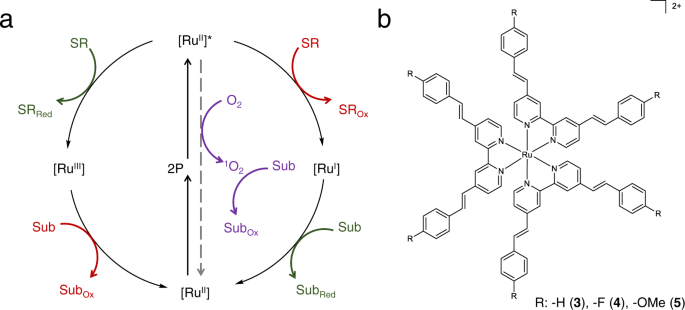
Ru(DMSO)4Cl2 (0.25 mmol, 0.12 g, 1 equiv.) and bpyvp-H (1 mmol, 0.36 g, 4 equiv.) were refluxed in dry ethanol (150 mL) under argon atmosphere for 15 h. After cooling down to the room temperature, the residue solid was filtered off. And the remaining solution was added with a saturated aqueous solution of NH4PF6. The dark-red precipitated solid product (3) was filtered and washed with water and diethyl ether with a yield of 80% (294 mg). 1H NMR (400 MHz, CD3CN): δ 8.76 (s, 6H), 7.82–7.74 (m, 12H), 7.70 (d, J = 7.5 Hz, 12H), 7.54–7.4 (m, 24H), 7.33 (d, J = 16.3 Hz, 6H). 13C{1H} NMR (101 MHz, CD3CN): 158.2, 152.4, 147.6, 137.3, 136.8, 130.6, 130.1, 128.4, 125.3, 125.1, 121.6.
[Ru((E,E’)-4,4’-(p-fluorostyryl))]-2,2’-bipyridine)3][PF6]2 (4)
4 was prepared via a similar procedure of that of 3. Ru(DMSO)4Cl2 (0.25 mmol, 0.12 g, 1 equiv.) and bpyvp-F (1 mmol, 0.36 g, 4 equiv.) were refluxed in dry ethanol (150 mL) under argon atmosphere for 15 h. After cooling down to the room temperature, the residue solid was filtered off. And the remaining solution was added with a saturated aqueous solution of NH4PF6. The dark-red precipitated solid product (4) was filtered and washed with water and diethyl ether with a yield of 75% (296 mg). 1H NMR (400 MHz, CD3COCD3): δ 9.04 (s, 6H), 8.12–7.98 (m, 6H), 7.88–7.63 (m, 24H), 7.41 (d, J = 16.4 Hz, 6H), 7.27–7.05 (m, 12H). 13C{1H} NMR (101 MHz, CD3CN): 163.0, 158.1, 152.4, 136.0, 133.2 (d, J = 3.5 Hz), 130.4 (d, J = 8.4 Hz), 125.1 (d, J = 34.5 Hz), 121.5, 117.1, 116.8. 19F NMR (376 MHz, CD3CN): -72.6 (d, J = 704.6 Hz), -112.8.
[Ru((E,E’)-4,4’-(p-methoxystyryl))]-2,2’-bipyridine)3][PF6]2 (5)
5 was prepared via a similar procedure of that of 3. Ru(DMSO)4Cl2 (0.25 mmol, 0.12 g, 1 equiv.) and bpyvp-F (1 mmol, 0.36 g, 4 equiv.) were refluxed in dry ethanol (150 mL) under argon atmosphere for 15 h. After cooling down to the room temperature, the residue solid was filtered off. And the remaining solution was added with a saturated aqueous solution of NH4PF6. A saturated aqueous solution of NH4PF6 was added. The dark-red precipitated solid product (5) was filtered and washed with water and diethyl ether with a yield of 73% (303 mg). 1H NMR (400 MHz, CD3CN): δ 8.68 (s, 6H), 7.71 (m, 12H), 7.64 (d, J = 8.5 Hz, 12H), 7.45 (d, J = 5.8 Hz, 6H), 7.17 (d, J = 16.3 Hz, 6H), 7.02 (d, J = 8.3 Hz, 12H), 3.84 (s, 18H). 13C{1H} NMR (101 MHz, CD3CN): 162.0, 158.1, 152.1, 147.9, 136.9, 130.0, 129.4, 124.9, 122.6, 121.2, 118.3, 115.5, 56.1.
Photocatalysis
Benzyl amine C-N coupling
In a typical experiment, a solution of 50 mM benzyl amine and 1 mol% photosensitizer in 5 mL CH3CN was added in a sealed 20 mL vial. After bubbling with O2 for 10 min, the solution was irradiated under near-IR LED (PR160L-740-C, 8.18 W) for a certain period of time to obtain N-benzylidenebenzylamine as the product. 1H NMR (400 MHz, CDCl3): δ 8.32 (s, 1H), 7.70 (d, J = 8.9 Hz, 2H), 7.17–7.35 (m, 8H), 4.75 (s, 2H). For scavenger control experiments, the concentration of scavenger was 50 mM, photosensitizer was complex 5 and the reaction time was 10 min. For power dependence experiment, the light source was 730 nm LED (M730L5, Thorlabs) and a 695 nm long-pass filter (SCHOTT RG695) was placed between the LED and the reaction vessel. The LED power was controlled via the LED driver (DC2200, Thorlabs).
Thioanisole sulfoxidation
In a typical procedure, a solution of 50 mM thioanisole and 1 mol% 5 in 4 mL CH3CN and 1 mL methanol was added in a sealed 20 mL vial. After bubbling with O2 for 10 min, the solution was irradiated under near-IR LED (PR160L-740-C, 8.18 W) for a certain period of time to obtain methyl phenyl sulfoxide as the product (yield: 95%). 1H NMR (400 MHz, CDCl3): δ 7.71–7.40 (m, 5H) 2.69 (s, 1H).
Anthracene-O2 [4 + 2] Diels-Alder reaction
In a typical procedure, a solution of 10 mM anthracene and 1 mol% 5 in 5 mL CH3CN was added in a sealed 20 mL vial. After bubbling with O2 for 10 min, the solution was irradiated under near-IR LED (PR160L-740-C, 8.18 W) for a certain period of time to obtain 9,10-dihydro-9,10-epidioxyanthracene as the product (yield: 99%). 1H NMR (400 MHz, CDCl3): δ 7.56–7.16 (m, 8H) 6.04 (s, 2H).
Cyclooctene ene-type reaction
In a typical procedure, a solution of 50 mM anthracene and 1 mol% 5 in 5 mL CD3CN was added in a sealed 20 mL vial. After bubbling with O2 for 10 min, the solution was irradiated under near-IR LED (PR160L-740-C, 8.18 W) for a certain period of time to obtain 3-hydroperoxycyclooct-1-ene as the final product (yield: 91%). 1H NMR (400 MHz, CDCl3): δ 9.39 (brs, 1H), 5.75–5.61 (m, 1H), 5.60–5.53 (m, 1H), 4.85–4.69 (m, 1H), 2.29–1.83 (m, 4H), 1.75–1.17 (m, 6H).
HMF upgrading
In a typical procedure, a solution of 50 mM HMF and 1 mol% 5 in 5 mL CH3CN was added in a sealed 20 mL vial. After bubbling with O2 for 10 min, the solution was irradiated under near-IR LED (PR160L-740-C, 8.18 W) for a certain period of time to obtain maleic acid anhydride (yield: 55%) and 5-hydroxy-4-keto-penteroic acid (yield: 37%) as the products. Maleic acid anhydride: 1H NMR (400 MHz, CDCl3): δ 7.04 (s, 1H). 5-Hydroxy-4-keto-penteroic acid: 1H NMR (400 MHz, CDCl3): δ 6.94 (d, J = 10.3 Hz, 1H), 6.84 (d, J = 10.3 Hz, 1H), 4.99 (s, 1H).
Phenacyl bromide dehalogenation
In a typical procedure, a solution of 50 mM phenacyl bromide, 10 equiv. triethanolamine (TEOA), and 0.2 mol% 5 in 5 mL CH3CN was added in a sealed 20 mL vial. After bubbling with Ar for 10 min, the solution was irradiated under near-IR LED (PR160L-740-C, 8.18 W) for 8 h. The product was purified by silica gel column chromatography with Vhexanes/Vethyl acetate = 100/3 to afford acetophenone as the product (yield: 86%). 1H NMR (400 MHz, CDCl3): δ 8.04 – 7.88 (m, 2H), 7.62 – 7.52 (m, 1H), 7.46 (dd, J = 8.3, 7.0 Hz, 2H), 2.60 (s, 3H).
Cyanation of tetrahydroisoquinoline
The starting substrate 2-(4-methoxyphenyl)-1,2,3,4-tetrahydroisoquinoline was synthesized based on a published procedure77. A mixture of 1,2,3,4-tetrahydroisoquinoline (0.63 mL, 5 mmol) and 4-iodoanisole (1.2 g, 5 mmol), copper(I) iodide (95.3 mg, 0.5 mmol), and potassium phosphate (2.1 g, 10 mmol) in 2-propanol/ethylene glycol (20/2, v/v) was refluxed at 80 °C for 24 h under argon atmosphere. After cooling down to room temperature, the mixture was quenched by water (50 mL) and extracted with ethyl acetate (30 mL × 3). The organic layer was concentrated under reduced pressure via rotary evaporation. The obtained residue was purified by silica gel column chromatography to afford the white solid product (860 mg, 72%). 1H NMR (CDCl3, 400 MHz): δ 7.19–7.25 (m, overlapped, 4H), 7.05 (d, J = 9.0 Hz, 2H), 6.96 (d, J = 9.0 Hz, 2H), 4.37 (s, 2H), 3.84 (s, 3H), 3.50 (t, J = 5.8 Hz, 2H), 3.04 (t, J = 5.7 Hz, 2H).
The following photocatalytic cyanation process was conducted in a sealed 20 mL vial containing a solution of 50 mM 2-(4-methoxyphenyl)-1,2,3,4-tetrahydroisoquinoline, 50 mM p-toluenesulfonyl cyanide, and 1 mol% 5 in 5 mL CH3CN. After bubbling with Ar for 10 min, the solution was irradiated under near-IR LED (PR160L-740-C, 8.18 W) for 24 h. The product was purified by silica gel column chromatography with Vhexanes/Vethyl acetate = 100/3 to afford 2-(4-methoxyphenyl)-1,2,3,4-tetrahydroisoquinoline-1-carbonitrile as the product (yield: 96%). 1H NMR (400 MHz, CDCl3): δ 1H NMR (400 MHz, CDCl3) δ 7.41–7.20 (m, 4H), 7.13–7.05 (m, 2H), 6.98–6.88 (m, 2H), 5.37 (s, 1H), 3.81 (s, 3H), 3.64–3.54 (m, 1H), 3.44 (m, 1H), 3.17 (m, 1H), 2.94 (m, 1H).
Ni-assisted Csp
2–Csp
3 coupling
In a typical procedure, a solution of 50 mM para-substituted benzaldehyde (-H, -OCH3, or -CF3), 10 equiv. allyl acetate, 10 equiv. N, N-diisopropylethylamine (DIPEA), 5 mol% 5, 15 mol% Ni(OTf)2, and 20 mol% o-phenanthroline in 2 mL CH3CN was added in a sealed 5 mL vial. After bubbling with Ar for 3 min, the solution was irradiated under near-IR LED (PR160L-740-C, 8.18 W) for 72 h. The product was purified by silica gel column chromatography with Vhexanes/Vethyl acetate = 10/1 to afford para-substituted 1-phenyl-3-buten-1-ol as the product (yield: 57 – 87%). 1-phenyl-3-buten-1-ol: 1H NMR (400 MHz, CDCl3): δ 7.41–7.22 (m, 5H), 5.81 (m, 1H), 5.22–5.09 (m, 2H), 4.73 (m, 1H), 2.60–2.43 (m, 2H), 2.22–2.17 (brs, 1H). 13C{1H} NMR (101 MHz, CDCl3): δ 144.1, 134.7, 128.6, 127.7, 126.0, 118.6, 73.5, 44.0. 1-(4-methoxyphenyl)-3-buten-1-ol: 1H NMR (400 MHz, CDCl3): δ 7.31–7.24 (m, 2H), 6.92–6.84 (m, 2H), 5.80 (m, 1H), 5.17 (m, 1H), 5.15–5.08 (m, 1H), 4.69 (t, J = 6.5 Hz, 1H), 3.80 (s, 3H), 2.54–2.46 (m, 2H). 13C{1H} NMR (101 MHz, CDCl3): δ 159.2, 136.3, 134.8, 127.3, 118.3, 114.0, 73.2, 55.5, 43.9. 1-(4-(trifluoromethyl)phenyl)-3-buten-1-ol: 1H NMR (400 MHz, CDCl3): δ 7.61 (d, J = 8.1 Hz, 1H), 7.47 (d, J = 8.1 Hz, 1H), 7.37–7.23 (m, 2H), 5.86–5.70 (m, 1H), 5.23–5.12 (m, 2H), 4.76 (m, 1H), 2.60–2.38 (m, 2H). 13C{1H} NMR (101 MHz, CDCl3): δ 148.0, 142.5, 134.2, 133.9, 128.8, 127.4, 126.3, 119.4, 119.1, 72.7, 44.1.