
PI Global Investments
Finance

Why a merger with SpaceX could be bad for Tesla shareholders


Elon Musk is musing again about another merger within his portfolio of companies — this time between two of his largest, SpaceX (SPAX.PVT) and Tesla (TSLA). For shareholders of the electric vehicle maker, however, it might not be a good thing.

Per CNBC, Musk has discussed with colleagues the possibility of folding the companies together, according to sources. Tesla employees said many expect a transaction to “eventually take place,” and the topic is openly discussed internally, as the two companies have already worked together on shared collaborations.

“In our view, there is a growing chance that Tesla will eventually be merged in some form into SpaceX/xAI over time. The view is this growing AI ecosystem will focus on Space and Earth together … and Musk will look to combine forces/technologies over time,” Wedbush analyst Dan Ives wrote in a note to clients earlier this year. xAI, Musk’s artificial intelligence startup that includes its Grok chatbot and X.com, merged with SpaceX in February.

In corporate circles, the “synergies” created when companies merge, like sharing resources and cutting costs to supposedly provide better products and services, are almost cliché.

In this case, however, although the two firms are sharing resources and working together on projects like the upcoming Terafab chip plant and orbital data centers, a tie-up would really be about one thing: control.

According to SpaceX’s recently filed IPO prospectus, Musk already owns much of SpaceX, and special voting shares make him an almost one-of-one shareholder. Musk’s special voting shares, known as Class B shares, have 10 votes each. His 5.5 billion Class B shares — 94% of SpaceX Class B shares in total — effectively give him 85% control of the company.

With so much control over SpaceX, as well as his holdings in Tesla (a roughly 20% stake), Musk would be effectively negotiating with himself and could give favorable terms in such a way that he could control the merged entity with the viselike grip that he has over SpaceX.

Luckily for Tesla investors, they would still get to vote on such a merger. Musk has a large Tesla stake but not a controlling one. Shareholders could vote a merger down if they don’t like the terms. Whether that vote serves as a meaningful check depends on how much Tesla shareholders want a piece of SpaceX.

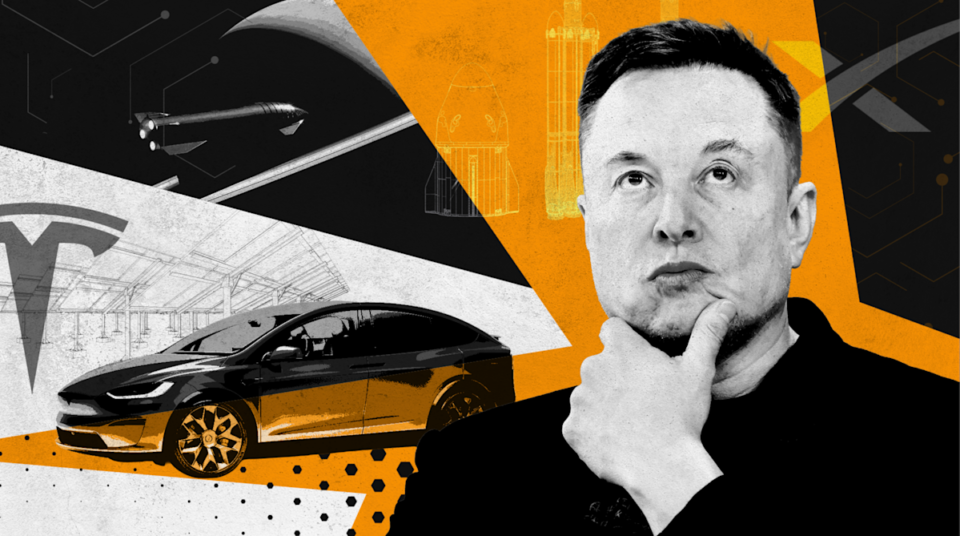
(Photo illustration: Yahoo Finance)

“SpaceX’s balance sheet means that any merger will be a stock deal,” Columbia Business School’s Michael Ewens, a corporate finance and private equity expert, told Yahoo Finance. “If it were cash, Tesla shareholders would have much less to worry about.”

And stock deals carry their own baggage when Musk is on both sides of the table.

Musk’s track record of merging companies he’s owned is somewhat problematic. Electrek’s Fred Lambert, a longtime Musk watcher and former Tesla shareholder, said these self-deals have been effectively engineered by Musk himself.

First came the bailout of SolarCity, a solar panel manufacturer and installer that Musk chaired (and where his cousins held high-ranking positions). The failing business was bought by Tesla for $2.6 billion in Tesla stock, essentially a bailout of the company. While Tesla still sells solar panels, the business has effectively shut down, Electrek reported.

The most obvious example might be Twitter (now X.com). Musk paid an eye-watering $44 billion for the company when he was forced to close the deal via a lawsuit. His management and controversial comments on the site crushed the company’s advertising revenue and value. But Musk had his own AI company, xAI, buy out X for $45 billion, including debt, again bailing out Musk and other X investors at the expense of xAI investors.

A SpaceX Falcon heavy rocket lifts off from launch pad 39A at the Kennedy Space Center, carrying the Viasat 3-F3 satellite into geostationary transfer orbit. (Manuel Mazzanti/NurPhoto via Getty Images)

But don’t feel too bad for xAI investors. SpaceX then acquired xAI, with Musk claiming the two needed to be merged to solve issues with AI and data center deployments in space. The deal valued xAI at a massive $250 billion, with SpaceX valued at $1 trillion.

It was another massive payout for xAI investors, including Musk, using the profitable and highly sought-after SpaceX shares as payment.

Concerns aside, some shareholders might want more Musk consolidation.

“Tesla shareholders might prefer a merger because that way Musk’s attention would not be divided between two companies. They would not have to worry about him allocating resources between the two,” Ann Lipton, University of Colorado law professor and expert in corporate governance, told Yahoo Finance. “They would lose their control, but investors in Musk companies do not seem to value that much.”

So while a focused Musk might be a good thing, it might also come at a high cost: dilution. In this case, it would mean existing Tesla shareholders would see their effective stake size shrink.

“Dilution is an issue; if SpaceX acquires Tesla at a $2 trillion or more valuation, it’s likely that his Tesla pay package would entitle him to even more shares in Tesla (which would become shares of SpaceX in a merger),” Lipton added.

The Tesla shares would then convert to SpaceX shares at the merger ratio, meaning regular Tesla shareholders’ slice of the combined entity shrinks.

A test car of the Tesla Cybercab in March 2026. (Andrej Sokolow/picture alliance via Getty Images)

It’s not hard to understand why Musk would want a merged entity, given his legal issues with some Tesla shareholders.

Tesla shareholder lawsuits and trials surrounding his compensation would effectively be a thing of the past, since SpaceX’s governance rules will remain in place. Per the prospectus, SpaceX doesn’t require independent directors or need independent directors to determine compensation, and any issues shareholders may have must be arbitrated, which, in most cases, is advantageous to the party mandating arbitration.

“The long-term risks here are a more complex firm with greater Musk control, greater related-party exposure, weaker mechanisms for minority shareholders to push back, and reliance on the growth of SpaceX’s non-Tesla business,” Columbia’s Ewens added. “All that said, the governance structures at SpaceX are similar to those at Tesla: Elon Musk runs the show. Tesla shareholders have already made that bargain.”

In the here and now, a potential SpaceX-Tesla merger would essentially use highly coveted and richly valued SpaceX shares to buy Tesla, a profitable company but one that may be on the downslide as its EV sales stall.

Elon Musk departs after a welcome ceremony with President Trump and China's President Xi Jinping at the Great Hall of the People on May 14, 2026, in Beijing. (AP Photo/Mark Schiefelbein, File)
Elon Musk departs after a welcome ceremony with President Trump and China’s President Xi Jinping at the Great Hall of the People on May 14, 2026, in Beijing. (AP Photo/Mark Schiefelbein, File)

“[Musk’s] history has often been to combine a weak company with a stronger one,” Lipton said. “I’m not sure that’s exactly the story or motivation of a Tesla/SpaceX merger; however, it may be more a way to consolidate control over Tesla and avoid the distraction costs of managing two public companies.”

Of course, the money doesn’t hurt either. Musk, the world’s richest person, stands to become a trillionaire if a certain SpaceX valuation is hit.

The question is whether Tesla shareholders would benefit too. And if there are doubts on that, Tesla shareholders may need to sell now.

“Tesla shareholders with concerns about the merger will have trouble getting out post-merger if it occurs close to the IPO,” Columbia’s Ewens warned. “They might inherit the lockup, or even without a lockup, might face a declining SpaceX share price after a pop on the IPO day (see Facebook’s IPO). It all depends on the currency of the transaction and how easily it can be converted into cash.”

Pras Subramanian is Lead Auto Reporter for Yahoo Finance. You can follow him on X and on Instagram.

Click here for the latest technology news that will impact the stock market

Read the latest financial and business news from Yahoo Finance


Source link

Related posts

The Biggest Mistakes CFOs Make When Choosing Payment Tech

D.William

Ben Bradley becomes head of HURST Corporate Finance

D.William

How to buy gold on Robinhood

D.William

Leave a Comment