
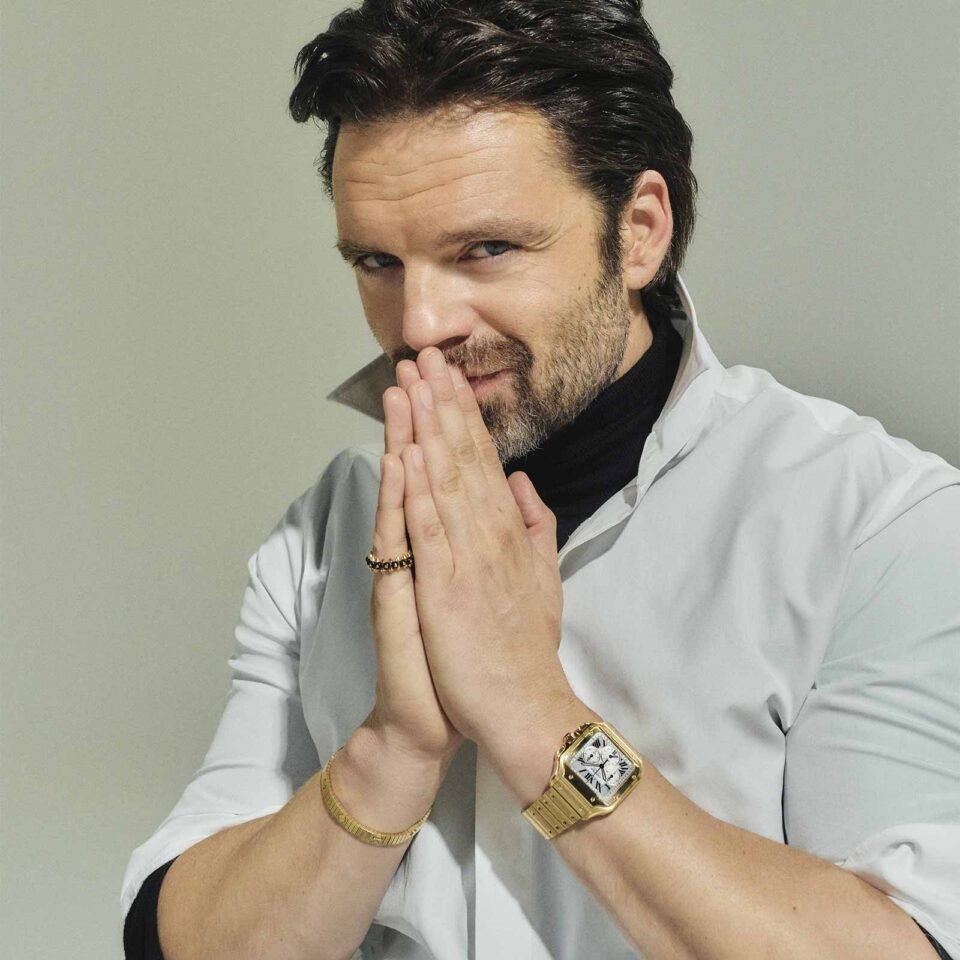
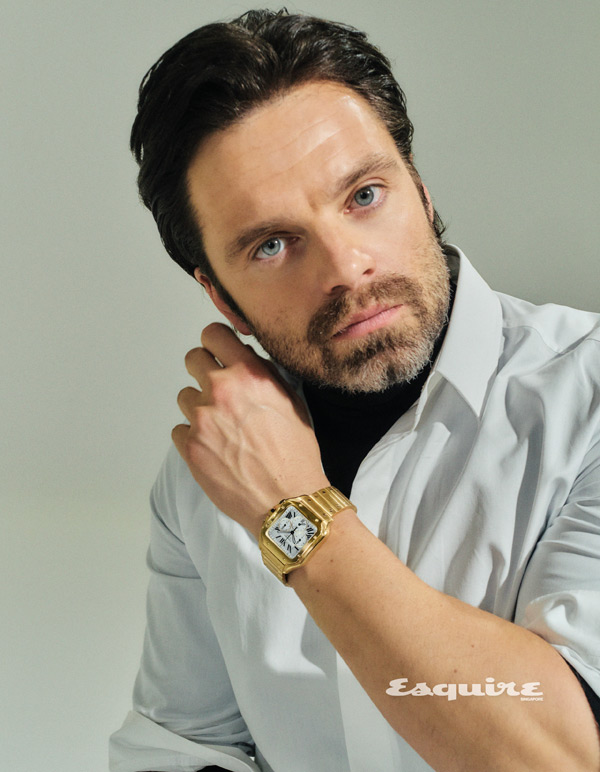
Santos de Cartier Chronograph, 47 x 39.8mm yellow gold case with yellow gold bracelet, CARTIER
It’s 12:15am on a Friday. The room is cool and dimly lit, and I’m lounging on a beanbag, wrapped in a maroon hoodie with a computer on my lap. On my screen, my interviewee wears a black hoodie and a white baseball cap.
There aren’t many descriptors that can help visualise the spatial portrait of what goes on inside a virtual interview—especially so when you’re interviewing Sebastian Stan. He fills the display. As he leans forward over his desk, a yellow lamp catches the stray tousles of brown hair curling from beneath his cap. I opened with a question: how does he deal with the discomfort that comes from playing the characters that he does?
“I think discomfort is something we all have to deal with at various levels, but when it’s connected to work and art or being creative, it’s the kind of discomfort that I’m seeking,” he says.
Stan has built a reputation in the industry for being somewhat of a chameleon. Able to slip inside the skin of a controversial sex symbol with a soul patch in one moment, then trade that for another with an orange complexion belonging to an uncurbed president.
In one of his more recent projects, his character undergoes a radical medical procedure to reconstruct his face in Aaron Schimberg’s A Different Man, a performance that earned him a Best Actor in a Motion Picture—Musical or Comedy award at the Golden Globes. This change in physicality borders on the edge of metamorphosis, and naturally demanded a certain degree of emotional energy and vexation to fit into these characters.
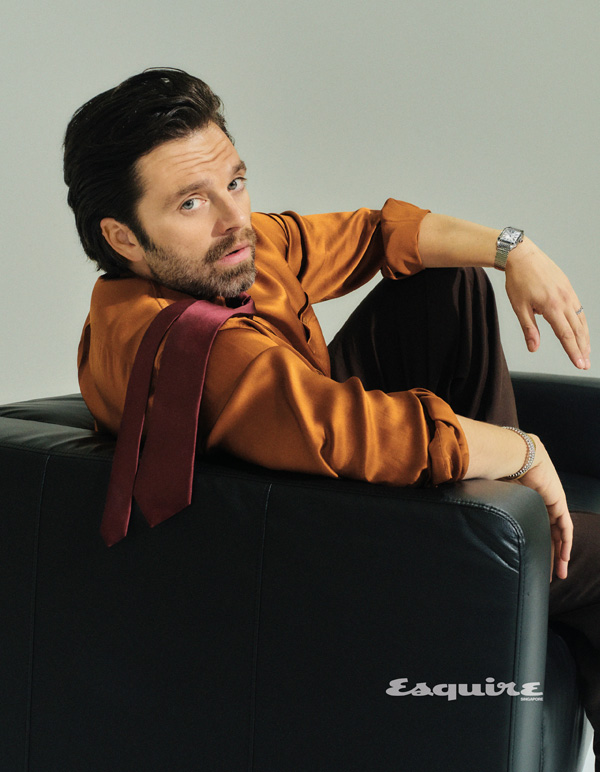
Santos-Dumont, 43.5 x 31.4mm platinum case with platinum bracelet, Clash de Cartier ring in white gold, Clash de Cartier bracelets in white gold and LOVE Unlimited bracelet in yellow gold, CARTIER
For a man whose career may be known to many for playing a Marvel superhero, the road he’s taken since is quite unconventional. He has since leaned into independent cinema, television, and even playing characters that are deliberately hard to love.
This willingness to move towards the unorthodox is perhaps why Stan resonates so deeply with the Santos de Cartier. The parallels between his career and the timepiece’s history are obvious. Cartier first stepped out of its comfort zone when Louis Cartier created a custom piece for his dear friend and aviator, Alberto Santos-Dumont—a design that broke watch design conventions at the time by eschewing the circular dial for a square one.
Released commercially in 1911, the Santos de Cartier became the first wristwatch produced specifically for men. Today, it remains one of the longest-running and most iconic collections in horology.
“I think discomfort is something we all have to deal with at various levels, but when it’s connected to work and art or being creative, it’s the kind of discomfort that I’m seeking.”
Stan pinpointed his own “off-the-beaten-path” in 2017. His role as Tonya Harding’s abusive husband from I, Tonya, opened his eyes because it was the first time he’d stepped into a place that felt genuinely different.
“That film and that experience propelled me to sort of want to keep going down this lane of discomfort and of risk-taking,” Stan says. “I believe that when we go towards something that scares us or feels uncomfortable, there’s a real opportunity to learn, not just about yourself, but also about the subject that you’re studying.”
He likens this to working out in the gym, where pain usually equates to muscle growth. Then he extends this metaphor inward, to the mental or circumstantial unease that shapes a person’s interior life, about how that same concept even applies to belief systems.
And then, Stan says something that contradicts all of it.
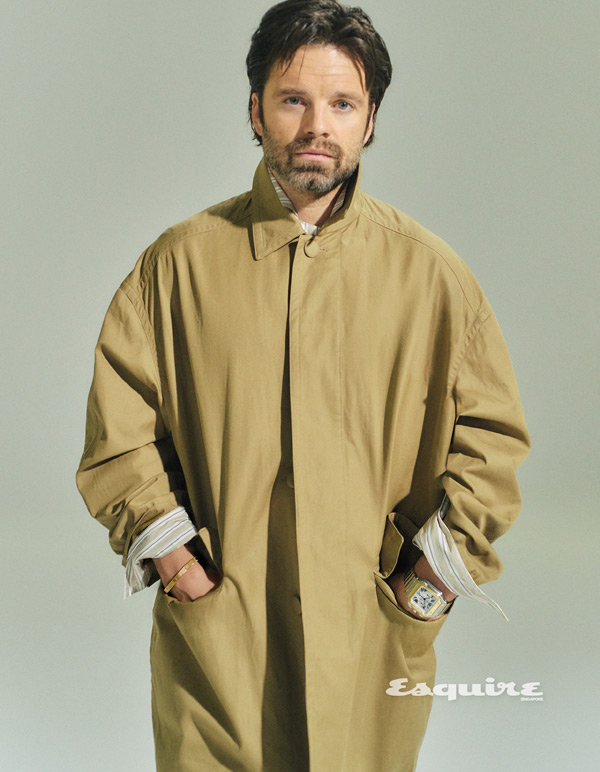
LOVE Unlimited bracelet in yellow gold and Santos de Cartier Chronograph, 47 x 39.8mm yellow gold and steel case with steel bracelet, CARTIER
“I think we’re in a time now where we’re being tested over and over again. Our morals are being tested. Our integrity is being tested. Our honesty as people is being tested,” he says. “We have examples of that all over currently. I don’t have to name them.”
Forget the romanticisation of grind culture, or the idea that pained history is the best chisel to bring about a humanness into character. No, this has more to do with the internal maturation that comes from stewing in that disquietude, when the easiest thing would be to dry off and find somewhere cleaner to stand—a fresh start.
Stan’s inclination to play unlikable men is a reflection of this. A rebellion, a physical manifestation of the inner back-and-forth he has with himself, determines what an actor’s responsibility actually is.
“I want to find work that truly and fearlessly reflects our world,” he reveals, his eyes going somewhere past the camera. “Unfortunately, our world is very dark and has many unpleasant characters, a lot of tragedy and a lot of pain and suffering. But I don’t want to ignore that.”
Between black and white, there are shades of grey. Each character he brings to life, the goal is simply to understand, and not to judge good or evil. In this sense, each performance becomes a mirror held up in front of the audience. No matter how twisted or disjointed the image is, viewers are forced to look.
If a pertormance ever made you ask a question to yourself or grow curious about the system, then, as far as he is concerned, Stan has done his work.
Then A Chuckle
“We got very deep very quickly there,” he quips with a toothy smile. “Let me tell you about the new Santos watch!”
He says it jokingly, but also with genuine rapture because he’s just a really really big fan of Cartier.
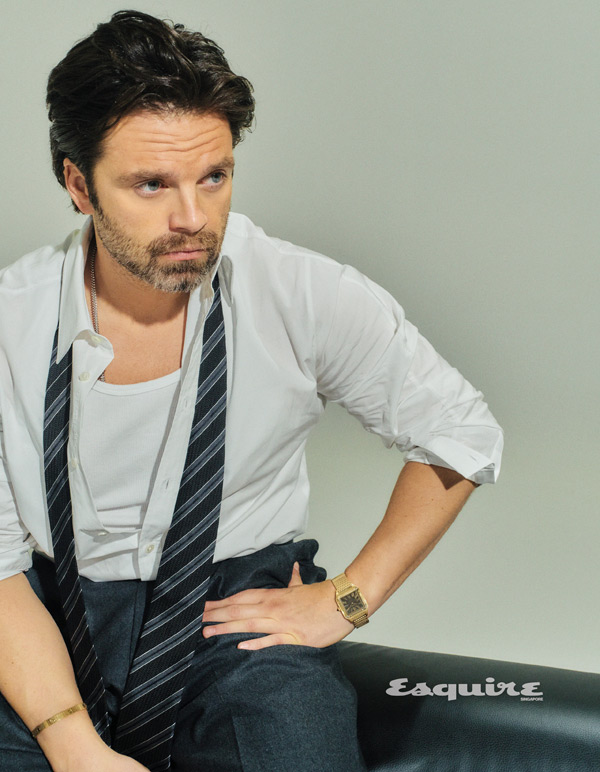
Tank, UNIQLO. Tie, ARMANI. Clash de Cartier long necklace in white gold, Santos-Dumont, 43.5 x 31.4mm yellow gold case with yellow gold bracelet and LOVE Unlimited bracelet in yellow gold, CARTIER
When he was 21, working towards his Bachelor of Fine Arts at Rutgers’ Mason Gross school, hed walk to auditions after school through Midtown, New York. “This is when you had auditions in person,” he adds. In those days, he’d arrive early, sometimes 15 minutes before, which gave him time to wander and browse the stores on Fifth Avenue.
Cartier was one of the stores that left an indelible impression on him. He never stopped and gawked through the window. Not that he needed to. The shimmering world behind the polished glass caught his eye each time he walked past. Pass by it enough times, and it leaves an impression.
This dent, however, was not formed out of envy; it was formed out of the settling realisation that what lay beyond was something different, perhaps, even something unattainable. It’s still something he reaches for, allowing his humility to latch onto and anchor himself.
It enables him to feel completely present and relish moments like the time he donned a sunray-dialled Santos de Cartier watch in 18-karat yellow gold and diamonds on the Oscar red carpet in 2025. It was the same night he’d received a Best Actor nomination at the Academy—the first of his career.
“I think red carpets are very strange places,” Stan says with a chortle. “The atmosphere is always forcing you to pose, and I just want to be myself.”
Given the value that the piece carries, it might make more sense to have it be displayed on a pedestal, behind glass. Some place where its mortality would be free from the harshness of the outside world.
“I don’t have the watch. It was a crazy watch to have,” Stan says, dragging a palm over his face. “But I’m sure there might be another time where I could wear it, and if I do, it will always remind me of what that night was.”
Sebastian Stan is the kind of man who sees no value in owning nine other pairs of jeans if he already has that one he can go to reliably and has an existing relationship with.
He points to the back of the room he’s in, “I actually don’t have a lot of things up on my wall, except for maybe two things that I know I love, that mean something, and will grow with history.”
Known Pleasures
As he describes himself, Stan is a human with his “own little things” he enjoys: a good glass of wine, music, and sugar (heavy emphasis on the last one). He finds pockets of happiness in the simple act of going for a walk, dining at a nice restaurant, and travelling somewhere new. But what of guilty pleasures?
“I feel like I watch a little bit too much true crime docuseries,” he admits.
That, and peanut butter. Spread a layer of peanut butter over anything, and he’ll eat it, shamefully. Heres something you’d never expect him to enjoy, though: being bald.
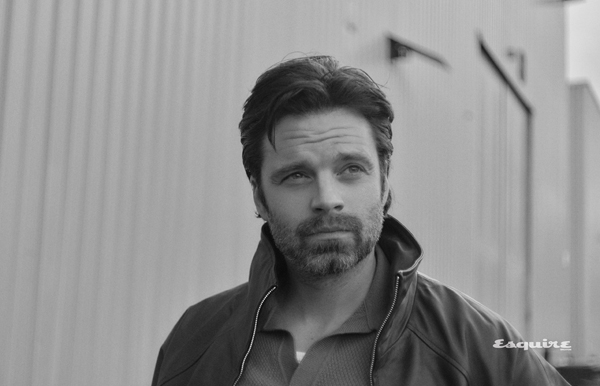
For his role as Mihai Gheorghiu in Fjord, an upcoming drama from Cristian Mungiu, Stan plays the Romanian patriarch who uprooted his family to a remote town in Norway to be closer to his wife’s kin. The wife is played by Renate Reinsve, best known for her roles in The Worst Person in the World, and Sentimental Value. Tensions surface when the community notices bruises on one of the daughters, as varying views on personal freedom and societal conformity emerge as central themes.
He also had to shave his head.
“[Going bald] was very liberating, to be honest,” Stan says. “When it comes to work and what’s required, vanity does not come into question for me.”
He goes on, admitting that he actually misses it very much, rubbing his now-full head of hair. He references Channing Tatum and Timothée Chalamet as examples of men looking good with no hair. “Also, it’s so easy in the morning getting up, you know. You don’t have to worry about it.”
It’s too early for Stan to speak at length about Fjord, but it’s a film that matters to him in ways that go beyond the craft. Fjord‘s director, Cristian Mungiu, best known for his Palme d’Or-winning 4 Months, 3 Weeks and 2 Days, was a director Stan dreamt of working with for a long time. And on a deeper level, for the actor who was born in Romania, Fjord is the actor’s first Romanian film.
Stan found the film fulfilling in ways that he didn’t fully anticipate. He recalls a specific moment at the end of filming, saying goodbye to the mostly Romanian crew, when one of them came with a Romanian flag. They wrapped him in it and embraced him. In his best Romanian accent, Stan repeats what they had told him: “Oh, you know, you are one of us!”
The decision to leave his birth country when he was a child fell squarely on his mother’s shoulders as she wanted Stan to pursue a life better than what she had led.
“I was very lucky to have left when I did, and to have the journey that I did. But it wasn’t necessarily a choice that I had made,” he says. “To come back and reconnect with my people on a level like that was really meaningful.”
Illusion of Freedom
There’s this idea called the “freedom paradox”, and it reads that unlimited choice can actually stifle creativity. Endless options may seem liberating at a glance, but for some, having a few clear boundaries is actually what helps their creativity shine.
For more than a century, Cartier’s Santos lived within this paradox. The square case, exposed screws, elongated Roman numerals… these are the constraints the watch placed on itself since 1904, and yet, it maintained relevance, evolving with the world. By worming and contorting against the confines of a tight box, the Santos accumulated well over a 100 different references through careful tweaks.
The latest adjustments to the model are as follows: a flexible bracelet and a slimmer chronograph.
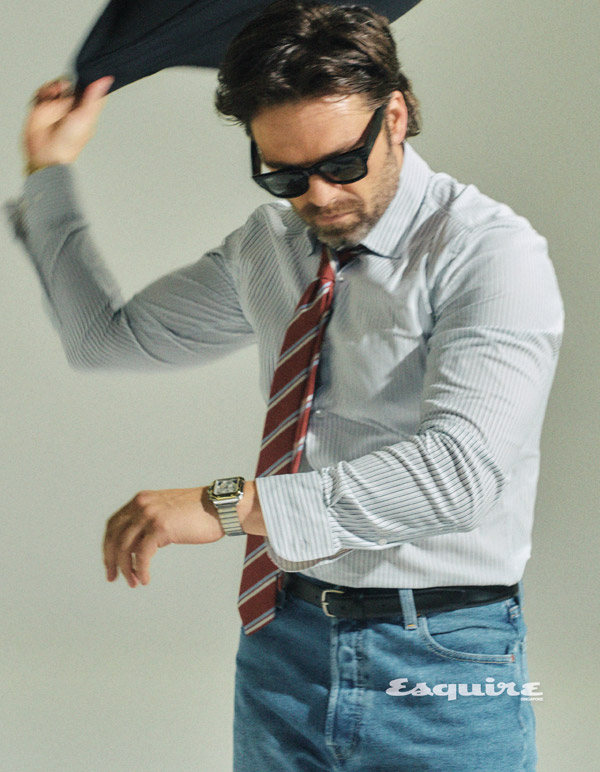

Santos de Cartier Chronograph, 47 x 39.8mm, yellow gold and steel case with steel bracelet, CARTIER
A new Santos-Dumont bracelet features rice-bead-like links arranged neatly to form a gauzy mesh. It cascades and drapes around the wrist the way fabric does, creating a sense of fragility that feels closer to velvet satin than metal. The flexibility is borrowed—pulled from the first made-to-measure metal watch bracelets the Maison developed in the 1920s.
Three new references will carry this bracelet, in platinum and yellow gold. But the standout lies in the yellow gold with obsidian dial.
Its delicacy is comparable to glass. Inlaid gems were meticulously harvested from a Mexican volcanic stone. Tiny air bubbles trapped within the obsidian form a luminous reflection that shifts with the angle of view, creating a mesmerising depth that pairs well with the lustrous sheen of yellow gold.
As for the chronographs, these aren’t new complications to the Santos family, but Cartier has tweaked them slightly. Now, they come in an LM (Large Model) instead of the previous XL (Extra Large) dimensions; allowing for a more wearable and thinner case for those with smaller wrists. The monopusher was upgraded to a double-press button, making the chronograph function more intuitive than before.
Although these chronographs will come in gold, gold and steel, and steel, Stan isn’t impartial to any one colour—so long as it’s got a white dial, which they all do. “You just can’t beat it,” he says. “It has that balance between being elegant and appearing rough when you need it to be.” There’s a simplicity and history that comes with that enjoyment.
“[Going bald] was very liberating, to be honest. When it comes to work and what’s required, vanity does not come into question for me.”
Some of his most critically acclaimed work comes from inhabiting historical figures that already exist—see Tommy Lee in Pam & Tommy, Jeff Gillooly in I, Tonya, and a young Donald Trump in The Apprentice. In this sense, much like the Santos, history functions within the box that determines the limit of how far he can stretch these characters.
So, what’s the shift he made as an actor that helped with his craft?
The answer is simple: flexibility. Stan believes that all art forms, including acting, are about staying open and allowing moments to surprise you and, in the process, learn something new.
“I think you run into trouble when you get stuck in certain mindsets or determine that life has to be a certain way,” he explains.
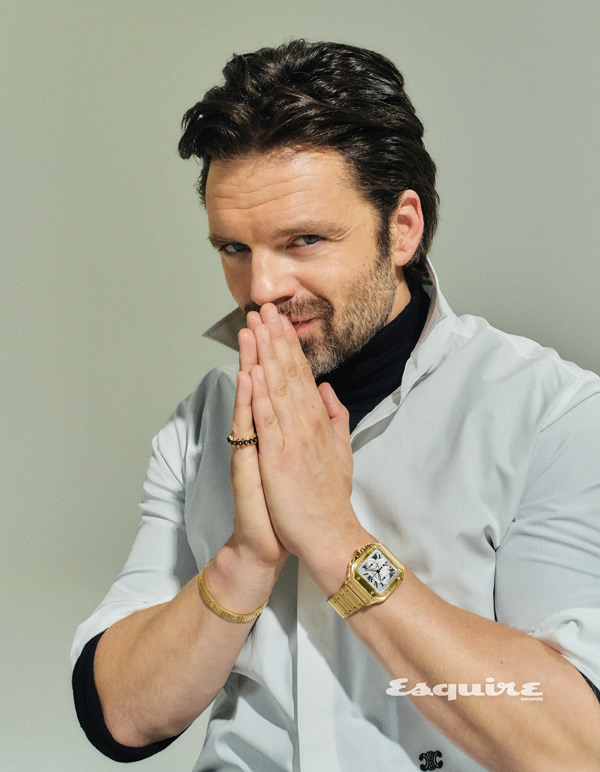
Clash de Cartier ring in rose gold and onyx, LOVE Unlimited bracelet in yellow gold and Santos de Cartier Chronograph, 47 x 39.8mm yellow gold case with yellow gold bracelet, CARTIER.
It’s nearly 1am by this point. We’ve spent just 40 minutes together, but it’s clear to see that he’s someone who lives a great deal inside his own head.
He will turn 44 in the middle of August, having spent the last two decades of his life in the industry. I pick his brain one last time.
What’s the biggest thing acting has taught you about yourself?
Stan repeats the question to himself. His eyes go somewhere else, and he pauses.
“It’s taught me that there is a lot that I don’t know,” his smile opens over like ripe fruit. “Not just about myself, but also about the world, people, humanity.”
Patience, curiosity, hunger, and being non-judgmental—these were qualities he thought he knew and thought he possessed when he was younger. But two decades of gnashing and sloshing around the industry can humble you.
Humility is a fickle thing, though. Especially in the glow of endless bright lights, a constant pitting against peers, and an inner voice that tells you how you’re not doing enough to maximise your potential.
This tinny, whiney utterance that causes the ego to coagulate and clot the journey ahead.
Stan has learned to quell that voice over the years, teaching it how to appreciate changes and find value in being wrong. It’s still a work in progress, but he’s beginning to find acceptance in doing something even if it doesn’t work, because “it’s more important to just […] try than not try at all.”
“I just have to keep going and see where it takes me,” he tells me. “And to stay open, stay open, stay open…”
It’s, perhaps, an honest portrait of the self. Sebastian Stan, after all, is a man who spent his career creating a space, and seeing what he would receive with open arms.
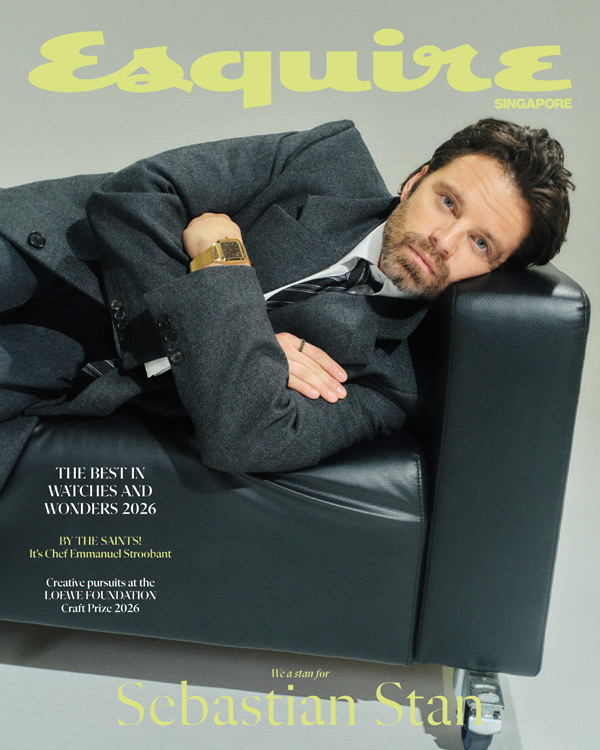
Santos-Dumont, 43.5 x 31.4mm yellow gold case with yellow gold bracelet and Clash de Cartier ring in rose gold and onyx, CARTIER
Photography: Chuck Reyes
Creative Direction: Asri Jasman
Styling: Michael Fisher at THE WALL GROUP
Grooming: Talia Sparrow at A-FRAME AGENCY
Producer: Aven Xiao
Production Assistant: Manele Zamoun
Styling Assistant: Molly MacIntosh
On-Set Styling Assistant: Sanya Batra