
In postwar Polish files, the phrase mienie pożydowskie gave officials a name for property left after the destruction of Jewish life. “Post-Jewish property” could mean a flat under municipal assignment, a workshop under state administration, a shop inventory, a farm holding, a cupboard, a sewing machine, a set of books, or the contents of a room whose owner had been deported. The phrase entered offices where clerks had to decide who could remain in a dwelling, who could claim rent, who could sell stock, and who could prove a connection to people whom the German occupation had already tried to remove from law, geography, and memory.
The word post did heavy work. It made Jewish ownership sound like an earlier phase of the object’s life, as if a chair or apartment had passed naturally from one condition into another. The owner’s death did not have to appear in every line of the file. The category carried it silently. A municipal worker handling such a petition did not need to write Treblinka, Bełżec, Auschwitz, Ponary, or a ditch outside town. He could write the property category, attach a registry number, and continue.
The German state and its collaborators murdered approximately six million Jews. The number has become familiar enough to risk losing its physical scale. Those Jews had lived in real rooms, paid rent, bought wedding rings, owned tailoring shops, kept ledgers, argued with landlords, repaired roofs, taught pupils, held mortgages, inherited candlesticks, and left coats hanging in wardrobes. The Holocaust was directed overwhelmingly at Europe’s Jews and sought the destruction of every Jewish life the Nazi state could identify. Roma and Sinti, disabled people, Soviet prisoners of war, Polish elites, homosexuals, Jehovah’s Witnesses, political prisoners, and others were also persecuted and murdered. The Final Solution placed Jews at the center of a continental project of annihilation.
That project began robbing its victims long before the killing was complete. Jewish property was seized in stages: bank accounts frozen, businesses transferred, professional licenses revoked, homes requisitioned, household goods inventoried, jewelry surrendered, valuables packed into state channels or local pockets. Eyeglasses, wedding rings, watches, fountain pens, children’s shoes, prayer books, candlesticks, family silver, and winter coats moved from private life into systems of extraction. Some objects were shipped, melted down, auctioned, reused, stolen, hidden, or casually absorbed into neighboring households. Bureaucracy gave theft a route. Proximity gave theft an appetite.
The movement into ghettos accelerated the transfer. Families from small shtetls and elegant urban apartments alike were forced into crowded quarters where disease and hunger did what the Germans expected them to do. A family that had occupied a house for generations might be compressed into one room with strangers. A lawyer from Łódź, a shopkeeper from Kielce, a rabbi’s widow from a village near Radom, and a child from a prosperous Warsaw apartment could all end up subject to the same ghetto logic: fewer rooms, fewer belongings, less paper, less proof, fewer surviving witnesses. Their homes did not accompany them. Their furniture did not wait loyally. Their neighbors learned very quickly which doors would no longer be answered.
After liberation, a survivor who returned to a town could find that the built environment had survived with terrible composure. The staircase remained. The shopfront remained. The courtyard pump still worked. The walls had absorbed new quarrels, new cooking smells, new rent arrangements. Inside the flat, a family might hold a nakaz kwaterunkowy, a housing assignment order issued by a local office dealing with rubble, refugees, and border changes. The survivor could remember the room exactly and still lack the paper required to dislodge the person sleeping there.
Poland’s postwar legal structure made this worse. The Main Office of the Temporary State Administration was created in 1945 to manage abandoned property. The decree of March 8, 1946 concerning abandoned and formerly German property created the Main Liquidation Office, Główny Urząd Likwidacyjny, and regional branches. German confiscations could be treated as legally tainted while the state still held the property under administrative custody. A Jewish heir returning from a camp, a forest hiding place, or the Soviet interior might be told that the German transfer was invalid in theory while the current occupant’s position required orderly review. “Orderly” is a dangerous word in a country where the disorder had included mass murder.
The civil-law defense of dobra wiara, good faith, gave current possessors a usable language. They had accepted a municipal assignment. They had paid rent. They had bought goods at auction. They had repaired damage. Their own former home had been lost. Some had acted with opportunism, some with fear, some with the ordinary human capacity to benefit from catastrophe while narrating oneself as innocent. The law did not always require them to explain the disappearance of the Jewish owner. It asked whether their document had standing.
A survivor’s evidence often came from the wrong universe. A court could ask for a deed destroyed with a municipal archive. It could ask for witnesses killed with the family. It could request proof of kinship from someone whose parents, siblings, cousins, and in-laws had been murdered in places designed to prevent later claims from being made. German policy had made Jewish continuity nearly impossible. Postwar procedure then demanded continuity as evidence.
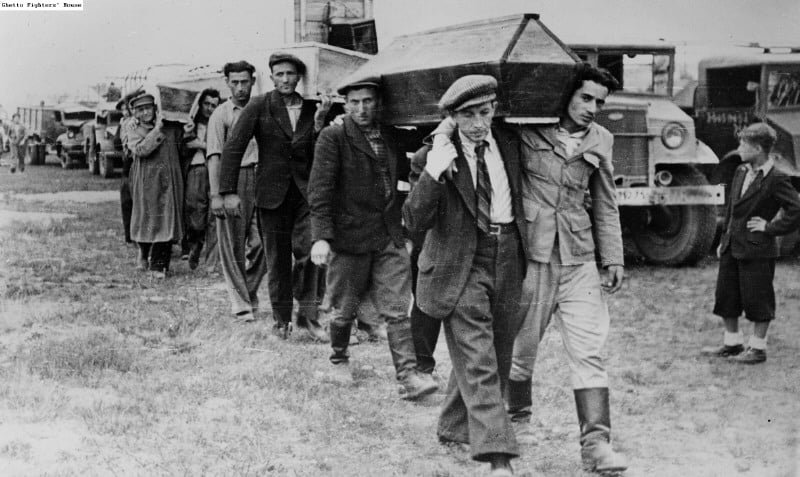
Kielce remains the most infamous Polish case because the violence tore through every respectable explanation. Before the war, more than 24,000 Jews lived in the city. After liberation, only a small remnant returned or gathered there. On July 4, 1946, forty-two Jews were murdered in and around the Jewish committee building at 7 Planty Street after a blood libel rumor spread through the city. The crowd included townspeople, workers, members of the civic militia, and soldiers. Jan T. Gross has argued that property anxiety helped give the violence its force. The return of Jews threatened to reopen matters many residents preferred to treat as settled: flats, shops, furniture, money, title, guilt.
The blood libel was old. The setting was new enough to matter. A town that had lived through German occupation now faced surviving Jews whose existence put pressure on household arrangements, business transfers, and local stories about who had done what during the war. The returning neighbor carried a claim that exceeded law. He made the postwar street look at the transaction hidden inside normal life.
This history did not end when the first generation died. Descendants continue to search for apartments, paintings, Judaica, bank accounts, libraries, businesses, jewelry, ritual objects, and family papers scattered through state collections, private homes, auction houses, and museums. Some claims involve major works of art with international attention. Others concern a kiddush cup, a portrait, a desk, a Torah ornament, a box of letters, or a necklace visible in the last prewar family photograph. The value is sometimes financial. Often the object is a surviving witness.
Museums sit uneasily inside this history. Some institutions have undertaken serious provenance research, returned looted works, opened archives, and treated heirs as claimants rather than nuisances. Others have resisted with the full vocabulary of delay: incomplete records, good-faith purchase, statutes of limitation, national patrimony, donor restrictions, evidentiary gaps. The language can sound technical while repeating the old imbalance. The family was destroyed under conditions that produced missing paperwork. The holder then asks the descendant to supply the paperwork whose absence was produced by the crime.
The same problem appears in private restitution disputes. A painting sold under duress in 1938 may have passed through several owners before entering a museum wall. A silver object may have been bought from a dealer after the war with no questions asked. A bookplate in a library volume may contain the only remaining trace of a murdered owner. The descendant who asks for return is sometimes treated as though she has disturbed the peace of an object that has already settled into respectable custody. That peace was never neutral. It was made possible by violence, opportunism, fear, market convenience, and the passage of enough time for possession to start impersonating innocence.
Jesse Eisenberg’s 2024 film A Real Pain touches the popular nerve of this history because it sends two Jewish-American cousins to Poland in honor of their Holocaust-survivor grandmother. Their journey includes the grandmother’s childhood home. The film is comic and wounded in the way American Jewish return often is: anxious, self-conscious, angry at its own insufficiency, alert to the absurdity of trying to place ordinary grief inside landscapes that have become heritage itinerary. A descendant standing outside a family building in Poland is rarely only visiting. Even without a lawsuit, the visit asks what happened after the family was removed, who entered, who kept living, who forgot, who learned to forget.
That question reaches beyond Europe, though comparison requires discipline. The Nakba of 1948 displaced roughly 700,000 Palestinians. The Absentees’ Property Law of 1950 created the Custodian of Absentee Property and gave legal form to the transfer of homes, land, shops, and orchards whose owners had fled or been expelled. The category of the “present absentee” allowed a Palestinian citizen of Israel to be physically present inside the state while legally absent from the property record governing his own house.
Recognition of that history remains difficult in Israeli society because the property did not vanish with the emergency that changed ownership. Houses were inhabited. Fields were cultivated. Urban quarters acquired new residents. Israeli fear that acknowledgment may be used to attack Jewish self-determination is politically real, especially in a country founded after the destruction of European Jewry and shaped by war from its first day. Palestinian insistence on naming dispossession is historically intelligible because the land, homes, and documents endured. Serious history does not settle sovereignty by analogy. It can still refuse to pretend that legal categories float above the circumstances that made them useful.
Jewish memory has demanded this kind of scrutiny from Europe. Germany designed and drove the annihilation of European Jewry. Across occupied and postwar Europe, many others learned how to live among the remnants. They bought, rented, occupied, stored, inherited, administered, denied, delayed, and sometimes returned. The moral record is uneven because human behavior was uneven. Some people protected property for Jewish neighbors. Some returned objects without litigation. Some lied.
Some waited until death made a claim impossible. Some descendants today meet cooperation from institutions that have chosen candor. Others meet glass cases, legal departments, and letters explaining why return cannot be authorized.
The phrase mienie pożydowskie remains useful to study because it shows how a society names the things left after targeted human removal. Its Polish setting is specific. Its danger is more widely recognizable. Once a person has been forced out, a file begins to form around the vacancy. Once the file exists, later readers may forget that the vacancy was made.
The problem of the returning neighbor lies in that made vacancy. The survivor came back to a town that had assigned rooms, issued certificates, stored inventories, sold goods, and adjusted its conscience to absence. His descendant may now arrive at a museum, archive, settled village, courthouse, apartment building, or village street with a photograph, a surname, a family story, a scrap of provenance, or nothing more than the stubborn knowledge that a life once occupied that place. The object may be small enough to hold in one hand. The refusal to look directly at how it changed hands is never small.
Selected Sources
Archival Collections
Central Archives of Historical Records in Warsaw (AGAD). Ministerstwo Administracji Publicznej (Ministry of Public Administration). Records on abandoned property (majątki opuszczone), 1945–1948.
Jewish Historical Institute (ŻIH), Warsaw. Centralna Żydowska Komisja Historyczna (Central Jewish Historical Commission). Record Group 301 (Survivor Testimonies), 1945–1947.
State Archives in Łódź. Wydział Gospodarki Komunalnej i Mieszkaniowej (Department of Municipal Economy and Housing). Records on nakazy kwaterunkowe and housing petitions, 1945–1946.
Texts
Aleksiun, Natalia. Conscious History: Polish Jewish Historians before the Holocaust. Oxford: Littman Library of Jewish Civilization, 2021.
Barkan, Elazar. The Guilt of Nations: Restitution and Negotiating History. New York: Norton, 2000.
Dean, Martin. Robbing the Jews: The Confiscation of Jewish Property in the Holocaust, 1933–1945. Cambridge: Cambridge University Press, 2008.
Gross, Jan T. Fear: Anti-Semitism in Poland After Auschwitz; An Essay in Historical Interpretation. Princeton: Princeton University Press, 2006.
Gross, Jan T., and Irena Grudzińska Gross. Golden Harvest: Events at the Periphery of the Holocaust. New York: Oxford University Press, 2012.
Hilberg, Raul. The Destruction of the European Jews. 3rd ed. New Haven: Yale University Press, 2003.
Khalidi, Walid, ed. All That Remains: The Palestinian Villages Occupied and Depopulated by Israel in 1948. Washington, DC: Institute for Palestine Studies, 1992.
Morris, Benny. The Birth of the Palestinian Refugee Problem Revisited. 2nd ed. Cambridge: Cambridge University Press, 2004.
Nicholas, Lynn H. The Rape of Europa: The Fate of Europe’s Treasures in the Third Reich and the Second World War. New York: Knopf, 1994.
O’Donnell, S. Shea, and Gabriel N. Finder, eds. Postwar Restitution and the Reconstruction of Jewish Life in Europe. Göttingen: Vandenhoeck & Ruprecht, 2022.
Segev, Tom. The Seventh Million: The Israelis and the Holocaust. Translated by Haim Watzman. New York: Hill and Wang, 1993.