
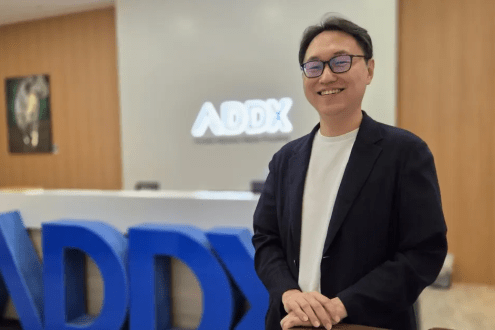
As private markets, alternatives and structured investment opportunities become more important in sophisticated portfolios, the challenge is no longer only about sourcing opportunities. It is about minimum ticket sizes, liquidity, transparency, execution, and the infrastructure needed to connect investors, intermediaries, issuers and product providers more efficiently.
For Inmoo Hwang, Co-founder, Group Managing Director and CFO of ADDX, this is where the platform has focused its efforts, he explained in an exclusive interview with Hubbis. Since its early development in 2017, its entry into the MAS regulatory sandbox in 2019, and the start of commercial operations after licensing in February 2020, ADDX has built its proposition around tokenisation, fractionalisation and digital workflows that make private markets more usable for a wider base of accredited investors.
The objective is not simply to digitise an existing subscription process. It is to create a more practical investment platform for private equity, private credit, hedge funds, structured products, fixed income, digital assets and other alternative opportunities – reducing the manual burden that has traditionally sat between investors and private markets participation.
Key Takeaways
- ADDX was founded to widen participation in private markets: Inmoo says the firm’s original vision was to make private markets and alternative investment products available beyond only institutional clients and UHNW Individuals.
- Tokenisation supports lower minimum tickets: By using blockchain as part of its infrastructure, ADDX can fractionalise selected investment opportunities, reducing the entry point from the USD250,000 to USD1 million thresholds often seen in traditional structures.
- Repeat investors are a key proof point: Inmoo says users are not only buying one product, but returning to build alternative investment portfolios across different categories.
- The client base spans three main groups: ADDX serves accredited individual investors, intermediaries such as private banks and brokers building private wealth capabilities, and family offices and EAMs.
- Secondary liquidity strengthens usability: ADDX operates a secondary exchange, giving investors a potential exit route if they need liquidity before the natural maturity or lock-up period of an underlying asset.
- The platform has moved beyond funds: ADDX has expanded from private equity funds into private credit, hedge funds, fixed income, commercial paper, structured products and derivatives capabilities.
- AI is becoming part of the research layer: ADDX has launched GoAI, an AI-powered research tool designed to help users identify relevant macro, company and country-level information more efficiently.
- White-label technology is a growing opportunity: ADDX is increasingly providing tokenisation infrastructure to partners, including a Japanese securities firm that used its technology to launch a tokenisation platform and tokenised bond.
- Regulation remains a pacing factor: Inmoo says different jurisdictions are adopting tokenised securities, stablecoins and digital asset infrastructure at different speeds, making cross-border adoption slower than initially expected.
- The long-term opportunity is capital markets infrastructure: Inmoo believes tokenised products, digital settlement and automated workflows can reduce cost, broaden investor pools, and improve execution across the financial ecosystem.
ADDX was founded around a clear market gap. Private markets and alternative investments had become increasingly important in institutional and UHNW portfolios, but participation remained limited, costly and administratively difficult for many sophisticated investors outside those segments.
For Inmoo, the appeal of building ADDX was personal as well as commercial. He saw an opportunity to open a part of the market that many investors could not previously reach unless they were already private bank clients or able to meet very high minimum subscription levels.
“When we first started this business, our vision was to make sure private markets products and alternative investments could be made available to a wider audience,” he says. “Not just typical institutional clients or ultra-high net worth individuals.”
The firm began in 2017, entered the MAS regulatory sandbox in 2019, and obtained its licence in February 2020. Since then, ADDX has onboarded products across private equity funds, hedge funds, private credit funds, structured products, digital assets and other alternative investments.
The proposition is built around practical portfolio construction. Investors can use the platform to assemble private markets exposure without the same paperwork, manual subscription processing and operational drag that often characterise traditional alternatives access.
A Digital Platform for Private Markets
ADDX serves three main client groups.
The first is the individual accredited investor. ADDX does not serve retail investors, but it does target individuals who meet the MAS accredited investor definition and want exposure to private markets without needing institutional scale.
The second group includes intermediaries such as private banks, brokers and other partners building their own private wealth capabilities. These institutions may want to offer alternatives to their clients, but need product access, digital infrastructure and operational support to do so efficiently.
The third group is family offices and EAMs. For these users, private markets are often already part of the investment conversation, but execution, reporting, administration and minimum size remain important constraints.
What connects these groups is the need for a more scalable process. Private markets investing has historically involved high commitments, long documents, manual onboarding, paper-based administration, limited liquidity and complex workflows. ADDX’s thesis is that digital infrastructure can reduce many of those barriers.
Using Tokenisation to Lower the Entry Point
The central technology layer is tokenisation. ADDX uses blockchain infrastructure to fractionalise investment opportunities and automate parts of the operating process.
“What tokenisation allows us to do is fractionalise the investment, so we lower the ticket size,” he says. “Instead of having to invest USD250,000 per ticket or USD1 million and above, investors can purchase, for example, a private equity fund as small as USD5,000 per ticket.”
That matters because many sophisticated individual investors may want alternatives exposure, but not in a way that forces over-concentration in a single fund or asset. Lower minimums allow them to allocate more precisely, diversify across strategies, and participate according to their own liquidity position and risk appetite.
Inmoo says ADDX’s objective is to help users build diversified private markets portfolios, not simply make one-off opportunistic purchases. The evidence that this is working, he says, is repeat usage.
“What worked well is that more and more of our users are repeat investors,” he says. “They do not just come and buy one product. They are buying different types of products. They are building their alternative portfolio using us.”
That repeat behaviour is important because it indicates that the platform is becoming part of investors’ broader allocation process, rather than serving only as a novelty route into private markets.
Why Participation Still Matters
For Inmoo, the core issue is that private markets and alternatives have long been available to institutions and the very wealthiest investors, while many accredited investors have been excluded by structure rather than sophistication.
“If you are not a private bank client, or not at a certain level as an individual investor, you would not be shown these kinds of investment opportunities,” he says. “In the early days, many of our users were excited because they could actually see different investment opportunities that typically were not shown to them elsewhere.”
The issue is not only availability. It is also commitment size. Investors may have the risk appetite and understanding to allocate to private markets, but not at levels that distort the rest of their portfolio. Smaller tickets allow them to participate more selectively.
“They do not have to commit a huge amount,” Inmoo says. “They can commit USD20,000 or USD50,000, depending on their cash position.”
For Inmoo, the allocation case is clear. Alternatives should not be reserved only for institutional portfolios. Used selectively, private markets exposure can help suitable accredited investors diversify beyond public market holdings and build a broader return and risk profile.
“We believe having a certain allocation to private markets or alternative investments makes sense for a lot of investors out there,” he says. “It is not just for institutional investors.”
Adding a Secondary Liquidity Avenue
Access to private markets is only one part of the problem. Liquidity is another.
Traditional private equity funds can come with long lock-up periods, often extending over many years. For investors, that can create a genuine constraint. Even where the investment thesis remains sound, life events, family commitments, cash needs or changing circumstances can make liquidity valuable.
ADDX addresses this through its secondary exchange, which gives investors a potential avenue to exit positions before the underlying investment naturally matures or distributes capital.
“We offer a secondary exchange, meaning we provide a liquidity avenue,” Inmoo says. “If they purchase a private equity fund with a 10-year lock-up period, they have an avenue to exit if they really have to, due to a life-cycle event, family commitment or another reason.”
This does not make private markets equivalent to public equities or listed bonds. These remain less liquid assets. But the existence of a secondary mechanism can make the asset class more practical for individual accredited investors, family offices and intermediaries that may otherwise hesitate to enter long-duration commitments without any potential exit route.
Expanding the Platform Beyond Funds
ADDX’s product roadmap has broadened substantially since the platform began.
Inmoo says the firm started with funds, including private equity funds, before adding other categories such as private credit and hedge funds. It later introduced fixed income capabilities, including short-term instruments such as commercial paper, which have proven popular on the platform.
The next phase included structured products. ADDX now works with six banks across the region to offer structured products to users. In 2026, the firm is adding derivatives capabilities, including accumulators and decumulators.
“When we first started, we started with funds,” Inmoo says. “Then we added private credit, hedge funds and fixed income capabilities. Last year we launched structured products. This year, we are adding derivatives capability.”
The commercial logic is straightforward. To become a more complete investment solution, ADDX needs to support different asset classes, liquidity profiles, risk-return characteristics and market views. This is particularly relevant for family offices and EAMs, which often need more than single-product access. They need a platform that can help source, structure, monitor and manage a broader alternatives allocation.
“With this, users can use us as a more holistic investment solution,” Inmoo says. “They can purchase different private markets funds and also get exposure using structured products such as accumulators and decumulators.”
AI as a Research and Decision-Support Layer
The second major area of investment is artificial intelligence.
For ADDX, AI is not being presented as a replacement for investor judgement. It is being used as a research and information layer to help users navigate a market where the volume of information has become difficult to manage.
Inmoo says the problem today is not lack of information. It is relevance. Investors are surrounded by macro commentary, company updates, government announcements, market data, geopolitical news and product-level information. The challenge is identifying what matters.
“There is too much information,” he says. “You cannot really tell which one is the relevant information for you.”
ICHX Tech, the parent company of ADDX, has developed GoAI, an AI-powered research tool designed to help investors understand macro developments, company activity and country-level shifts more effectively. The aim is to make research more targeted, filtering broad market noise into information that is more directly useful when users evaluate investment opportunities.
“We want to make sure our investors are well informed,” Inmoo says. “When it comes to making investment decisions, they are better informed.”
This fits with ADDX’s wider platform strategy. Lower ticket sizes and digital subscriptions are valuable, but investors also need stronger tools to understand the opportunities they are considering. As the range of products grows, the research layer becomes more important.
The White-Label Technology Opportunity
The third strategic priority is ADDX’s technology solutions business.
Inmoo sees this as part of the firm’s expansion beyond Singapore. Rather than only serving users directly through the ADDX platform, the firm can provide infrastructure to partners that want to launch their own tokenisation platforms or digital investment capabilities.
One example came in Japan in March, when a securities firm used ADDX’s white-label technology to launch its own tokenisation platform and issue a tokenised bond.
“One of our partners in Japan, a securities firm, used our white-label technology,” Inmoo says. “They launched their own tokenisation platform in Japan, and they also launched a tokenised bond on that platform.”
This white-label and technology solutions business is expected to become a more significant focus over the next six to 12 months. The rationale is that tokenisation adoption will not happen through a single platform alone. Local partners, securities firms, wealth platforms and financial institutions may want to build their own capabilities, supported by infrastructure that ADDX has already developed.
For ADDX, that creates another route to scale. It allows the firm to participate in the broader development of tokenised capital markets infrastructure, even where the end-client relationship sits with another institution.
Regulation and the Pace of Adoption
Not everything has moved as quickly as Inmoo initially expected.
The biggest underestimation, he says, was how long different jurisdictions would take to adopt new ideas such as tokenised securities, stablecoins and digital asset infrastructure into their regulatory frameworks.
Singapore has been relatively progressive. Inmoo points back to 2018, when Singapore was already consulting on tokenisation and related themes. But other markets have moved at different speeds, with different regulatory priorities and local market conditions.
“What we underestimated was how much time it would take for different jurisdictions to adopt these new ideas and put them into their regulatory frameworks,” he says. “Different countries move at a different pace.”
That has made regional expansion and institutional adoption slower than expected. The technology may be ready, and the investment use case may be clear, but regulatory adoption remains uneven.
This is not unusual for infrastructure shifts. Tokenised securities and blockchain-based settlement interact with licensing, investor protection, custody, transferability, fiat movement, digital currencies, market conduct and financial stability considerations. Jurisdictions are not all starting from the same point, and they are not all solving for the same market conditions.
For ADDX, the practical implication is that growth requires patience, regulatory engagement, and an ability to work within different market frameworks as they evolve.
Key Priorities
ADDX’s agenda is shaped by three main priorities:
Expanding Product and Platform Capabilities: ADDX is continuing to broaden its offering across private equity, private credit, hedge funds, fixed income, commercial paper, structured products and derivatives. Inmoo says the objective is to become a more holistic investment solution for accredited investors, family offices and EAMs, allowing users to build more flexible portfolios through the platform.
Building AI-Powered Research and Investor Support: ADDX is investing in AI capabilities, including GoAI, its AI-powered research tool. The goal is to help investors identify relevant macro, company and country-level information more efficiently, so they can make better-informed investment decisions in a market where information volume can be overwhelming.
Scaling White-Label Technology and Tokenisation Infrastructure: ADDX is also developing its technology solutions business, including white-label tokenisation infrastructure for partners in other markets. The firm has already supported a Japanese securities firm in launching a tokenisation platform and tokenised bond, and sees this as an important area of growth over the next six to 12 months.
Into The Future
Inmoo sees the long-term opportunity in terms of market infrastructure.
For him, blockchain’s value in capital markets is not abstract or speculative. It is practical. It can maintain ownership records, protect the integrity of those records, transfer them efficiently, and support real-time settlement. The point is not to make financial markets look more technological for its own sake. It is to reduce friction in processes that remain surprisingly manual.
“What blockchain can do is actually quite simple,” he says. “It makes sure records are properly maintained, nobody can hack those records, and when we move ownership records, we can do settlement in a real-time manner.”
That matters because much of the traditional financial ecosystem still depends on legacy processes. Inmoo recalls that when ADDX first started working with fund managers, some still asked for documents to be sent by fax. ADDX’s own platform could process a subscription in real time, but the connection to traditional finance required older forms of communication and processing.
“Our users can click the subscription and it goes through immediately,” he says. “But in order for us to interact with the traditional financial industry, they asked us to send faxes.”
The situation has improved, with emails now often accepted instead. But Inmoo says the broader system remains behind the digital experience users see elsewhere.
Fiat movement is another example. Clients may send money and then call their relationship manager because the funds have not yet appeared. The money may be somewhere in the banking system, but the platform cannot see it until it arrives.
“We spend a lot of time handling fiat,” he says. “The client says they have sent the money, but we have not seen it coming into our account. It must be somewhere up in the air. We do not know where it is.”
This is where Inmoo sees the next stage of change. If investment products are tokenised on blockchain, different processes can be automated, including settlement, asset transfer, interest payments and corporate actions. If stablecoins or digital currencies also sit on blockchain infrastructure, then both the investment product and currency leg can settle faster.
The benefits would be shared across the ecosystem. Issuers could reduce reliance on manual processes and intermediaries, lowering issuance costs and reaching broader pools of capital. Investors could find, access and manage opportunities more easily. Market participants could reduce friction across issuance, distribution, settlement and post-trade processes.
“If all of this comes into play, issuers can reduce reliance on manual processes and intermediaries, which means they can reduce the cost of issuing instruments,” Inmoo says. “At the same time, if you allow broader access to different user profiles, issuers can tap into different pools of capital.”
He is clear that this will take time. Infrastructure change requires broad adoption, not only by digital platforms, but by issuers, intermediaries, regulators, banks, investors and institutional market participants.
Still, Inmoo believes regulatory visibility is improving. He points to developments such as digital asset legislation progressing in the US, which he says can help provide greater clarity and transparency around regulatory frameworks, and in turn support institutional adoption.
The long-term direction, in his view, is towards a more efficient capital markets ecosystem in which tokenised products, digital settlement and better infrastructure reduce cost, broaden investor pools and improve execution for all participants.
Getting Personal with Inmoo Hwang
Inmoo was born in Seoul and spent most of his younger years in Korea. His first major international exposure came when his father moved to India as the country manager of the Export-Import Bank of Korea. Inmoo was around 13 years old when the family moved to New Delhi in the mid-1990s.
“It was quite a cultural shock,” he says. “I had grown up in Seoul until I was 13, and then I went to a totally different culture and country.”
The family returned to Korea when the Asian financial crisis began and his father’s banking branch in India closed. Inmoo later studied industrial engineering at Seoul National University, before beginning a career that took him through corporate development, consulting and eventually fintech entrepreneurship.
His early career included time at SK Telecom, where he was part of the corporate strategy and global M&A team covering Singapore, Malaysia and Indonesia. The role involved regional due diligence and investment activity, including transactions involving hundreds of millions of dollars.
That experience helped deepen his interest in Southeast Asia. When he later joined Boston Consulting Group (BCG), he asked to transfer from the Seoul office to Singapore.
“I was travelling to this region quite often even before that,” he says. “So when I moved to BCG, asking to transfer to the Singapore office was an easy decision.”
Consulting gave him exposure to strategy and corporate recommendations, but it also clarified what he did not want from the next stage of his career. He found the long hours and recommendation-heavy nature of the work frustrating, particularly when many strategy documents were never implemented.
“The reason I left consulting was the endless hours to produce recommendation documents,” he says. “Usually, they did not get executed. I wanted to see my effort seeing some light.”
That was part of what drew him to ADDX. In a startup environment, ideas must be executed, not only documented. Inmoo says the most rewarding part of the journey has been being in the driver’s seat, working with the team to turn strategy into delivery and value creation.
“Whatever I think about, whatever I come up with, is something that I must execute,” he says. “That is the part I enjoy the most.”
Outside work, Inmoo is married with two children, a daughter aged 14 and a son aged 11. He enjoys tennis, cycling and spending time outdoors with his family. He says he tries to do sports and outdoor activities with his children, partly to keep them away from too much screen time.
“As a parent, I try to avoid doing digital stuff with them,” he says. “They do enough of that in their free time, so I try to take them out. Outdoor sports are what I enjoy doing with them.”
He is also involved in church and social service activities. Tennis remains one of his preferred sports, and Rafael Nadal has long been one of the players he most enjoyed watching.
Much of his current focus remains on building ADDX and helping advance the next stage of private markets infrastructure. For Inmoo, that means moving beyond recommendations and into execution – turning infrastructure ideas into a working market platform, and helping private markets become simpler, faster and more practical for the investors and institutions using them.