
Current Climate brings you the latest news about the business of sustainability every Monday. Sign up to get it in your inbox.
UCG/Universal Images Group via Getty Images
Welcome back to Current Climate. We don’t know how harmful artificial intelligence will be in terms of eliminating jobs and disrupting major industries, but public opinion has soured on the massive, energy-thirsty data centers powering the technology.
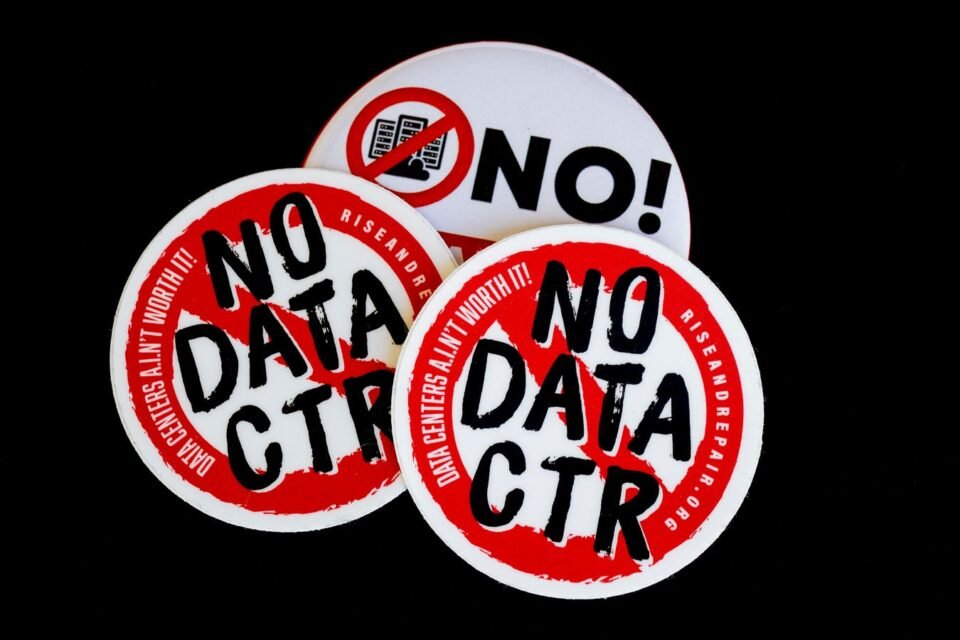
A whopping 70% of Americans oppose data center construction in their communities, according to Gallup. So states and cities across the U.S., from Georgia to Michigan to Monterey Park, California, are proposing or enacting outright bans on permitting new data centers, blamed for jacking up electricity and water costs.
But there’s one silver lining: The data center surge is propping up sales of clean energy technology, especially solar and battery storage systems, an unexpected surprise after President Donald Trump trashed many of his predecessor’s green power policies. The U.S. added 6.4 gigawatts of clean power capacity in the first quarter of the year, while overall clean power capacity across the country hit 370 gigawatts, enough to power about 80 million homes, according to a report by American Clean Power.
And data centers are a big driver of that expansion because they’re investing in solar and battery systems that can be installed faster and more cheaply than Trump’s preferred option of gas turbines or burning dirty coal.
“It takes a minimum of three to five years to get a natural gas-fired turbine built and permitted and running. If it’s a utility trying to build it, there’s a long regulatory process for that,” Phil Hirt, a retired environmental historian from Arizona State University, told The Arizona Republic. “But solar and battery, piece of cake, and they’re the cheapest form of electricity. They don’t consume any water. There’s no fuel cost.”
And even as fights over Trump’s efforts to kill offshore wind projects and wind down wind and solar tax credits continue, big investors in clean energy appear undeterred.
This “arguably is one of the best periods to invest in renewables in the U.S. over the last 20 years,” Miguel Stilwell d’Andrade, CEO of Portuguese power company EDP, told Semafor. It intends to invest $5.3 billion in U.S. renewable energy projects over the next three years.
The Big Read
Zach Dell’s Battery Company Is In Talks To Raise Funding At A $12 Billion Valuation
Austin-based Base Power, a provider of home batteries for backup power, is in talks to raise around $1 billion at a $12 billion valuation, four sources familiar with the matter told Forbes. Ribbit Capital is in talks to lead the round, one of the sources said. Base Power and Ribbit Capital did not respond to Forbes’ request for comment. The Information first reported on the fundraise.
Founded in 2023 by Zach Dell, son of billionaire computer pioneer Michael Dell, and Justin Lopas, Base Power installs and maintains large capacity home batteries which can serve as backup power if the main grid goes down. It also sells electricity at cheaper prices primarily to residents in Texas and part of Illinois. Acting as a power plant, Base Power charges its fleet of scattered home batteries from the grid when prices are cheap and demand is low, like late at night or mid-day. Then it sells excess power back to the main grid when demand is high during peak times, lowering electricity costs and helping stabilize the grid.
Homeowners are increasingly dealing with grid reliability issues thanks to severe weather conditions and aging infrastructure. That’s bound to only get worse with the AI boom leading to a rise in electricity-guzzling data centers across the country. But backup generators can cost up to $15,000. Base Power’s 10,000 customers pay just $695 to install the battery and a $19 monthly subscription fee, the Wall Street Journal reported in February. Customers receive one or two battery packs the size of air conditioning units that sit outside their homes, offering 25 and 50 kilowatt-hours of storage.
In October 2025, Base Power raised $1 billion in Series C funding from big name backers like Andreessen Horowitz, Lightspeed Venture Partners and Josh Kushner’s Thrive Capital, valuing the startup at $4 billion.
Hot Topic
Mike Shroepfer, ex-Meta CTO and founder of Gigascale Capital, on big opportunities in clean energy technology
Your venture fund just raised $250 million to back clean energy-related startups, especially those with tech that can help data centers. Why is this a good time for that kind of investment?
There’s an intersection of tailwinds that are really interesting to me, which is the demand has been pulled forward. Everyone’s talking about energy in a way that we haven’t talked about even five or 10 years ago, and people talk about data centers. But it’s not just data centers. We are onshoring, we are electrifying, EVs are a thing. There’s a ton of multi-variate tailwinds there. That’s on the demand side.
Then, on the supply side, somehow we have shown up with a bunch of changes in technology. If all of this was happening 20 years ago, and I said the word solar, you’d laugh me out of the room because solar was so expensive compared to everything else. But solar has gotten 99% cheaper.
And if I told you, “I’m going to install gigawatt hours of batteries on the grid,” you would have laughed, because basically, my phone can’t make it through the afternoon. How’s this going to work on the grid? But batteries have gotten super cheap along the way. We just have a number of these tailwinds of technology. Robotics and AI, it’s not crazy to think about fully automated factories doing currently hard to automate things.
It’s really this interesting confluence of lots of demand, lots of supply. So the opportunity is: how do we make sure these two things meet? We’ve got a bunch of technologies that are T-minus one to two years from commercial applicability and competitiveness, a bunch of demand right now. How do we get through that window of time?
That’s kind of what I like to do. I like to take technologies and move them into the real world. That’s what we’re doing.
What are the impediments to accelerating a better grid to take advantage of improved energy tech as energy demand is rising?
Let’s talk about a really boring piece of technology that somehow everyone’s talking about now: the power transformer. I’m talking about the big green box or a thing you’ve seen at a substation. This was invented in the 1800s. The current incarnation was really from the 1930s. Our production lines for this are sort of nascent and hard to scale out because it’s a quite difficult process to manufacture. So people are trying really hard, but these things are back-ordered literally three to five years.
So you have people who have a solar plant, or I have a data center and I need to hook it to the grid and I can’t buy this piece of equipment that changes voltages. And the other thing is, if you look at the way we build our grid, it’s like the worst form of special snowflake project ever. Every single thing is individually spec’d for exactly what it is. It’s a custom home every single time.
At Meta, I started building data centers in 2011. Even back then, the word on the street was, “The West doesn’t know how to build things anymore. Everything’s always over budget and over time.” And we just kept delivering data centers time and time again, on budget plus or minus a couple of percent, and on time. It wasn’t that we were smarter. We just did the same thing over and over again.
This is how we get good at making things cheaply: we do it over and over again. The grid today, every single transformer is like a special spec-built thing. Bring in a company like Heron Power. Heron says, “Huh, we’ve been scaling this thing called power electronics in electric vehicles now at the hundreds of millions of units scale. It’s a new way to do voltage conversion that is more compact, more efficient on variable load and produced with an entirely different process, so we can scale this very quickly.”
So Heron is building a factory right now. They’re going to be producing units next year that are a third the size of traditional transformers, and it’s the same because it’s all software. It’s programmable, meaning it doesn’t matter what my input and output voltages are; you can change it on the spot, unlike a traditional transformer, where that stuff’s literally encoded in the hardware. You can just make the same thing over and over and over again and ship it to a data center, you can ship it to a solar farm, you can ship it to a car charger. It’s the same product. And so that to me is the transformation. It’s a new technology, a new form factor, but also mass production. That’s why everything you buy that has gone down in price, TVs, phones are mass produced. Everything that’s special purpose and bespoke, like healthcare and other things, have all increased in price.
Our solution to these problems is to turn these custom homes into mass-produced units with new technology.
What Else We’re Reading
Scientists lose critical climate record as ocean observatory will go dark under Trump funding cuts (Associated Press)
A South Korean beekeeper counts the cost of climate change (Reuters)
DOE bars homes from using rebates to ditch fossil-fueled heating for electric heat pumps (Inside Climate News)
California and New York weaken climate rules as red states ramp up green energy (The Guardian)