
PI Global Investments
Finance

More Than Half of Europeans Are Worried About Their Personal Finances, Driving Spending Cutbacks


  • BCG’s Consumer Sentiment Survey Shows Nearly Two-Thirds of Europeans Are Trying to Reduce Consumption

  • 62% of Europeans Are Willing to Switch Brands for a Better Deal

  • Health and Wellness Are a Top Priority as Consumers Reduce Spending on Alcohol, Sugary Drinks, and Snacks

BOSTON, June 9, 2026 /PRNewswire/ — European consumer pessimism about the economy has risen for the third consecutive year, reaching 56% in 2026—up from 54% in 2025 and 49% in 2024—as rising energy prices and geopolitical tensions compound years of inflation pressure.

European Consumers Are Still Cutting Back

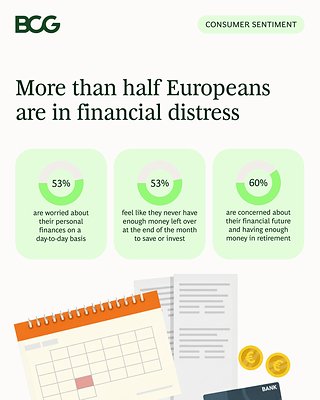
This pessimism translates into financial distress: 53% of European consumers are worried about their daily personal finances, up from 40% in 2024. Six in ten are concerned about having enough money in retirement.

Amid financial pressure, 63% of European consumers will only buy at a discount or actively seek deals, and 62% will switch brands for a better price. That erosion in brand loyalty is reflected in recent purchasing behavior: 44% say their most recent purchase was from a new or unfamiliar brand.

These findings are from the third annual European Consumer Sentiment report from Boston Consulting Group (BCG), titled European Consumers Are Still Cutting Back. The report is based on a survey of more than 20,000 consumers across 11 European countries.

“For a third straight year, European consumers are feeling pessimistic about the economy, and that caution is becoming increasingly embedded in spending behavior,” said Andreas Malby, leader of BCG’s Consumer practice in Europe, the Middle East, Africa, and South America, and a coauthor of the report. “Consumers are pulling back in discretionary categories while protecting the purchases they see as essential, particularly around groceries, pet care, and health and wellness.”

Spending Cuts Across Nearly Every Category

Across 12 categories, groceries (+11 points) and pet care (+12) are the only categories posting positive net spending over the past six months. This is driven by price increases more than volume growth. Every other category is flat or declining, with the steepest cuts in fashion (–25), alcohol (–23), and packaged snacks (–18).

Older generations are cutting discretionary spending significantly more than younger consumers, with net spending over the next six months at –13 points for Gen X and Baby Boomers, compared with –2 points for Gen Z and Millennials.

Across generations, the spending pullback may persist even if economic conditions improve. Given a hypothetical windfall of 10% to 15% extra income, nearly half of consumers say their top priority would be to save rather than spend.

Financial pressure is also pushing more consumers toward second-hand purchases. Nearly half of Europeans (47%) buy second-hand products. Among them, 46% cite saving money as the primary motivation, compared with just 17% who cite environmental concerns.

Health and Wellness Spending Remains Resilient

While spending is cut across categories, health and wellness remain nonnegotiable:

  • Two-thirds of consumers say health and wellness are extremely important, with 29% spending more on supplements in the past year. Nearly half (46%) report consuming less alcohol or considering it.

  • Many are holding pet food to higher standards than their own. Six in ten say they are willing to spend more on high-quality pet food, and 68% want clearly recognizable ingredients listed on labels.

  • Nearly three-quarters (74%) of Europeans now recognize GLP-1 appetite-suppressing medications, and one in four report either using them or seriously considering doing so.

Digital Channels Reshape Product Discovery

The use of generative AI (GenAI) tools in product discovery has quadrupled since 2024, with 8% of consumers now regularly using them when researching purchases. Social media is the fastest-growing discovery channel overall, particularly among younger consumers. Both GenAI and social media are growing at the direct expense of general internet search, which is flat to declining across every category.

“European consumers are scrutinizing every purchase more closely than they did a few years ago,” said Malby. “Brands that stand out will be the ones that clearly demonstrate value, build stronger relationships with Gen Z and Millennial consumers as their spending power grows, remain discoverable across digital channels, and respond to growing consumer interest in health and wellness.”

Download the publication here:
https://www.bcg.com/publications/2026/european-consumers-are-still-cutting-back

Media Contact:
Kendall Kosten
kosten.kendall@bcg.com

About Boston Consulting Group
Boston Consulting Group bridges the gap between ambition and outcomes for the world’s leading companies and organizations. We are built for this era of unprecedented change — bringing strategic clarity rooted in over 60 years of deep domain knowledge, combined with applied AI shaped by our practitioners. BCG works shoulder-to-shoulder with CEOs across industries and geographies to deliver transformative impact at scale: stronger returns, transferred capabilities, and change that sticks. For more information, visit bcg.com.

Boston Consulting Group logo
Cision
Cision

View original content to download multimedia:https://www.prnewswire.com/news-releases/more-than-half-of-europeans-are-worried-about-their-personal-finances-driving-spending-cutbacks-302794556.html


Source link

Related posts

Top 50 Investment Bankers in India Leading Fintech Investments

D.William

How Record Q1 Copper Profitability And Dividend Move At Teck Resources (TSX:TECK.B) Has Changed Its Investment Story

D.William

AIUB Finance Club Hosts Inauguration and Member Orientation Ceremony

D.William

Leave a Comment