
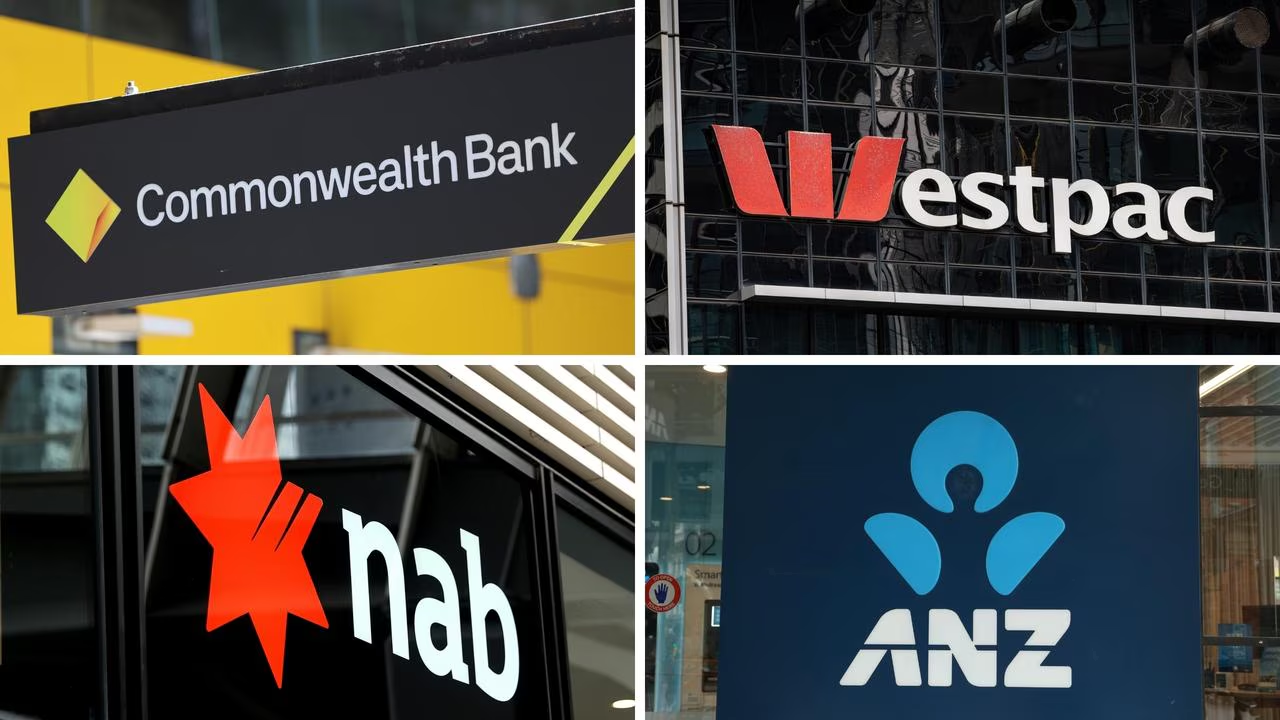
It takes a special level of bravery or foolishness to short stocks, and another level still to bet against the big four banks of Australia, which have a combined value of more than $655 billion.
However, that’s what hedge funds – which use investor funds in aggressive and complex ways to generate money, even when a market crashes – are doing in record numbers.
Amid concerns the Commonwealth Bank, Westpac, NAB and ANZ are seriously overpriced and dangerously exposed to a housing slump brought on by new tax rules, they have doubled their short positions in the past six months to almost $11 billion.
It’s the biggest short position since the corporate regulator, the Australian Securities and Investments Commission (ASIC), began collecting data on hedge funds in July 2010.

A short position is when you bet against a stock and make money when it crashes, as opposed to a long position, where you make money if the stock price goes up.
According to the latest ASIC daily aggregated short position reports, short sellers have locked in over 35 million CBA shares and nearly 60 million Westpac shares, culminating in an institutional bet of $10.6 billion against the structural stability of Australia’s banking elite – an elite that controls over $4 trillion of assets.
Commonwealth Bank is the overwhelming focal point of the bears, commanding $5.66 billion, or more than half, of the entire short campaign. Westpac sits as the second most targeted at $2.12 billion, with National Australia Bank close behind. Meanwhile, ANZ has largely been spared, accounting for 8 per cent of the shorted capital.
The true size of the short position is likely significantly higher than reported as hedge funds are executing their bearish bets via over-the-counter (OTC) derivatives, such as total return swaps, which completely bypass ASIC’s standard reporting requirements.
The ‘widow-maker’ trade
It’s a dangerous position to short big banks, a strategy known in the industry as the “widow-maker” trade, because if the value of the banks’ share prices rise, the short seller is forced to post ever-increasing amounts of cash into their margin account that can leave fund managers on the brink of a heart attack.
David Allen, a portfolio manager at Plato Investment Management, which holds $23 billion in funds, told news.com.au the record short position building against the banks was “inevitable”.
He said his fund is not actively shorting the big four at this moment, but there are serious concerns among hedge funds about their “extreme valuations” amid tax changes that have rocked the housing market, the main driver of the banks’ profits.
“I don’t think they’re in trouble, but the valuations were extreme. Everyone knew they were extreme,” he said.
“Commonwealth Bank was arguably the most expensive bank in the world. This was really inevitable, the hedge fund community has just been waiting for an entry point where things start to get a bit softer.”
He said shorts had pounced because the domestic economy is flashing warning signs, with GDP growth slowing and bank net interest margins – the difference in the money they make on loans versus what they have to pay to savers – clearly peaking.
‘150 red flags’: What shorters are looking for
Mr Allan said Plato hadn’t shorted the big four at this point in time because the banks were still strong on paper. In analysing a stock, it would have to rack up dozens of “red flags” in Plato’s internal system before managers would consider directly betting against them.
“For us to go short, we want to see stretched valuations, that’s a tick. Negative sentiment, that’s a tick. But we also want to see a large number of red flags,” Mr Allen said.
“A key part of our process is 150 red flags that are totally systematised. It might be undisclosed related-party transactions, extremely aggressive accounting, or maybe the stock price is weak while directors are offloading a whole lot of their stock.”
Because the big four banks remain robust, well-regulated corporate behemoths, they fail to trigger these fundamental warnings.
“At this stage, the big banks are still high-quality businesses, so we’re not running out to take short positions,” Mr Allen said, describing the current landscape as a standard asset correction rather than a structural collapse.
“This is much more of a correction type situation … much like you saw in the tech sector at the start of the year.”
However, he said Plato is “underweight” on the big four — meaning they hold only a tiny long position on them. That is unusual when compared to the big super funds and exchange traded funds that millions of Aussies own and are heavily exposed to the value of the big banks.
Mr Allan said there were better opportunities to make profits by investing in overseas banks.
“Plato Global Alpha is a global strategy. Commonwealth Bank makes up just 0.2 per cent of the global benchmark,” he said.
“We actually don’t hold any long, and we don’t hold any short either. We are technically underweight because there are much better opportunities out there.
“If you want a great bank, you invest in something like BNP Paribas (a French multinational universal bank). They trade at less than one times book value compared to CBA that trades above three times, yet BNP Paribas’ net interest margins are 30 per cent higher. If you want exposure to good banks, there are much cheaper options than what we have domestically.”
Tax changes the ‘straw that broke the camel’s back’
While there have been warnings about the big four banks being overvalued for some time, experts say the catalyst that may have triggered this record multi-billion dollar pile-on from short sellers could be the federal budget’s proposed changes to negative gearing and capital gains tax (CGT).
We are already seeing the effects of the changes playing out on the housing market in real time, with plummeting clearance rates leading to the weakest auction marketplace Australia has seen since the early days of Covid and house prices dropping.
The Aussie banking sector is heavily reliant on residential property loans, so a weaker housing market would hit their main source of profit.
Shane Oliver, chief economist at AMP, said the changes, combined with high interest rates, mean the big four face strong headwinds.
“The shorts are placing a bet against the banks on the back of concerns that they’re overvalued, and that the tax changes will mean less demand for investor finance,” he told news.com.au.
“It could be a dampener on the property market. And of course, we’ve got high interest rates, which could also dampen demand for housing finance, all of which work against the banks.”
Mr Allan said concerns about the housing market could be throwing rocket fuel on short positions against the big four.
“Valuation is the kindling really, but the match is arguably the tax changes that have come through. This is more of the straw that broke the camel’s back rather than the key rationale in the first place,” he said.
“They were just far, far too stretched beyond any reason or justification. They’re being priced as growth companies, and they’re anything but.”
Uncertainty is one of the biggest bugbears for investors and Labor’s proposed tax changes represent uncharted territory for modern Australian real estate.
Mr Oliver said the last time negative gearing was dismantled was briefly between 1985 and 1987, but that was too long ago to make any meaningful comparisons to today.
“That’s a long time ago,” he said.
“And it didn’t coincide with other major tax changes at the same time. There’s a bit more uncertainty this time around for the property market, and hence for the banks. There’s no doubt they are exposed to it.”
Could we see a GFC-style collapse?
The words ‘big short’ likely conjure flashbacks to the Oscar-winning 2015 movie by the same name that details how the US banking system collapsed in 2008 — sending the entire world into financial oblivion.
At the height of the Global Financial Crisis (GFC), the mortgage default and delinquency rates in America reached catastrophic levels and the movie follows the story of the brave investors who made billions by betting against the system in the years that led up to it.
The crisis was sparked by a house of cards-style collapse of mortgage bonds held by big banks that were made up of dodgy home loans given to Americans who could never pay them back.
There are worrying signs here in Australia. Recent research from Roy Morgan shows up to 30 per cent of Australian mortgage holders are classified as “At Risk” of mortgage stress (meaning they are spending an unsustainable portion of their after-tax income purely on servicing their home loan).
Mr Oliver said that at the same time, more Aussies are struggling to pay their loans and the housing market is faltering, and the safety nets of the past are fraying.
“On previous occasions, the property market was rescued to some degree by a resumption of rate cuts or a surge in population,” he said.
“This time around, rate cuts might be a fair way off, probably not until the second half of next year. Population growth is slowing down, and there’s political pressure to slow it further.
“The bigger issue would come if the property slowdown coincided with a sharp rise in unemployment, leading to negative equity in some loans, and therefore an increase in non-performing loans.
“That’s the more severe scenario, where prices come off by 20 per cent or something like that. Then you end up with a more negative property cycle, and banks could suffer higher levels of non-performing loans.”
Mr Oliver said he believed the risk of that happening is “fairly low, but it’s not insignificant”.
Mr Allan and Mr Oliver agreed that, although the position against Aussie banks is at record levels, the shorts are predicting a valuation correction on the big four rather than a complete collapse like we saw in the GFC.
They say this is because banking and borrowing in Australia is heavily regulated, meaning there are more safety nets for those falling behind on their loans.
And, while mortgage stress levels are high, the US saw much scarier figures in its housing market even in the years preceding the GFC.
At its absolute worst, the US system saw more than one in 10 homes facing delinquency. Australia’s current total non-performing loan rate sits at just 1.1 per cent.
‘Infinite losses’: Dangerous game, supers exposed
Although experts are not predicting a collapse, a sharp drop in the shares prices of the big four would hit super balances hard as Australia’s largest profit-for-member industry and public sector funds hold tens of billions of dollars in bank equities.
If there was a large correction in the share prices of the banks, millions of super holders would be exposed, meaning they would likely take a hit to their balances.
The stock market would be smacked too, as the Australian banks now account for 22 per cent of the ASX 200.
However, if it goes the other way and the stock prices rise, spare a thought for the poor buggers who shorted them.
A share price spike could see them lose up to $5 billion in a matter of days, but that would only be the start.
When you short a stock, your risk is mathematically infinite, because if you short a stock at $10 hoping it goes to $0 and the stock explodes, you still have to buy that stock back at the higher price at a massive loss.
When a bunch of short sellers all panic and try to buy back the stock at the same time to cut their losses, it drives the price up even faster. This nightmare scenario is called a “short squeeze”.
Mr Oliver said the threat of that happening is very real, warning the global hedge funds currently shorting the banks may have backed themselves into a corner.
He said that a price spike in the big banks would trigger something called a “short covering rally”, prompting short sellers to buy back shares to lock in profits or minimise losses. It’s a bit like a “short squeeze” but less panicked.
“The one contrary view is that often when you’ve got huge short positions built up, it doesn’t take much to send the prices higher,” he warned.
“Some good news comes along, and then investors have to close down their short positions by buying back the stock, which fuels a further rebound. In other words, the banks could have a bounce before they eventually correct more substantially.”
News.com.au reached out to the big four banks for comment on the record short position. All of them declined.