
Migration outpaces housing construction nearly three-to-one, intensifying Australia’s supply crisis
A severe supply-demand mismatch is gripping the Australian property market, as incoming migration levels outpace net new housing construction by nearly three to one.
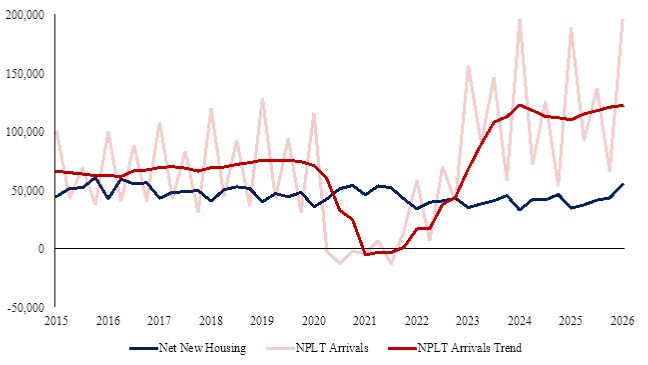
According to a fresh analysis of Australian Bureau of Statistics (ABS) data by the Institute of Public Affairs (IPA), net permanent and long-term overseas arrivals reached 489,300 for the 12 months ending March 2026. Over the exact same period, net new housing supply added just 174,500 dwellings to the market.
The data highlights a widening deficit that presents both immense rental demand for the real estate industry and a structural bottleneck that is actively freezing out first-time homebuyers.
The March quarter mismatch: by the numbers
The quarterly breakdown highlights an escalating imbalance, showing that the volume of incoming residents is overwhelmingly eclipsing new builds:
- The March 2026 Quarter: Net new housing supply stood at 54,200 dwellings, while net permanent and long-term overseas arrivals surged to 193,780.
- The 12-Month Trajectory: Total housing additions reached 174,500, completely dwarfed by 489,300 long-term arrivals.
- The 10-Year Decline: Remarkably, Australia’s capacity to build homes has retrograded. In the 12 months to March 2016, net new housing supply was higher at 204,400 dwellings—meaning net new housing supply today is approximately 14.6 per cent lower than it was a decade ago.
- The Migration Spike: Conversely, between 2016 and 2026, net migrant arrivals (not including tourists) increased by 96.65 per cent, from 247,290 to 486,300.
“The government’s commitment to cut migration in order to get more Australians into homes has been shattered by the latest official data showing net permanent and long-term overseas intake has about tripled housing supply over the year to March 2026,” said Dr Kevin You, Senior Fellow at the Institute of Public Affairs.
“We are building fewer homes than we did a decade ago, but we are bringing in more migrants than ever before. This is why young Australians are struggling to get a house of their own,” said Dr You.
This acute residential squeeze aligns with broader macroeconomic findings detailed in the IPA’s report, Decline: A Snapshot of the Australian Economy in the 2020s.
The report details how a sluggish housing construction sector has combined with record migration to trigger an estimated cumulative supply shortfall of more than 179,000 homes between 2022 and 2024.
For real estate professionals navigating the inventory drought, the report identifies the core structural systemic blocks delaying supply:
1. Escalating build times and material costs
The industry is battling severe structural friction. In the financial year ending 2024, the time needed to build a new house was 50 per cent longer than in the financial year ending 2014. The material cost of building a house was also more expensive, by 53 per cent over the period.
2. Forced urban densification
Over the past two decades, Australia has undergone a deliberate shift toward planned urban densification. Between 1999 and 2021, the proportion of detached homes declined from 80 per cent to 70 per cent, while the share of townhouses, units, and apartments increased from 20 per cent to 30 per cent.
Alarmingly for the industry, growth in building approvals between the 2024 and 2025 financial years reveals that only 29 per cent are attributable to detached homes, with the rest (71 per cent) attributable to other types of dwellings such as units and apartments.
Meagre growth in housing approvals is disproportionately focused on the types of dwellings that Australian families do not aspire to live in.
3. Record-low vacancy rates
The extreme pressure on stock has permanently altered the rental landscape. While residential vacancy rates averaged about 2.4 per cent between the calendar years 2014 and 2019, they plummeted following the pandemic, hovering at barely 1 per cent, with the vacancy rate recorded at 1.2 per cent in August 2025.
First-home buyers locked out
For real estate agencies, the long-term impact on transaction profiles suggests first-home buyers are being systematically priced out, reshaping the traditional buyer demographic.
The report underscores that the average price of a home in Australia exceeded $1 million for the first time in the December quarter of 2024. In New South Wales, the average price of a home reached $1.27 million as of the end of the 2025 financial year, forming an intractable barrier to prospective first-time buyers.
Consequently, the median age of Australia’s first home buyers skyrocketed from 24.5 in the year 2000 to 34.5 in 2022.
Furthermore, as of the 2021 census, home ownership among Australians aged 30 and 34 was down to only 50 per cent.
“Australians are tolerant and welcoming, and migrants have played an important part in our national story. But a functioning migration programme must be properly planned, have the consent of the community, and be targeted towards areas of economic need. The federal government has evidently failed on all three counts.”