
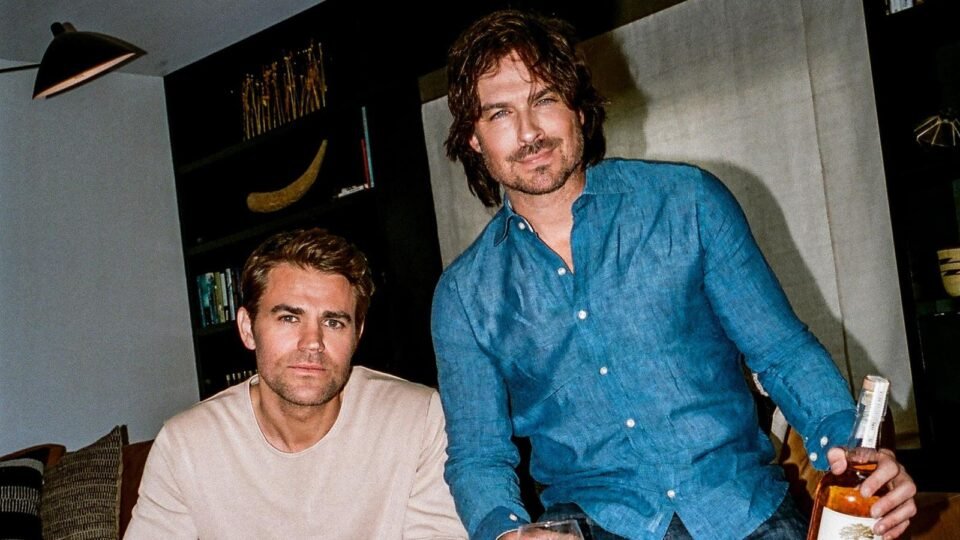

Paul Wesley and Ian Somerhalder of Brother’s Bond Bourbon
Brother’s Bond
For a business born, at least partly, from television mythology, Brother’s Bond’s most interesting story is no longer the obvious one.
Yes, Ian Somerhalder and Paul Wesley are still, to millions, Damon and Stefan Salvatore: the immortal brothers of The Vampire Diaries, forever locked in a handsome, brooding push-pull of love, rivalry and dangerously sharp cheekbones. And yes, their whiskey brand catches the cultural residue of that relationship with purpose. But Speak to Somerhalder and Wesley about Brother’s Bond now, and the register changes quickly.
The show is there, naturally. The friendship is there, emphatically. But so are grain bills, regenerative rye, global travel retail, duty-free strategy, European distribution, airport activations, hospitality positioning and the strange thrill of seeing your own bottle on a shelf in Frankfurt before buying it to take to family in Poland, as Wesley did the day of our interview.
Five years on from its initial US launch, the funny thing about Brother’s Bond is that the bigger the business becomes, the more useful its origin story gets. Before the UK rollout, trade shows and distribution deals, it was just two actors in Atlanta, spending too much time together, drinking.
“It honestly came from time spent together on set in Atlanta, long conversations, a lot of laughter, and a shared appreciation for bourbon,” Wesley says. “Our characters on the series drank bourbon, and we also shared that same bond off screen. At some point, we realised we wanted to create something that captured that feeling.”
Somerhalder tells the same story with a more obsessive kind of enthusiasm. For him, the spark was “curiosity and respect for the craft.” He and Wesley, he says, spent years sharing bourbon and talking about it before the idea became real. Then came the work; visiting distilleries, playing with mash bills, tasting endlessly and hand-selecting the whiskeys that would eventually go into their blends.
“We knew exactly what we were chasing—a bourbon with elegance and balance, smooth but complex, something a serious enthusiast would respect but anyone could enjoy,” Somerhalder says.
And, honestly, that’s the whole commercial tension of Brother’s Bond. The brand has always had an obvious first audience: the people who loved Somerhalder and Wesley before they ever cared what they drank. But the ambition was never to stop there. Bourbon has its purists, collectors and gatekeepers as much as it almost has people who like the idea of whiskey but have yet to be invited into the category. Brother’s Bond is trying to meet both groups at once.
The proof, Somerhalder says, began at his kitchen table, where he and Wesley blended the bourbon themselves over the course of a year. They started with the name, found the right glass bottle, designed the label and kept working until the liquid made sense. When they finally landed on the four-grain profile they wanted, they nearly drank the evidence.
“We loved it so much we nearly drank the whole sample—the lab needed about 100ml to analyse it and we’d left ourselves barely 28!” Somerhalder says. “Luckily I write everything down as we go, so I could rebuild it almost to the millilitre. That’s how we knew it was right: we couldn’t stop drinking it.”
Brother’s Bond Bourbon
Brother’s Bond
“There’s no performance,” Wesley adds. “You either have a great product or you don’t. You can market it all you want but if you don’t have a great product, people will not become real fans of the brand.”
Somerhalder puts it in terms of the world they came from. “It’s the same with acting: if it’s not on the page, if the script isn’t there, no amount of performance will save it.”
Quickly, it becomes evident that Somerhalder and Wesley are anything but interchangeable co-founders. Wesley is drier, more economical, often more pragmatic. Somerhalder is more expansive, the one who can move from flavour to farming to global storytelling in a single answer. Asked how their friendship translates into business decisions, Wesley gives the cleanest character note of the interview: “Ian is always glass half full and I’m half empty. I always look for the flaws and improve upon them and he tries to enhance the positives.”
That difference matters. Somerhalder pushes outward; Wesley pushes in. One brings the sweep, the other the edit. Wesley calls the Vampire Diaries association “a double-edged sword”.
“It opens doors, but then you have to work ten times harder to prove you’re worthy of them,” he says. “So the effort isn’t about distancing ourselves from that chapter—it’s about earning credibility in a completely new world on its own terms.”
Ian Somerhalder and Paul Wesley carrying Brother’s Bond Bourbon
Brother’s Bond
Somerhalder sees less of a divide between the two worlds. “The friendship and the way we work together came directly out of those years—we spent thousands of hours solving problems side by side, and that’s exactly what building a whiskey company takes,” he says.
The wider question, now that the brand is expanding into more and more European markets, is where bourbon belongs outside its most familiar settings. Wesley says different cultures read the brand differently. In some countries, whiskey already has a natural audience. In others, tequila or gin is more popular, meaning they “sometimes need to convince people to try bourbon for the first time.”
One answer is to change the occasion. Brother’s Bond recently launched a partnership with Santa Marina in Mykonos, a setting that doesn’t exactly scream bourbon, but managed to do so by positioning Brother’s Bond as a key cocktail ingredient. “The four-grain mash bill makes it balanced enough to hold its own in an Old Fashioned, but soft enough to work in longer, sunnier serves—spritzes, highballs, something on a terrace at golden hour,” says Wesley.
Global travel retail does a similar job, too, only at scale. “It is genuinely one of the hardest spaces in the world to break into,” says Somerhalder. “Without a big budget or a way in, you simply don’t get there—so being part of it still feels surreal.”
The brand has also moved beyond a single bottle. Its portfolio now includes its original Straight Bourbon Whiskey, an American Blended Rye, a Bottled-in-Bond Straight Bourbon and a Regenerative Grain Straight Bourbon, build enough depth for different drinkers, serves and markets.
The Brother’s Bond range
Brother’s Bond
For Somerhalder, the most serious part of that future sits in the grain. Particularly regenerative agriculture. Asked what he has had to learn quickly, he speaks of “how interconnected everything is—from agriculture to production to distribution, every single detail matters,” he says. “The regenerative side taught me that fastest.”
The company harvests certified-organic regenerative rye in Indiana, then malts and distils their own regenerative grain. “That is not the norm for a company our size—most people don’t go near it,” he says. “But what amazed me is how directly it shows up in the glass: when the distillate is that pure, you lean on the barrel less, you use less char, and the grain gets to speak for itself.”
Somerhalder nails the brand’s craft argument; not in saying regenerative farming is good for the soil, which it is, but saying it changes the whiskey. “You realise nothing happens in isolation—the soil, the farming, the barrel, the blend, it’s all one continuous chain,” he says. “Every choice upstream ends up in the bottle.”
Wesley’s education has been less lyrical, but just as useful. “How much goes into the operational side,” he says. “It’s not just creative. It’s logistics, timing, execution. It’s a lot of work, overwhelming at times.”
Ian Somerhalder drinking Brother’s Bond Bourbon
Brother’s Bond
And yes, in my opinion, the bourbons are brilliant. But I’m not the only one to think so.
Wesley says the brand grew around 40% over the past year, pointing to markets including the UK, Germany, Italy, Greece, Cyprus, Japan and Taiwan as part of the current momentum. What excites him now is not expansion as a line on a chart, but “getting the bourbon into more hands, in more places, and seeing what people make of it.”
Somerhalder is careful about that growth. “I never want growth to outrun quality,” he says. “We’re in some incredible new markets now, but the goal is always to do it in a considered way, not just plant flags.” The regenerative work, he adds, feels like the future: “building something that grows globally but stays rooted in how it’s made.”
That, in the end, is the better Brother’s Bond story. All that has happened after the built-in audience paid attention. And all the industry-smashing moves that might happen next.