
Synopsis: The Q1 report noted that despite ongoing global and regional uncertainties, Cambodia’s public financial management reforms continued to advance in line with the government’s reform action plan.
Cambodia collected 25.9 percent of its annual revenue target and executed 22.64 percent of planned expenditure in the first quarter of 2026, with the Ministry of Economy and Finance (MEF) projecting total revenue collections to reach around 102.5 percent by the end of the year.
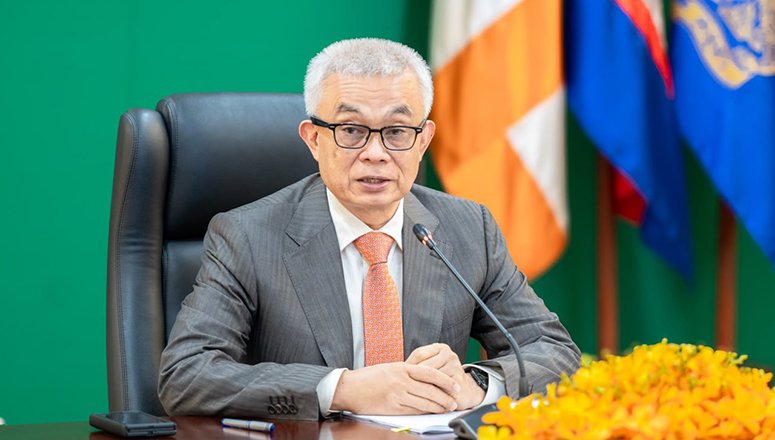
The update was presented during the Public Financial Management Reform Steering Committee (PFMRSC) meeting, chaired by Aun Pornmoniroth, Deputy Prime Minister and Minister of Economy and Finance (MEF), and also Chairman of PFMRSC, in Phnom Penh on June 15.
According to an MEF press release, the meeting reviewed progress under the ‘Public Financial Management Reform Program (PFMRP) Phase-Four’ in the first three months and discussed priorities for the remainder of the year.
The Q1 report noted that despite ongoing global and regional uncertainties, Cambodia’s public financial management reforms continued to advance in line with the government’s reform action plan.
A key indicator of progress was budget reliability. Current revenue reached 25.9 percent of the annual target during the first three months, supported by growth in key sectors, including finance and banking, and modernisation of revenue collection and management systems.
Based on the Medium-Term Fiscal Framework 2027-2029, the government expects total revenue collection to reach approximately 102.5 percent of the target established under the Law on Finance Management 2026. Meanwhile, national budget expenditure reached 22.64 percent of the annual allocation.
The report showed expenditure implementation remained disciplined, supported by clear spending priorities, accurate cash flow planning and the absence of major disbursement bottlenecks.
Budget execution and disbursement processes were carried out smoothly, reflecting improvements in operating procedures and the modernisation of financial management systems.
The meeting also reviewed progress in strengthening financial accountability through the expansion of the Integrated Financial Management Information System (I-FMIS), reforms to accounting and reporting systems, and efforts to accelerate the preparation of payment documents and national financial statements for audit by the National Audit Authority (NAA).
Based on the report, core FMIS functions and streamlined business processes are being implemented as planned, while reporting functions continue to be enhanced in line with budget implementation guidelines and the FMIS Phase-Four.
Another area of progress was budget planning, which has become more closely aligned with policy priorities through improved allocation formulas between national and sub-national administrations and better prioritisation of expenditure programmes and projects.
The Medium-Term Financial Framework (MTFF) and Medium-Term Budget Framework (MTBF) are now regularly prepared for discussion and approval, providing greater transparency regarding forecast revisions, expenditure priorities and project selection.
The preparation of strategic budget plans and annual budget proposals has also been strengthened through reviews conducted by the General Department of Budget (GDB) of MEF.
The Q1 report further highlighted progress in developing the procurement information budget system, which incorporates procurement management, financial oversight, information technology monitoring and public disclosure of budget information.
However, officials acknowledged that the system remains under development and requires further support to strengthen procurement accountability, internal audits and financial control mechanisms.
In addition, the sustainability of the reform agenda has been reinforced through the implementation of the Royal Government circular on procurement management and the sub-decree on the Qualifications of Public Financial Management Officers.
Authorities have also identified training needs for public finance officials and developed a roadmap linking capacity-building programmes to professional positions.
Based on the first-quarter findings, Pornmoniroth called for stronger expenditure management, the preparation of the medium-term budget framework for sub-national administrations, and the full implementation of FMIS-based financial management and budget execution procedures.
The Deputy Prime Minister also urged expansion of budget units with delegated authority, assessment of Cambodia’s public financial management system under the Public Expenditure and Financial Accountability (PEFA) framework, and closer cooperation with development partners to further strengthen the reform process.