
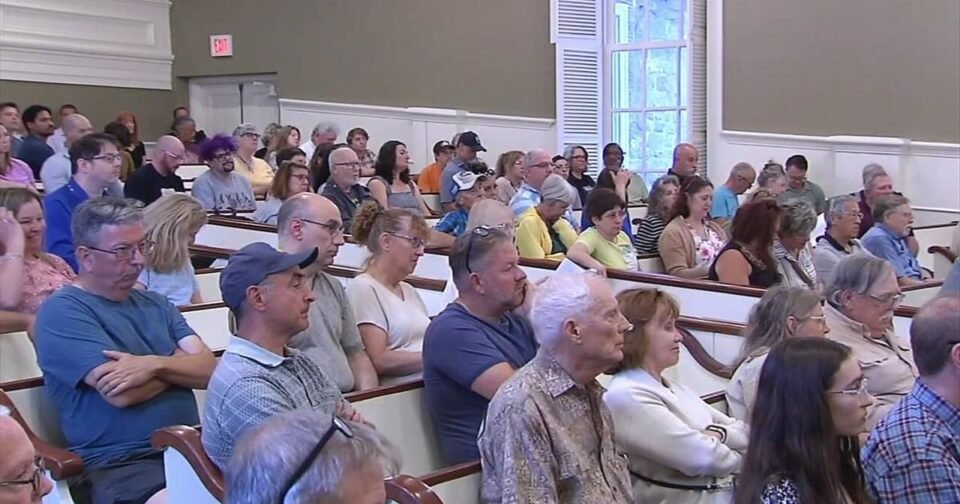
ALLENTOWN, Pa. – The Lehigh County Board of Commissioners finance committee held a hearing on a newly proposed tax Wednesday night at the Historic Lehigh County Courthouse.
The “Intangible Personal Property Tax,” also commonly known as the “wealth tax,” would allow the county to acquire an additional $25.5 million each year in revenue by taxing Lehigh County residents on their various assets.
Controller Mark Pinsley said the county’s revenues have been unable to meet its spending habits for a sustained time period.
“This year, I think we’re overspending by $3 million,” Pinsley told WFMZ during a recent interview. “I think next year is proposed $5-and-a-half million.”
To solve the deficit, Pinsley issued a report examining an “alternative path… to study the idea of having something other than a property tax” to provide Lehigh County with new, consistent and additional funding. Without a new tax, Pinsley said, the county would have to raise property taxes or reduce spending.
The legal basis for the new tax is Pennsylvania’s 1913 Intangible Personal Property Tax statute. It provides the opportunity to impose up to a 4 mil tax on selected intangible financial assets. However, some have questioned whether the tax would withstand legal challenges.
Proponents said working families would be protected under this plan. Pinsley said the proposed tax will be on passive income and assets such as stocks, bonds and second homes, while exempting primary homes and 401(k) savings. In addition, proponents indicated it would help address Lehigh County’s economic inequality and pay for more county services for the most vulnerable individuals with a marginal middle class impact.
Opponents said the “wealth tax” is a new version of an old scheme to acquire more money for the county government. Further, they argue, many proponents of the tax will have buyer’s remorse when they discover their own investments could be subject to the tax, or that they would be considered “wealthy.”
Expert opinions
Wednesday night’s hearing featured “financial experts” who reached different conclusions about the same proposal.
Steve Herzenberg, an economist with Keystone Research Center, endorsed the tax proposal as a mechanism to “mitigate or reverse the growth of inequality in the last 30 years.” He called the current tax system “upside down” and one that favors the wealthy who don’t pay their fair share.
“Given the extreme concentration of financial wealth, a flat intangible wealth tax would fall overwhelmingly on a tiny fraction of the wealthiest taxpayers,” Herzenberg said.
With the additional money, he said, Lehigh County could use some of it to lower property taxes for most people. This would actually benefit all Lehigh County residents because the government would improve quality of life and facilitate more rapid wealth growth thanks to the new tax, he said.
“If you have a small financial wealth tax, and then you use a small portion of that to lower property taxes — if you do it right — you can get a combination of the revenue the county needs and still lower taxes for the overwhelming majority,” Herzenberg said.
On the other hand, Asher Schiavone, director of government affairs with Greater Lehigh Valley Realtors, said assets the tax could be imposed on include stocks, bonds, mutual funds, exchange traded funds, brokerage investment accounts, certain passive business equity interests and comparable financial assets. Most people have some or many of these assets, he said.
“Overspending by $3 million sounds like an expense problem, not a revenue problem,” Schiavone said.
He also said the new tax will not lower housing prices.
“This tax will make housing less affordable,” Schiavone said.
He added the new wealth tax could drive out local rental property owners and replace them with “Wall Street investors.”
“LLCs and rental properties are retirement investment vehicles,” Schiavone said.
Commissioner feedback
Finance committee members in attendance questioned each expert following their statements. Lehigh County Executive Josh Siegel followed with a statement, noting that the proposed tax is not being considered for the 2027 budget; he said this phase of discussions is meant to explore what can be done differently.
The meeting experienced various audio problems as commissioners attending virtually indicated they could not hear nearly any of the evening’s presenters.
Commissioners then offered their comments. Opponents included Commissioners Ron Beitler, Geoff Brace, Dan Hartzell and Antonio Pineda.
Pineda pointed out that the tax, which was previously used in the early 1990s, faced a wave of lawsuits before it was abandoned. Beitler said when the county voted to end the tax in 1992, it only brought in $2.5 million in revenue.
Commissioners Sarah Fevig and Jon Irons said it was not possible to support or reject a bill that does not yet exist. Fevig took it one step further, saying any Intangible Personal Property Tax bill would have to prove its worth to gain her support. She said having the discussion and acquiring information about the concept were beneficial.
In their own styles, each commissioner acknowledged that many Lehigh County residents are financially struggling, that income inequality is a problem, that Lehigh County provides important services to many people, and that tax reform at both the state and federal level is needed.
Most Lehigh County residents who spoke during a public comment session opposed the proposed Intangible Personal Property Tax.
The finance committee did not render a vote on the wealth tax proposal during Wednesday night’s meeting.