
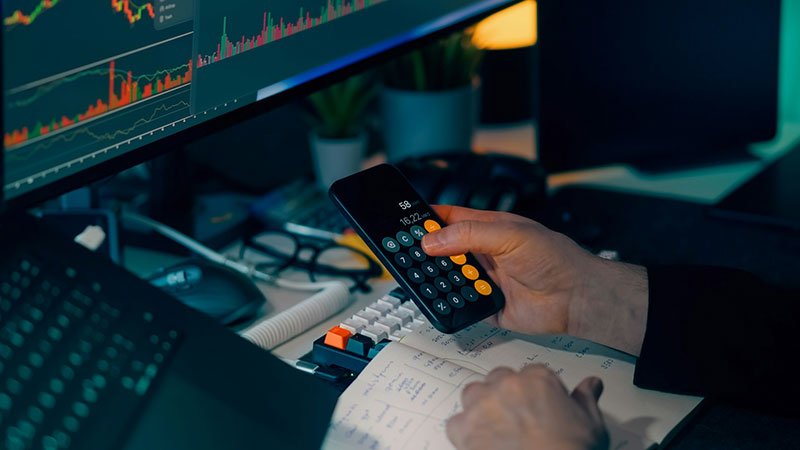
Somewhere on a trading desk this morning, a model read every earnings call that dropped overnight, flagged the three filings that quietly walked back last quarter’s guidance, wrote the summary, and watched the order book for slippage. Then a person clicked buy. That click, the last step in the chain, is where the whole story of AI in the markets currently lives.
Nearly every large fund now runs on AI somewhere in the building. Almost none of them let it make the call. About 95% of hedge funds use generative AI in their workflow, up from 86% a year earlier, according to the Alternative Investment Management Association. Yet only around 5% of asset managers hand a model any autonomous or semi-autonomous authority over decisions, per a 2026 Mercer survey. The machines do the homework. People still sign the trades, and that distance is the most interesting number in finance right now.
How far has AI actually spread on the buy side?
Further than the skeptics assume. 61% of traders now rank AI as the single most important technology in their work, up from just 25% in 2022, according to J.P. Morgan. More than half of asset managers, 55%, use it in at least one investment process, per Mercer.
And the market’s plumbing was automated long before the chatbots arrived. More than 70% of spot foreign-exchange orders on the main inter-dealer platforms are now submitted by algorithms, the Bank for International Settlements reports. The patent trail says the same thing: over half of all algorithmic-trading patents filed each year since 2020 contain AI, up from 19% in 2017, according to the IMF.
Those figures come from AI in finance statistics for 2026, a compilation that pulls together more than fifty sources across markets, banking and insurance. The pattern in all of them rhymes. Adoption is close to total. Authority is close to zero.
So why won’t anyone let it decide?
Because efficiency is proven and edge is not. Only 8% of asset managers report a measurable improvement in investment returns from AI, even though 69% report efficiency gains, according to Mercer. Read those two numbers together and the 5% autonomy ceiling stops looking like timidity. A model that is fast, tireless and confidently wrong at size does more damage than a human who is wrong at human speed.
There is also the question of who answers for a loss. A portfolio manager can be hauled in front of an investment committee, a compliance officer or a regulator and made to explain a decision. A model cannot, and “the system did it” has never been an acceptable answer when client money is gone. As long as accountability lands on a person, that person tends to want the final say.
Think of the cockpit. Pilots let the autopilot handle the long, boring middle of a flight and keep their hands near the controls for takeoff and landing, the parts where being wrong is expensive. The buy side has settled into the same arrangement with its models. AI writes the note, screens the universe, watches the tape. The human keeps the trigger.
What is the risk nobody is pricing?
Everyone leaning on the same brain. If 95% of funds run similar models, trained on similar data, prompted in similar ways, their conclusions start to converge. In a calm market you never notice. In a sell-off, correlated models can nudge a crowd of funds toward the same exit in the same second.
Crowded trades are an old problem. What is new is the speed and the silence: the herd no longer has to phone each other to agree, because they are all reading from versions of the same playbook. From that angle, the firms that keep a human on the decision are managing a risk the headline adoption number hides.
Where is AI genuinely earning its desk?
In the unglamorous work that never makes the pitch deck. Research synthesis, idea generation, coding and testing strategies, monitoring positions, drafting the compliance memo. This is where the 69% efficiency figure shows up, and it is real money. A three-person team can now cover ground that used to take ten.
The payoff today arrives as speed and lower headcount: the same trade, reached faster and by fewer people. That is genuinely valuable, and it is also why the technology has spread so fast while the autonomy line has barely moved. Saving time is easy to measure and easy to trust. Beating the market is neither.
Is the money following the machines?
Yes, and it is flowing toward AI whether or not the returns are in. 60% of institutional investors say they are more likely to allocate to funds with a meaningful generative-AI budget, according to AIMA, and 90% expect AI to lift performance for at least some managers within three years. An AI program has quietly become a fundraising prerequisite. A fund without one now has to explain the gap in due diligence, even while the link to returns stays mostly a promise.
The funds themselves are not slowing down either. 58% of hedge funds expect to expand their use of AI inside the investment process, per AIMA, which means the adoption figure that is already near total still has room to deepen. From here, what separates one fund from the next is how much of the investment process each one trusts AI to run.
The same shift is reaching ordinary investors through robo-advisors, which now manage about $2.06 trillion across roughly 34 million people, close to $61,900 each, according to Statista. Machines already run real money for retail. They just do it at the cautious, rules-based end, which turns out to be the whole point.
What does this mean if you are the one investing?
Ask where the human still sits. If you are choosing a fund, the useful question is no longer whether it uses AI, because almost all of them do. The better question is where a person still makes the call, and whether the firm can show returns or only show efficiency.
If you use a robo-advisor or an AI-powered trading app, understand that you are getting the conservative, rules-based version, and that the caution built into it is doing its job. The honest read of the data is plain. AI has made the back and middle of investing faster and cheaper, while the part that actually makes or loses money stays overwhelmingly human, on purpose.
What should you watch from here?
Three numbers will tell you which way this is going, whichever side of the screen you sit on.
- The autonomy share, currently 5%. If funds start handing models real decision authority, the industry has decided AI can be trusted with the trigger.
- The measurable-returns share, currently 8%. This is the cleanest test of whether AI is producing genuine edge or only saving time.
- The allocation signal, currently 60%. If investors keep rewarding AI budgets regardless of proven returns, every fund will build one whether it helps performance or not.
The market spent three years wiring AI into nearly everything it does, then decided it could not be trusted with the one thing that counts. That position may not hold. For now it is the most defensible stance on the floor, and the three numbers above will show the moment it starts to crack.
This article was contributed by the editorial team at TheAIDaily, a Netherlands-based publication tracking AI adoption, data and policy across global markets.