
“Isn’t being a good investor ultimately about seeing the people?”
Venture capital (VC) has long been referred to as a “people industry.” This is because the process of finding promising founders, building relationships, and identifying investment opportunities was believed to ultimately depend on the experience, intuition, and networks of investment managers. In fact, the saying “good deals come from good relationships” has long been a common saying in the investment industry. From deal reviews and due diligence to the Investment Committee (IC) and post-investment management, most operations were conducted in a people-centered manner.
However, a new change is recently emerging in the Silicon Valley venture investment industry.
AI that assists human tasks, rather than replacing humans, has begun to deeply permeate the entire investment process. Tasks that were previously handled manually—ranging from writing investment review notes and portfolio analysis to preparing Limited Partner (LP) reports and analyzing fund performance—are being automated based on data platforms and AI agents.
There is also analysis suggesting that the competitiveness of VCs is shifting from simply relying on networks to how efficiently they can utilize data and connect it to decision-making.

From CRM to AI Agent
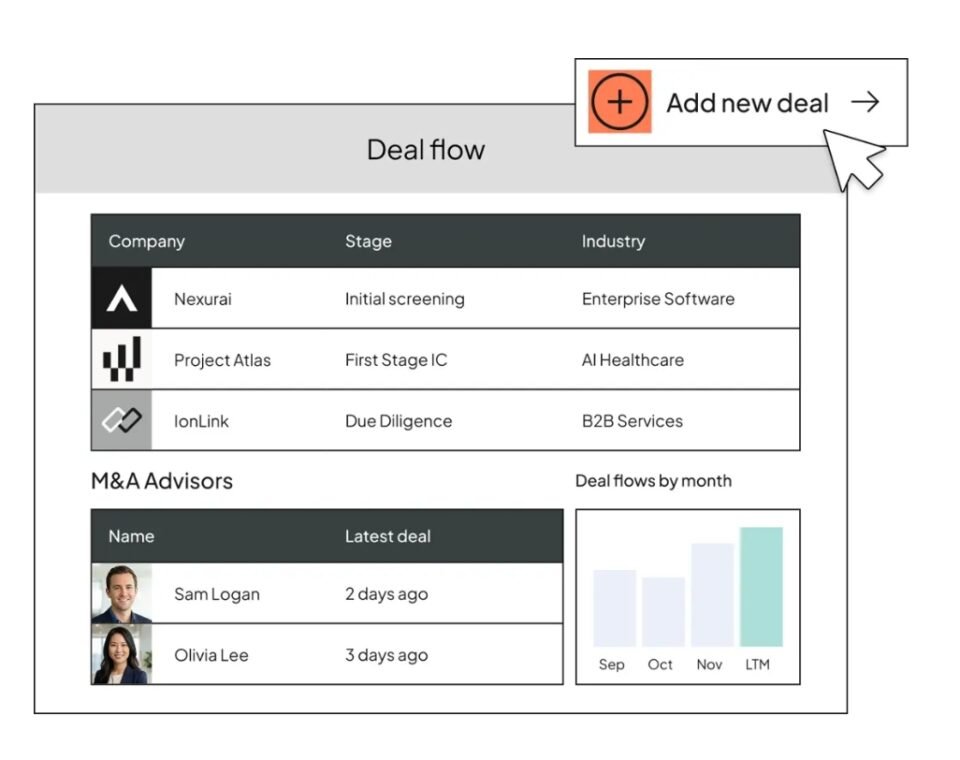
In the past, the core of VC software was Customer Relationship Management (CRM). Its primary purpose was to record and manage who met which startups, what investment reviews were underway, and which founders were involved. The investment industry refers to this as ‘deal flow’ management.
A representative example is Affinity from the United States. Affinity defines itself not as a simple CRM, but as a “Relationship Intelligence Platform.” It digitizes the network assets held by its portfolio companies by integrating and analyzing emails, calendars, meeting records, corporate information, and investment review history.
For example, when reviewing a specific startup, it automatically identifies founders, existing investors, industry experts, and representatives from portfolio companies connected to the firm. Relationship information, which previously relied on the individual investment manager’s memory or notebooks, is now accumulated as an organizational data asset.
Currently, Affinity is utilized by thousands of investment and financial institutions worldwide and is recognized as a leading CRM platform in the venture capital (VC) and private equity (PE) industries.
Recently, features based on MCP (Model Context Protocol) were also unveiled. MCP is a protocol that enables AI to connect with external data and systems in a more standardized way.
This does not simply mean that “AI capabilities have been added.” It is closer to meaning that a foundation has been laid to connect and utilize the relationship and investment data accumulated by investment firms with Generative AI such as ChatGPT.
Ultimately, the role of CRM is evolving from a simple record system into a data hub that AI can utilize.

The era where AI creates LP reports
Changes are also appearing in the field of portfolio management.
A representative example is Visible from the United States. Visible has grown into a portfolio monitoring and investor reporting platform for VCs. Currently, hundreds of venture funds utilize it for portfolio status management and investor reporting.
Post-investment management for VCs is more complex than expected. Even after the investment, they must continuously track portfolio companies’ revenue, user count, cash runway, workforce status, and whether follow-up investments have been secured on a monthly or quarterly basis. Furthermore, they must organize this information and report it regularly to LPs.
The problem is that this process involves a significant amount of repetitive work. The task of collecting data from portfolio companies, inputting it into Excel, verifying the data, and then creating graphs and tables to organize it into a report is repeated.
Visible has focused on automating these processes within its platform. Recently, by enhancing its AI capabilities, it has expanded beyond simple data collection to support KPI analysis, anomaly detection, and report drafting. For example, the AI can automatically generate analysis such as, “The average revenue growth rate of portfolio companies this quarter increased by 15% compared to the previous quarter, and certain companies require additional monitoring due to a rapid rate of cash depletion.”
This has significance beyond simple business efficiency. This is because the very way VCs view data is shifting from a ‘collection’-centric approach to an ‘interpretation’-centric approach.

Carta, which becomes the operating system (OS) of an investment company
Carta, one of the most influential platforms in the U.S. VC ecosystem, is also moving in a similar direction.
Carta originally started as a Cap Table management service. It was a solution for managing the shareholder structure and equity changes of startups. However, it has now expanded into a comprehensive platform providing Fund Administration, Portfolio Analytics, LP Management, and Performance Analytics.
The industry also regards Carta not merely as software, but as an infrastructure company for the private capital market.
Recently, Carta has been introducing itself as a “Private Capital ERP.” This means that while ERP (Enterprise Resource Planning) is a system that manages overall corporate operations, Carta aims to be a platform that manages the overall operations of investment firms.
With the integration of AI capabilities, investment firms are now able to perform fund performance analysis, assess investment status, and conduct comparative portfolio analysis more quickly.
Ultimately, in Silicon Valley, the competition is not merely about investment management solutions, but rather about “who will become the operating system (OS) of investment firms.”

Changes Begin in Korea, ‘Factsheet MCP’
The domestic venture investment market has also started to show a similar trend.
Until now, the domestic VC and accelerator (AC) industries have relied heavily on investment management systems, Excel, and manual report writing. Investment data is scattered across various systems, and report writing often depends on the experience and manual work of the personnel in charge. However, following the spread of generative AI, there are movements emerging to connect investment data with AI.
Recently, Asflow introduced ‘Factsheet MCP,’ which applies Model Context Protocol (MCP) to its investment data management platform Factsheet.
This is a method in which, when a user inputs a Natural Language Prompt such as “Write OO Fund Semi-annual LP Report,” “Analysis of Investment Company Performance over the Last 3 Years,” or “Summary of Portfolio Company Status,” the system combines fund data and portfolio information to generate the necessary data.
This is not merely a function achieved by simply adding a chatbot. The important point is that a structure has been created enabling the AI to understand and utilize the data held by the investment firm. Ultimately, the performance of AI is often determined by the data it can connect with, rather than the model itself.
This can be interpreted as a signal that the ‘data platform + AI agent’ trend, which the Silicon Valley VC SaaS (Software as a Service) market is already experiencing, has begun to enter the domestic investment ecosystem in earnest.
The remaining challenge is the security and privacy of sensitive investment data.
The point where the venture investment industry takes the most conservative approach to the adoption of AI agents is data security.
The information handled by VCs mostly consists of data requiring a high degree of confidentiality, such as startups’ undisclosed technology, valuations, shareholder registers (Cap Tables), and detailed financial status. Since much of the information exchanged during the investment review stage is also not publicly disclosed, security is considered a core value in the investment industry.
Initially, there were significant concerns that directly inputting such sensitive data into public generative AI models could lead to information leakage or unauthorized use for training the models. Even if AI could generate excellent analysis reports, it was not easy to accept security risks in the investment industry, where strict non-disclosure agreements (NDAs) are paramount.
For this reason, global VC SaaS companies are focusing on building a new security architecture beyond simply adding AI capabilities. This approach involves adopting a data isolation policy as a default, which does not use customer data for training AI models, and applying Role-Based Access Control (RBAC) equally to AI agents.
This is also the reason why the aforementioned MCP-based technology is receiving attention.
This is because, rather than indiscriminately opening an investment firm’s core internal database to general-purpose AI, it supports the AI in safely referencing only the permitted data context within a controlled environment and strict security policies. In other words, it is a structure that helps investment firms maintain control over their data while expanding the scope of AI utilization.
Ultimately, the success or failure of AI adoption in the future investment industry is highly likely to be determined not by “how smart the AI is,” but by “how safely it can handle sensitive investment data.”
Then, will AI replace investment analysts? Currently, the consensus in the industry is that this will not be the case. Evaluating a founder’s leadership, reading market changes, and assessing a team’s execution capabilities remain within the realm of humans. This is because investment decisions involve many factors that cannot be explained by numbers alone.
However, AI can give investors back their time. AI can now take over a significant portion of the repetitive tasks involved in creating LP reports, such as gathering data across various systems, organizing investment review materials, and compiling portfolio status. This is why Silicon Valley VCs are actively embracing AI.
The point is that AI is not a technology that replaces investment decisions, but rather one that enables investors to focus more time on making those decisions. The essence of venture investment still lies in understanding people and companies. However, it is highly likely that AI will increasingly take over the tasks of data organization, analysis, and reporting required in that process. And this shift is now beginning in Korea as well.
Article Sources and References
※ The service introductions and feature descriptions used in this article were written based on each company’s official website and product introduction materials.
Related