
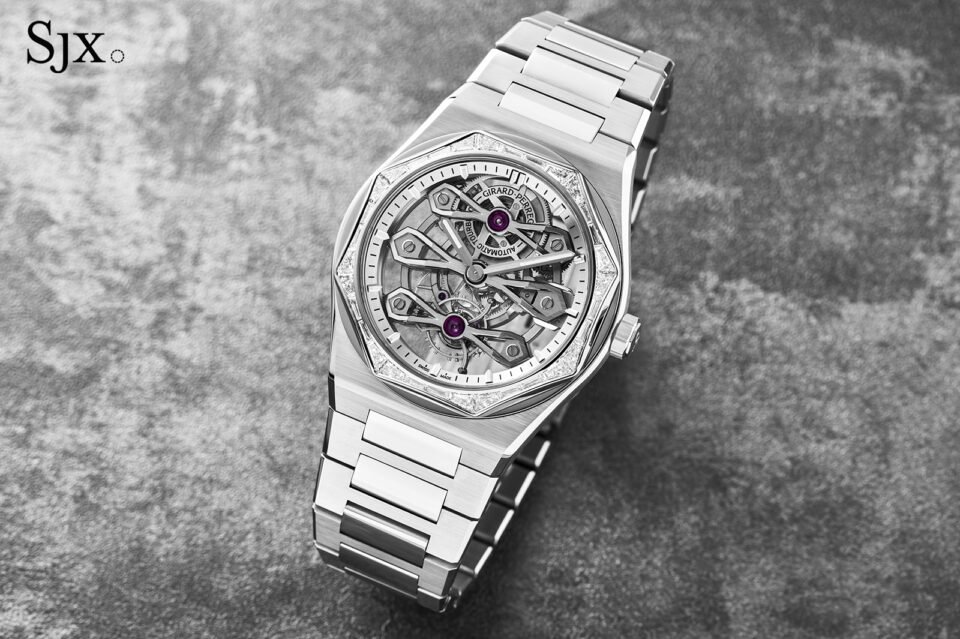
Girard-Perregaux (GP) closed out the Laureato’s 50th anniversary last year by launching the Laureato Three Gold Bridges, 18 years after the ‘three gold bridges’ format was first applied to the brand’s signature sports watch. Available with our without a diamond-set bezel, the Laureato Three Gold Bridges signals the brands emergent ambitions.

Initial thoughts
Few brands can lay claim to their own distinctive movement architecture, and GP is right to make the ‘three gold bridges’ format a pillar of the brand’s resurgence. While the brand did not have a monopoly of this format in the pocket watch era, the appealing architecture has been synonymous with GP since the formula was first applied to a wristwatch in the 1990s.
To look at the Laureato Three Gold Bridges is to understand how a mechanical watch works, and that’s a key aspect of its appeal. The layout clearly separates the major functions, with the power source, the going train, and the regulating organ supported by dedicated bridges front and back.

The sporty Laureato case and sturdy H-link bracelet are secondary to the spectacular movement, but the hard-wearing stainless steel construction does a good job of making the haute horlogerie calibre wearable on a daily basis, even if the 30 m water resistance rating trails competitors.
The gem-set model illustrated is priced at CHF219,000, while the unadorned variant with a simpler white gold bezel retails for CHF162,000. This pricing slightly undercuts that of similar watches like the Vacheron Constantin Overseas Tourbillon Skeleton and the Audemars Piguet Royal Oak Flying Tourbillon Openworked, but it feels ambitious even considering the obvious work that has gone into the movement.

A more refined case and bracelet, possibly in a more unusual material like titanium, would enhance the value proposition at current rates.
A short history
To understand how GP is working to recapture lost magic, it’s worth a quick look at the brand’s trajectory. The watchmaking activities of GP began with the firm’s founding in 1856, though the concern named after Constant Girard and his wife Marie Perregaux would later acquire the older firm of Bautte, which had produced watches since 1791 — the date most familiar to contemporary fans of the brand.
Almost immediately, GP took aim at the high end of the market, sourcing tourbillon movements from the celebrated constructor Ernest Guinand. The signature ‘three bridges’ architecture first emerged in 1867, but it was the 1889 release of the La Esmeralda pocket watch that formalised the aesthetic codes that would reinvigorate the brand a century later.

Girard-Perregaux was relatively quiet during the first half of the 20th century, but reestablished its relevance in 1965 with the launch of the Gyromatic HF, the first production movement that ticked at 5 Hz. This innovation signalled the brand’s area of focus as a manufacture, and the brand would stay on this path through the quartz era, establishing the standard frequency for quartz calibres — 32,768 Hz — in 1971.
Even as other brands outsourced production to specialists, GP built its own digital modules for the Casquette, which was produced from 1976 to 1978. What we now call the Laureato debuted in 1975, and has been an in-house product ever since, with both the design and the movement — whether quartz or mechanical — originating from the GP manufacture.
This last detail is notable, since similar watches of the era like the Patek Philippe Nautilus and Audemars Piguet Royal Oak were penned by freelance designer Gérald Genta and powered by movements built by Jaeger-LeCoultre.

In the 1980s, some industry insiders started to realise that visionaries like Philippe Stern and Jean-Claude Biver were right and that the future of Swiss watchmaking was mechanical. As a result, GP restarted mechanical watch production in 1989, and introduced the first Three Gold Bridges tourbillon wristwatch in 1991.
Luigi “Gino” Macaluso acquired the brand in 1992 and led a resurgence that was so profound it earned him the Prix Gaïa — arguably the industry’s highest honour — for entrepreneurship in 1998.
Macaluso passed away in 2010 and the brand was acquired by what is now known as Kering, the luxury goods empire founded by François Pinault. But without the charismatic Italian at the helm, GP withered in the group structure. Things changed in 2022 when Patrick Pruniaux led a management buyout, extricating GP from the Kering portfolio and hiring Marc Michel-Amadry as Managing Director in 2025.

A new slate of products — powered by new calibres like the 4800 — is intended to reinvigorate the brand and recapture the magic of the 1990s in particular, when Macaluso established the brand’s modern identity as maker of bold and original watches.
The Laureato that lives large
The Laureato Three Gold Bridges is the flagship of the refreshed Laureato collection, despite its period-correct construction that is mostly steel. Indeed, the case and bracelet are stainless steel, but the bezel is made of white gold, and is available with or without diamonds.

This mixed-metal format calls back to the original two-tone Laureato of 1975, but now the gold on the outside mirrors the presence of gold on the inside as well. Baguette-set bezels can often come across as generic, but in this case the diamonds are cut elegantly to follow the curve of the bezel, giving it a refined appearance.
In terms of sizing, it’s par for the course, with a 41 mm diameter and a thickness of 10.85 mm. I find watches with integrated bracelets tend to wear larger than the specs suggest, and while that’s true for the Laureato as well the visual dynamic of the openworked movement shrinks the visual size by eliminating any vast expanses of empty dial space.
Three Gold Bridges
The Laureato Three Gold Bridges represents GP’s renewed ascendency, emphasising the brand’s unique design history and capabilities as a manufacture. This starts with the famous ‘three gold bridges’ architecture, which has been modernised to meet contemporary expectations.
The angular, faceted shape of the bridges is clearly modern, but the craftsmanship is traditional. The namesake bridges themselves are solid 18k white gold — an intellectually compelling detail that gives the monochromatic movement an extra degree of gravitas.

Overtures to contemporary collector culture abound, most obviously in the attention to inward angles, which have been applied obsessively front and back (and in between).
Functionally, the movement is not entirely new, and the clever automatic system, which features a micro-rotor that’s co-axial with the mainspring barrel, has been seen before. But the architecture looks completely different in this austere, angular format, and moreover it remains a suitable platform for a flagship watch like the Laureato Three Gold Bridges.
Key facts and price
Girard-Perregaux Laureato Three Gold Bridges
Ref. 99112-58-3576-1CM (white gold bezel)
Ref. 99112-58S3451-1CM (diamond-set bezel)
Diameter: 41 mm
Height: 10.85 mm
Material: Stainless steel and white gold bezel
Crystal: Sapphire
Water resistance: 30 m
Movement: GP9620
Functions: Hours, minutes, 60-second tourbillon
Winding: Automatic
Frequency: 21,600 beats per hour (3 Hz)
Power reserve: 55 hours
Strap: Stainless steel bracelet with folding clasp
Limited edition: Yes, 50 pieces for the regular version, not limited for the gem-set version
Availability: At GP retailers and boutiques
Price: CHF162,000 (white gold bezel) or CHF219,000 (diamond bezel) excluding taxes
For more information, visit Girard-perregaux.com.