
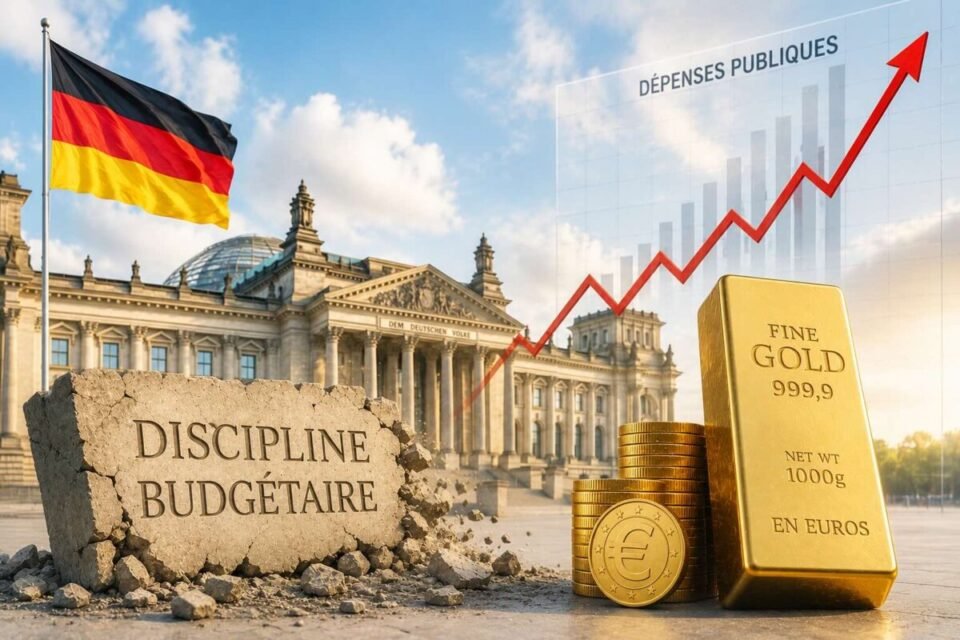
For more than thirty years, Germany has been the main pillar of the eurozone’s fiscal credibility. It was not simply a matter of public finances. Berlin embodied the very philosophy on which the single currency was based: limited debt, contained deficits, and a central bank independent of government financing. The Maastricht criteria — a public deficit below 3% of GDP and debt limited to 60% of GDP — bear the distinct mark of this German vision of monetary stability.
This philosophy was not limited to economics. It was deeply rooted in German history. The traumas of Weimar hyperinflation and the subsequent collapse of the Reichsmark after World War II had instilled a lasting distrust of public debt and money creation.
While France, Italy, and Belgium regularly allowed themselves budget deficits, Germany continued to embody this discipline. It was, in a sense, the moral guarantor of the euro.
Today, that era is over.
Friedrich Merz’s government is now planning to rely heavily on borrowing. According to budget projections released in recent days, Germany is expected to raise more than 200 billion euros as early as next year, followed by an additional 838 billion euros between 2027 and 2030. A large portion of these funds will finance the country’s rearmament, with the military budget set to rise from approximately €109 billion to nearly €184 billion by 2030 — representing about 3.5% of GDP. Added to this is a program worth nearly €500 billion dedicated to infrastructure, energy networks, bridges, hospitals, and rail transportation.
This shift cannot be explained solely by rising military spending.
It comes at a time when the German economic model is likely facing its deepest crisis since reunification.
For a long time, Germany was able to maintain a policy of fiscal discipline because its economy generated enough wealth to finance its social model. Its industry was the true engine of Europe: automotive, chemicals, steel, machine tools, industrial equipment… Export growth made it possible to maintain considerable trade surpluses while keeping public finances relatively sound.
This model has gradually begun to crack over the past decade.
The first major impact came from the energy sector. The gradual shutdown of nuclear power plants, decided upon after Fukushima, has profoundly altered the cost of electricity in Germany:

Nuclear power generation has fallen from about 170 TWh per year in the early 2000s to virtually zero today. This decision has made German industry much more dependent on natural gas and, following the war in Ukraine, on significantly more expensive liquefied natural gas imports.
This sustained rise in energy costs has come at the worst possible time. At the same time, China has become a direct competitor in sectors where Germany has historically dominated, notably the automotive, industrial equipment, and chemical industries. Exports to China are slowing, while Chinese manufacturers are rapidly gaining market share, including in Europe.
The graph below is particularly revealing:

If German industrial production had simply continued the trend observed between 1993 and 2017, it would be about 24% higher today than it actually is. The industrial production index, which should have approached 120, now hovers around 90. The gap with the historical trajectory is even continuing to widen.
Germany is therefore not taking on massive debt because its economy is overheating. It is taking on debt because its industrial model is running out of steam.
This is a fundamental shift.
For decades, Germany was able to enforce fiscal discipline because its industry generated enough wealth to finance its social model. Today, Berlin is choosing to respond to the industrial slowdown with massive fiscal expansion.
The question, then, is not whether Germany can sustain more debt.
The real question is much more significant: who is going to buy this debt?
For nearly fifteen years, this question hardly arose at all. Central banks absorbed a significant portion of sovereign debt issuance through quantitative easing programs. Interest rates were artificially suppressed, and investors knew that a buyer of last resort existed.
Today, the context is radically different.
The European Central Bank is gradually reducing the size of its balance sheet. Commercial banks are subject to stricter regulatory requirements. International investors have alternatives that sometimes offer higher yields, particularly in U.S. bonds.
Above all, Germany will not be the only one turning to the markets.
France continues to run deficits exceeding 5% of GDP. Italy will need to refinance several thousand billion euros in debt over the next few years. Belgium, Spain, and the United Kingdom are also continuing to issue debt, while the United States is expected to continue issuing several thousand billion dollars in Treasuries each year.
In other words, the major Western nations will simultaneously be asking investors to absorb a record amount of public debt.
If private demand is insufficient, two scenarios become possible.
The first scenario involves allowing interest rates to continue rising in order to attract enough private capital to absorb this avalanche of new bond issuances. This is, in fact, the path the market already seems to be favoring.
The Euro-Bund futures chart is particularly telling:

Since bond prices move inversely to interest rates, the collapse of the Bund since 2020 reflects a dramatic rise in German yields. In the space of just a few years, Germany has gone from an environment of negative rates to yields nearing 3% on its 10-year debt. In other words, the market is already demanding a much higher return to finance the German government.
The problem is that this rise in rates is occurring even before Berlin launches its massive debt program. If nearly €850 billion in additional debt hits the market between 2027 and 2030, investors could demand an even higher risk premium. The more the supply of bonds increases, the more their prices tend to fall and the more rates rise.
The second scenario would see central banks gradually become buyers of last resort once again, in one form or another. History shows that when governments take on long-term debt, central banks often end up supporting this trend, whether through bond-purchase programs, yield curve control policies, or other indirect financing mechanisms.
The first consequences are already visible.
Interest payments by the German government are expected to nearly double, rising from about €42 billion next year to nearly €81 billion in 2030. And this figure represents only interest payments, not principal repayment. Any further rise in interest rates or economic slowdown would further exacerbate this budgetary pressure.
Ultimately, the real change does not lie in the €850 billion in additional debt.
It lies in the fact that Germany is abandoning the role it has played since the creation of the euro.
For twenty-five years, investors implicitly assumed that Berlin’s presence limited the risks of fiscal slippage across the entire eurozone. This credibility benefited all member states.
That assumption is no longer valid.
The euro will obviously not disappear. But it is gradually losing one of its main sources of credibility: the conviction that the eurozone’s leading economy contributor would remain committed to strict fiscal discipline over the long term.
It is precisely during this kind of regime shift that gold fully regains its monetary function.
Gold is not anyone’s debt. It depends neither on a parliamentary vote, nor on a government deficit, nor on a central bank. When all major economies simultaneously opt for more debt to support their growth, the relative value of a monetary asset whose supply remains limited naturally tends to rise.
European investors still very often view gold through the prism of the dollar.
We believe that the real story of the coming years could be quite different.
If the last major advocate of European fiscal discipline also embraces the logic of massive debt, then gold denominated in euros could become one of the major beneficiaries of this historic shift. This is likely one of the most significant turning points for the single currency since its creation.
Reproduction, in whole or in part, is authorized as long as it includes all the text hyperlinks and a link back to the original source.
The information contained in this article is for information purposes only and does not constitute investment advice or a recommendation to buy or sell.