
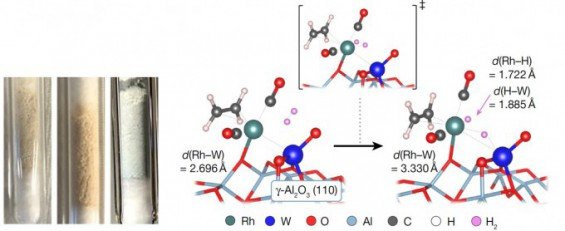
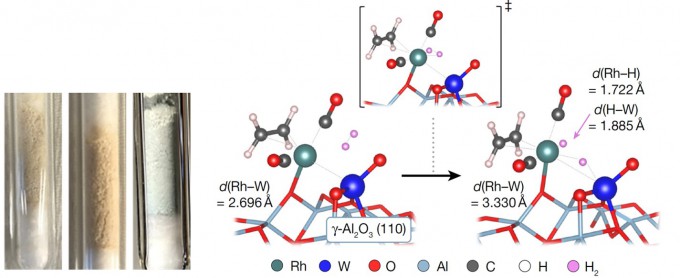
A joint research team led by Professor In Soo Ro of the Department of Chemical and Biomolecular Engineering at Seoul National University of Science and Technology and the University of California, Santa Barbara, has developed a heterogeneous catalyst (pictured left) that induces the alkyne hydroformylation reaction. By adding tungsten (W) to the existing homogeneous catalyst that used only rhodium metal, they improved reaction efficiency, enhanced recyclability, and reduced wastewater generation. Photo courtesy of In Soo Ro
Rhodium is one of the rarest and most expensive precious metals. It costs eight times more than gold. In some chemical processes, rhodium catalysts were often discarded after a single use. A joint research team from Korea and the United States has developed a technology to recycle these rhodium catalysts, a breakthrough expected to improve economic efficiency and reduce environmental pollution.
A joint research team, led by Professor In Soo Ro of the Department of Chemical and Biomolecular Engineering at Seoul National University of Science and Technology and researchers from the University of California, Santa Barbara, has developed a new recyclable heterogeneous catalyst for the alkyne hydroformylation reaction. The findings were published in the international scientific journal ‘Nature’ on September 8.
The alkyne hydroformylation reaction is one of the largest processes in the chemical industry. This reaction, which converts ethylene, carbon monoxide, and hydrogen into aldehydes, is used throughout the chemical industry, including in the development of pharmaceuticals and lubricants. Globally, 12 million tons of aldehydes are produced annually.
This reaction predominantly uses a rhodium-based ‘homogeneous catalyst’. Homogeneous catalysts cannot be recycled and generate significant amounts of wastewater. While ‘heterogeneous catalysts’ exist, which are recyclable and produce less wastewater, they have not been used in industrial settings due to their low reaction efficiency. This is because carbon monoxide binds strongly to the rhodium, preventing other reactants like ethylene, and hydrogen from attaching.
To solve this problem, the research team created a heterogeneous catalyst by reducing the size of the rhodium particles and adding tungsten oxide. The distance between the rhodium and tungsten oxide was brought down to an atomic scale. This design allowed carbon monoxide to bind to the rhodium, while ethylene bound to the tungsten oxide. The ethylene and hydrogen attached to the tungsten then combined to form an intermediate reactant, which in turn reacted with the carbon monoxide to produce the final aldehyde.
The catalyst developed by the team demonstrated a selectivity of 96%(the ability to facilitate only a specific reaction). This is comparable to existing rhodium-based homogeneous catalysts and is the highest level achieved by any heterogeneous catalyst developed to date.
“Despite the growing demand for a more eco-friendly chemical industry, the alkyne hydroformylation reaction could not be replaced with a heterogeneous catalyst,” said Professor Ro. “Through this research, we have presented a new catalyst that can serve as a substitute for homogeneous catalysts.”
Copyright ⓒ DongA Science. All rights reserved.