

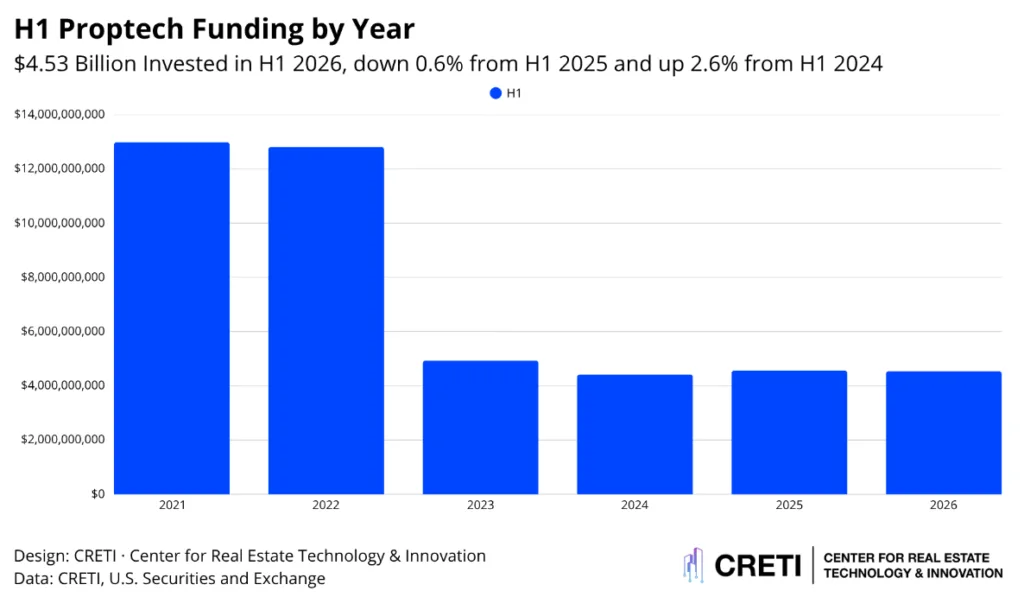
- Proptech venture capital held steady at $4.53B across 231 rounds in H1 2026, nearly flat year-over-year.
- Nearly half of all capital was raised in just 11 rounds of $100M or more, signaling strong concentration.
- Debt and private equity comprised 38% of total funding, pointing to greater selectivity and market maturity.
Key Takeaways
Divergence Behind the Headlines
According to Creti, Proptech venture investment appeared stable during the first half of 2026, but the headline numbers hide sharp concentration.
The H1 2026 Proptech Venture Capital Report recorded $4.53B across 231 rounds. The median raise reached $6.75M. However, 11 rounds worth at least $100M captured 49.6% of all funding.
Rounds below $5M represented most seed and pre-seed activity but attracted less than 3% of total capital. This divide shows continued startup formation alongside institutional concentration around fewer scaled companies. Proptech now rewards disciplined growth, stronger economics, and selective investment rather than broad expansion.
Get Smarter about what matters in CRE
Stay ahead of trends in commercial real estate with CRE Daily – the free newsletter delivering everything you need to start your day in just 5-minutes
The Details
H1 2026 funding remained essentially flat, falling 0.6% from H1 2025 and rising 2.6% from H1 2024. However, investment remains roughly 65% below the 2021 and 2022 boom years.
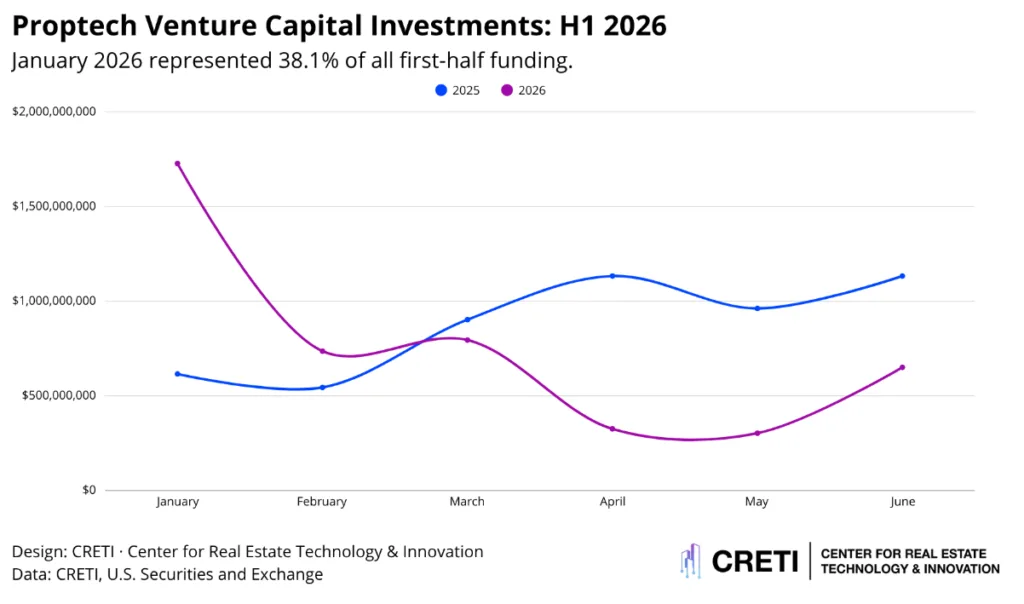
January generated $1.73B, representing 38% of the half-year total. April funding dropped to $325.2M, while May produced $302.8M. June rebounded to $650.4M, supported by major late-stage rounds such as Higharc’s $95M Series C.
The $6.75M median round highlights the gap between headline funding and typical company raises. Large transactions dominate total capital, while hundreds of smaller companies attract modest checks.
Capital Concentration Sets the Tone
The 2026 funding landscape showed a pronounced barbell structure. Seventy-five deals below $5M captured only 2.8% of total funding. Meanwhile, 11 rounds above $100M attracted nearly half of all capital. Flow’s $100M raise at a $2.5B valuation illustrates how investors continue backing larger, established proptech platforms.
Another 58 deals between $10M and $50M accounted for roughly 29% of funding. This range often supports commercialization, expansion, and increased institutional participation.
Funding sources also changed significantly. Debt represented 27.7% of disclosed capital, while private equity contributed another 10.4%. Together, they supplied about 38% of disclosed funding. Later-stage and asset-heavy companies increasingly use structured capital instead of relying entirely on venture equity.
Why It Matters
Proptech’s stable headline numbers conceal substantial differences across companies, stages, and financing structures. US proptech investment remains about 65% below H1 2021 and 2022 levels.
The sector appears to be establishing a lower funding baseline. Capital remains available, but investors increasingly favor fewer companies with proven scale. Housing, construction, energy infrastructure, and building operations continue attracting significant interest.
Large rounds also increasingly include debt and private equity rather than traditional venture capital. That shift suggests greater market maturity and changing investor risk preferences. Scale, capital efficiency, and infrastructure relevance increasingly separate leading companies from the broader market.
For CRE operators, brokers, and venture investors, aggregate funding totals now provide an incomplete market benchmark. Deal distribution, investment stage, capital structure, and sector focus offer more meaningful signals. Institutional capital continues concentrating near the top, while early-stage innovation operates with fewer resources.
What’s Next
Proptech funding will likely remain concentrated throughout 2026 unless broader economic conditions or liquidity markets improve significantly. Early-stage activity should remain healthy, but advancing into larger rounds will remain difficult.
Investors should expect more debt, asset-backed structures, and hybrid financing models. Companies addressing housing, energy, infrastructure, and operational efficiency should remain particularly attractive.
For CRE professionals and investors, technology alone will no longer determine opportunity. Funding structure, scalability, capital efficiency, and growth trajectory will become increasingly important as proptech matures.