
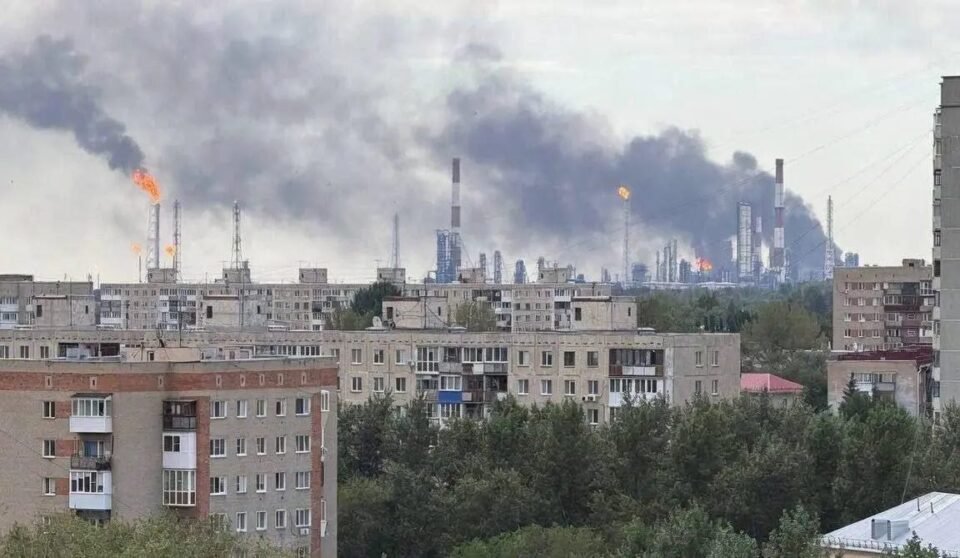
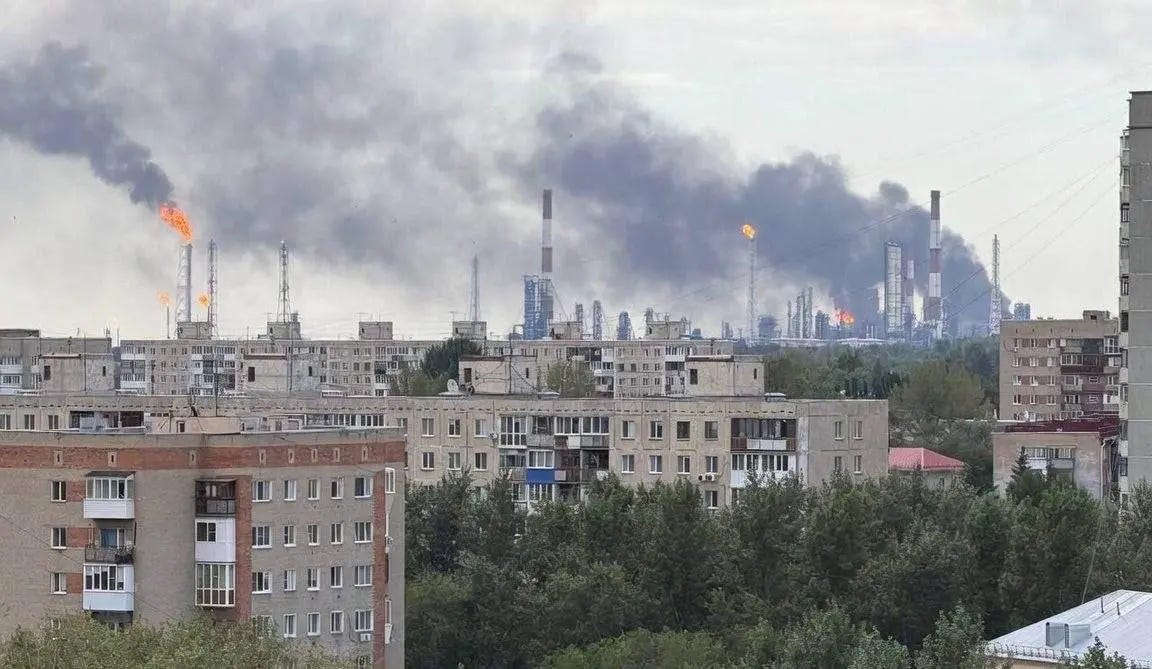
The latest US strikes on Iranian infrastructure targets and threats to reimpose their naval blockade on the Islamic Republic point to the centrality of economic warfare in current conflicts. Both types of action aim to alter decision-making by disrupting output and feeding public discontent.
And indeed, look at the way Iran tried to shape its ongoing fight with America, or Ukraine is turning the tables against the Russian invader right now. They are blowing up key installations – infrastructure – often by means of long-range strikes.
Neither the Islamic Republic nor Ukraine can match America’s long-range air force with dozens of piloted bomber aircraft. But both are engaged in what might be called a strategic air campaign. There are lots of questions about whether such methods work, in delivering victory, and others too about whether such strikes can be justified in terms of jus in bello, what we used to call the ‘laws of war’, and now often refer to as humanitarian law.
Blowing up a purely civilian structure like the ‘baby milk factory’ that Iraq claimed had deliberately been struck by Coalition aircraft in 1991, evidently violates these rules (codified in the Geneva and Hague conventions). But of course while accusation and propaganda surrounding such damage contribute to the information warfare battle, the definitions of what is a ‘dual-use’ or military target are often so broad that many of the strikes we see by belligerents will never be subjected to forensic judgment.
Iran has hit Dubai airport, Qatar’s main natural gas terminal, and oil refineries throughout the region. Ukraine has also blown up elements of Russia’s energy infrastructure repeatedly, and so effectively of late that significant shortages are developing.
You might justify – or attempt to – any of these strikes as undermining your enemy’s ability to make war. After all, Dubai airport might be used by American forces, or the fuel produced in Russian refineries delivered to their army occupying eastern Ukraine.
But let’s get real. We can see, from the frightened passengers cowering in that emirate, or the huge fuel queues developing in Russia, that hitting these targets has an impact on the civilian population. Indeed, you might say in many cases that this is their primary effect – with the attacker aiming to change the enemy’s calculus by exposing the public to a war and its costs.
Ukraine knows when it is hitting Russian warships in dry dock, or the Iranian Revolutionary Guards when they launch missiles at Prince Sultan air base in Saudi Arabia that these are straightforward military targets. By the same token, they know when the case is far less clearcut.
These days most European countries would be very nervous about hitting what is mainly civilian infrastructure or imposing a blockade – they are afraid elite opinion and accusations of illegality. Inevitably perhaps, Trump’s strikes against infrastructure have prompted such charges, a sign of implied bias if ever there was one since you will search in vain for similar headlines about Iranian or Ukrainian targeting.
But it wasn’t always like that, and you don’t need to go back as far as the Royal Air Force bombing Dresden because it was a ‘railway hub that might be used for reinforcements’ to find them. During the 1999 Nato war against Yugoslavia when there were quite a few attacks on Serbian infrastructure.
At Novi Sad, the Alliance destroyed three bridges over the Danube, ostensibly to stop the Yugoslavs shifting troops towards Kosovo, the theatre of war. But the city of Novi Sad was more than 300km away from that province and evidently most bridge users were civilians.
While the ‘dual use’ argument was sufficient for military lawyers to sign off on these missions it was part of a pattern of Nato actions to hit sites that were key to the prestige and economic wellbeing of the Belgrade government. It gained their attention in a way that weeks of taking out tanks or trucks in Kosovo, one by one with precision guided munitions, could not have done.
So, when the US and Israel started bombing Iran on 28th February it might seem surprising that there was a reluctance to strike similar targets. Naturally, during the opening phase of an air campaign, their primary focus was the Islamic Republic’s air defences and missile forces.
But even when Iran responded with thousands of drone and missile strikes on the infrastructure of its Arab neighbours, the US initially held back from following suit. That was doubly surprising given defence secretary Pete Hegseth’s commitment to, “maximum lethality”, and rejection of, “stupid rules of engagement”.
Indeed, Donald Trump upbraided the Israelis as they started to switch to infrastructure targets. When they hit the Iranian side of the Pars gas field on 18thMarch these criticisms became public.
Was this because Gulf states, who were then on the receiving end of Iran’s response, pressured the Americans to stop Israel? Quite possibly, certainly the IRGC’s threat to hit the desalination plants so vital to those emirates gave them a powerful deterrent in that ladder of escalation.
Those facilities, converting brackish water into the drinkable variety, are civilian targets by almost any definition. Iran did not in fact put them out of action, successfully using the threat to gain escalation dominance at the time.
Trump has threatened to hit desalination plants and indeed to end Iranian civilisation, but not followed through either, exposing his words as bluster. It seems curious he and Hegseth, who so often revel in transgressing liberal norms, might have held back even momentarily. But like many aspects of the late campaign, Trump’s muddled war objectives were to blame, he argued for a time that destroying key infrastructure or economic targets was contrary to the principle of trying to help the Iranian people.
In any case this restraint was relaxed with the US giving Israel to green light to hit certain key places like steel mills and petrochemical works. And by 13thApril, having taken some weeks to get the requisite forces in place, the US stepped up economic warfare by imposing its maritime blockade on the Islamic Republic.
My assessment is that these steps played an important role in getting Iran back to the negotiating table. Shutting down their trade provided an opportunity to nullify the edge that Iran had gained by closing the Strait of Hormuz.
Little wonder that the manoeuvring for advantage since the two sides signed their memorandum of understanding, had concerned Iran’s attempts to extend its authority over the Strait and America’s to thwart that, while threatening the Islamic Republic’s own ability to continue exporting its oil.
Similarly, Ukraine’s long range drone offensive aims to alter the Kremlin’s position by a combination of economic harm and making Russians fuming in the petrol queues confront the consequences of invading their neighbours. Volodymyr Zelenskyy has even ironically referred to the deep strikes on Russian refineries as ‘applying sanctions’.
Neither Putin nor those ruling Iran are particularly sensitive to the popular mood. But they cannot ignore possible long term economic harms. Does that mean that effective strikes aimed at exacerbating these fears will prompt both the IRGC and Russian president to alter course or escalate? We don’t yet know.
But what we can see, after decades in which western countries were focused on expeditionary campaigns or insurgent groups that in this new moment of state on state coercion, economic war is regaining a central place. You might argue that faced with all out struggle, even European countries might overcome their scruples about what might recently have been classed as civilian infrastructure. But at this moment, I sense that many decision makers on the Continent have not yet absorbed this harsh reality.