
Syrian journalist Ayman Abdel Nour told TML: “There is no reason to wait until every sanction is removed. The government should begin eliminating obstacles facing investors now. Those who move early will be best positioned to benefit.”
[DAMASCUS] Government officials and Syrian-American business leaders gathered in Damascus on Monday for the first US-Syria Business Forum held in the country, seeking to transform recent political rapprochement between Damascus and Washington into tangible economic partnerships and investment opportunities.
The forum brought together members of the US-Syria Business Council, Syrian-American investors, seven cabinet ministers, the governor of the Central Bank of Syria, the head of the Syrian Investment Authority, and dozens of Syrian business leaders.
The gathering comes months after significant shifts in US-Syria relations, including Washington’s easing of some economic restrictions and the launch of the process to remove Syria from the US list of state sponsors of terrorism, developments widely viewed as opening the door to renewed economic engagement after years of isolation.

Participants watch a recorded address by Jacob McGee, Deputy Assistant Secretary of State, during the opening session of the First Annual US-Syria Business Forum in Damascus. (Ayman Abdel Nour)
Leading the initiative is Jihad Al-Salqini, president of the US-Syria Business Council, an organization established to strengthen commercial ties between the two countries and encourage members of the Syrian diaspora to invest in Syria. Before convening its first forum in Damascus, the council had organized three previous business forums in the United States.
Al-Salqini said the event is primarily about rebuilding confidence rather than triggering an immediate wave of American investment.
“This forum is first and foremost about rebuilding trust and reopening channels of communication between the business communities in both countries,” Al-Salqini said in exclusive comments to The Media Line.
We do not expect companies to enter the Syrian market immediately, but this forum is an important first step
“American investment requires time, feasibility studies, and legal and financial guarantees. We do not expect companies to enter the Syrian market immediately, but this forum is an important first step that can pave the way for future investments.”
According to Al-Salqini, American companies have already expressed interest in opportunities in energy, technology, agriculture, food industries, healthcare, infrastructure, and logistics, although most inquiries remain exploratory rather than investment commitments.
“The biggest obstacle remains uncertainty,” he said. “American investors need legal clarity, financial stability, and confidence before committing capital.”
The biggest obstacle remains uncertainty,” he said. “American investors need legal clarity, financial stability, and confidence before committing capital
He added that the US-Syria Business Council has spent recent years building networks between entrepreneurs in both countries, organizing business events, and introducing American companies to opportunities in Syria.
Looking ahead, he said the council aims to facilitate partnerships, provide market information, and help address obstacles facing bilateral economic cooperation.
Asked what advice he would offer an American investor considering Syria, Al-Salqini replied, “I would encourage them to visit Syria themselves, see the reality on the ground rather than relying on preconceived impressions, carefully study the market, and begin with well-planned projects alongside trusted local partners.”
I would encourage them to visit Syria themselves, see the reality on the ground rather than relying on preconceived impressions
He added, “Syria offers significant opportunities during its economic recovery, but success requires a thorough understanding of the market and prudent risk management.”
Central Bank Governor Safwat Raslan said Syria has entered “a new phase based on stability, reform, and economic openness,” stressing that the government welcomes investors from around the world as partners in rebuilding the country’s economy.
In exclusive remarks to The Media Line, Raslan said the greatest remaining challenge is reconnecting Syria’s financial sector with the international banking system.
“We have made positive progress on many fronts,” he said. “However, the biggest challenge is completing Syria’s reintegration into the global financial system by expanding correspondent banking relationships and facilitating international payments and transfers. These are essential steps for any international investor.”
Raslan said the Central Bank continues to strengthen financial regulations, anti-money laundering measures, and international compliance standards while rebuilding banking relationships abroad, steps he believes will significantly improve investor confidence.
These efforts come as international institutions estimate that rebuilding Syria’s devastated infrastructure will require hundreds of billions of dollars, making foreign investment one of the country’s most pressing economic priorities after more than a decade of conflict.
Meanwhile, Syrian journalist and political analyst Ayman Abdel Nour, who divides his time between Syria and the United States, cautioned against overstating the forum’s significance.
“The forum is important, but it would be an exaggeration to describe it as the real turning point,” Abdel Nour told The Media Line exclusively.
“The real turning point came when US President Donald Trump announced the process of ending the effects of the Caesar Act sanctions and later launched the process of removing Syria from the list of state sponsors of terrorism. Those developments laid the foundation for today’s economic opening.”
Abdel Nour noted that the Damascus forum follows three previous US-Syria Business Council events held in the United States and reflects growing government interest in rebuilding economic ties with Syrian American investors.

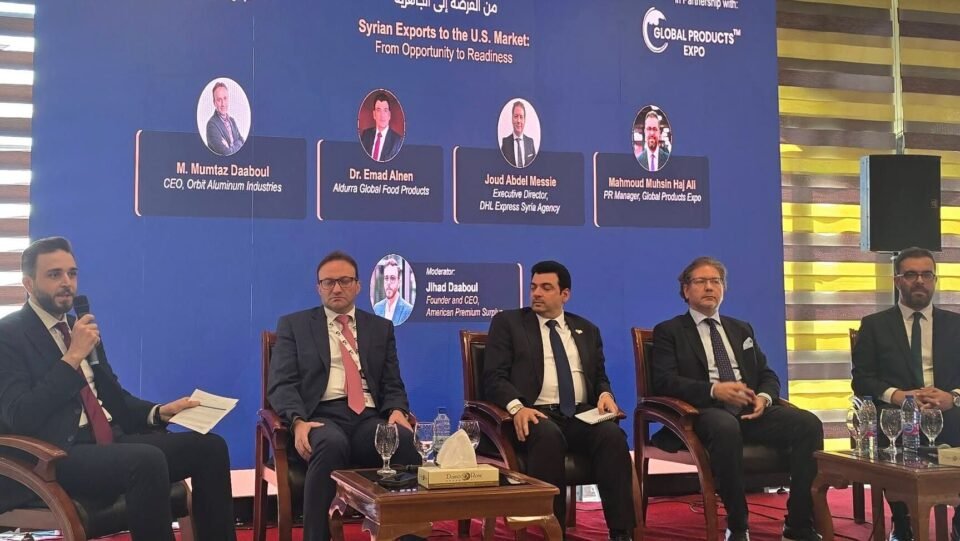
Panel discussion on “Investing in Syria: Legal and Practical Considerations,” bringing together representatives of the Syrian Investment Authority, international legal experts, and private-sector executives. (Ayman Abdel Nour)
He argued that while investment opportunities are emerging, legal and financial reforms must continue.
“There is no reason to wait until every sanction is removed,” he said. “The government should begin eliminating obstacles facing investors now. Those who move early will be best positioned to benefit from future opportunities.”
Not everyone, however, believes the focus should remain solely on large-scale investments.
Mazhar Makhlalati, founder of the financial technology company Likasa, said small and medium-sized enterprises received too little attention during the forum.
“I hoped to hear clear government plans to support SMEs through financing programs and partnerships with banks,” Makhlalati said in exclusive comments to The Media Line. “This sector creates the largest number of jobs and forms the backbone of any healthy economy.”
Nevertheless, he praised the Finance Ministry’s decision to streamline Syria’s tax system, describing the move as an encouraging signal to investors and as evidence of a changing relationship between the government and the private sector.
Makhlalati added that while the forum did not yield immediate agreements for his fintech company, it created valuable networking opportunities that could lead to future partnerships.
He also argued that although technology will be one of Syria’s most important sectors in the future, the country’s immediate priorities should be rebuilding its energy sector and basic infrastructure.
Technology alone cannot drive development. Reliable energy and infrastructure must come first
“Technology alone cannot drive development,” he said. “Reliable energy and infrastructure must come first. Technology can then become a major engine of economic growth.”
Participants broadly agreed that the forum represents an important first step toward reconnecting Syrian American investors with Syrian institutions.
Whether it ultimately succeeds, however, will depend less on the meetings held in Damascus than on whether the momentum generated by the gathering can be translated into concrete investments supported by continued legal, financial, and banking reforms.