
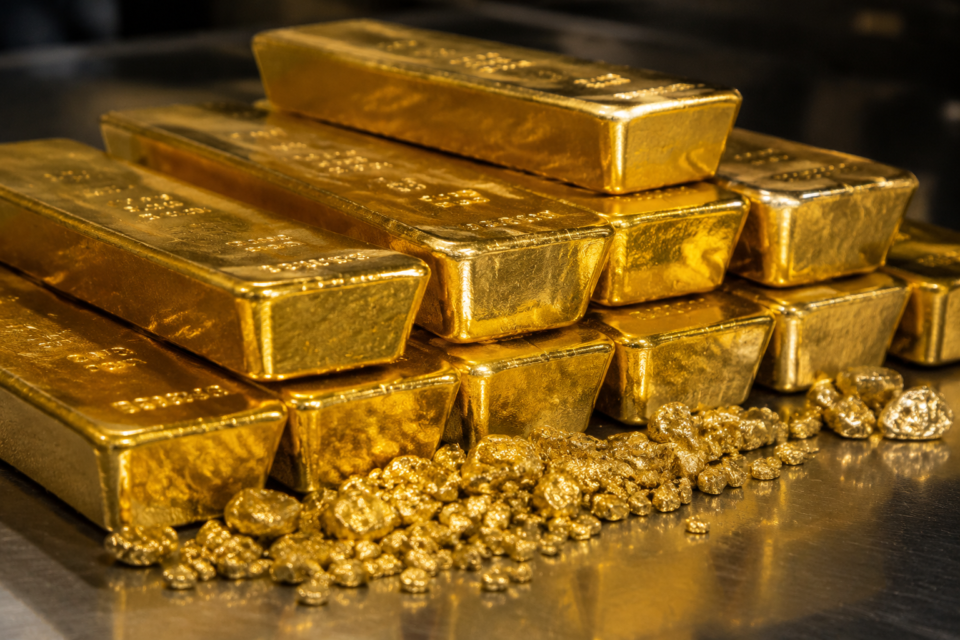
Spot gold and silver prices moved lower ahead of the North American market open on Thursday.
Rising Treasury yields, a firmer US dollar and another sharp increase in crude oil prices outweighed safe-haven demand linked to the ongoing US-Iran conflict.
At the time of writing, spot gold was trading near $4,066.82 an ounce.
The metal was down 1.52% on the session.
Spot silver was trading near $58.06, down 2.75%.
The decline came as markets continued to assess the impact of higher oil prices on inflation expectations.
Investors were also weighing recent economic data and expectations for the Federal Reserve’s policy path.
Gold traded in an early range of $4,072.20 to $4,141.70.
Earlier on Thursday, gold had held near $4,130 an ounce.
Investors were weighing a weaker dollar against rising oil prices and a sharp increase in short-term Treasury yields.
Spot bullion was little changed at $4,132.01 after reaching $4,165.87 on Wednesday.
August gold futures slipped 0.4% to $4,134.60.
The latest price action shows the competing forces influencing the precious metals market.
Geopolitical uncertainty continues to support safe-haven demand.
Silver also came under pressure after recently showing signs of stronger short-term momentum.
Earlier on Thursday, silver hovered just below $60 an ounce.
Buyers had defended a recent breakout, helping restore momentum after the metal suffered a sharp retreat last week.
Spot silver traded near $59.80 after moving between roughly $59.33 and $60.08.
Futures remained close to $60.10.
The metal had approached $61 in the previous session.
In the latest session, silver’s early range was $57.21 to $60.95.
The metal failed to hold the $60.75 breakout level and retreated toward the $58.73 support area.
Silver’s weaker performance compared with gold also reflected broader market pressure.
Market positioning after the European Central Bank’s rate decision and the latest US jobless claims report remains less dovish than softer inflation data initially suggested.
The ECB left its benchmark interest rate unchanged at 2.25% after a June hike.
The central bank also emphasised that uncertainty around the energy shock remains high.
In the United States, initial jobless claims dropped to 187,000.
The data reinforced the view that layoffs remain contained, even as hiring momentum has cooled.
The combination of these developments has shaped expectations for monetary policy.
Markets currently view the Federal Reserve’s July 29 meeting as likely to result in rates being held steady.
Higher oil prices have increased inflation risks.
This has kept the possibility of later-year rate hikes in focus.
The 10-year Treasury yield rose to 4.714% at 8:30 am ET.
It reached its highest level in the current move.
The dollar also remained firm.
The geopolitical situation around the Strait of Hormuz remains a major factor for markets.
Iran and the US remain entrenched in their dispute over control of the strait.
The shipping risks have also extended beyond Hormuz.
Houthi attacks on two Saudi oil tankers in the Red Sea have widened concerns about shipping routes.
Brent crude moved above $98 a barrel.
WTI traded near $90.
Traders have been pricing the risk of simultaneous disruption around key shipping chokepoints.
For gold, the geopolitical bid is being offset by the inflation and interest-rate channel.
However, rising yields, a firm dollar and renewed inflation concerns are limiting the upside for gold and silver.