
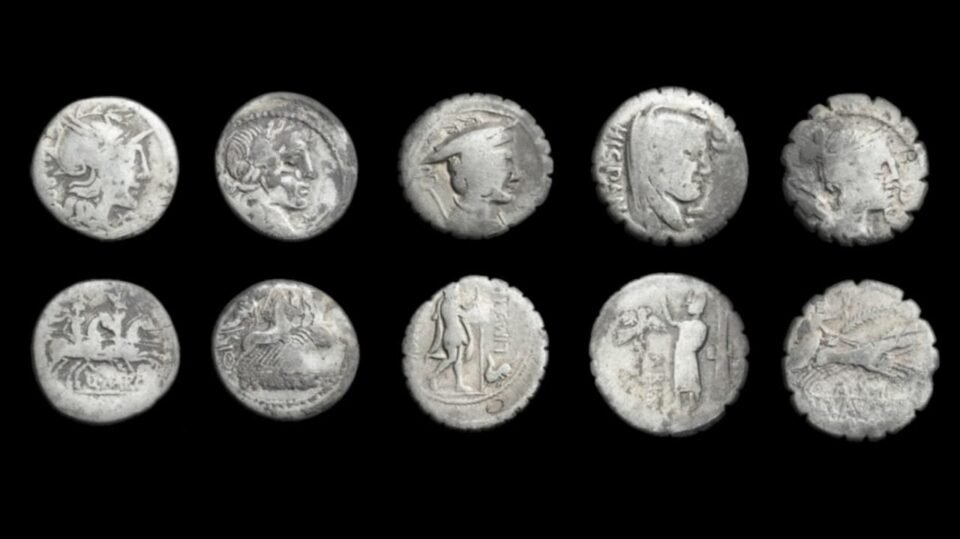
Silver coins from the Roman Republic rarely turn up in central Germany. Archaeologists have now confirmed the first documented hoard of Roman Republican silver denarii in the German state of Saxony-Anhalt. The small group of five coins adds fresh evidence about contacts between Rome and the people living beyond the empire’s borders around the start of the Common Era.

The coins were found in 2025 near Halle (Saale) by volunteer archaeological heritage steward Dirk Braungardt. The State Office for Heritage Management and Archaeology of Saxony-Anhalt announced the find on July 22. Researchers see the hoard as an important piece of the region’s Roman-era history.
The hoard contains five silver denarii. One coin was minted in 148 BCE. The other four were struck between 82 and 79 BCE during the late Roman Republic. Archaeologists recovered all five from a very small area. This shows the coins were once buried together, likely inside a small pouch. Farming, erosion, or animal activity later spread them across the field.
The find stands out because Republican denarii are rare in Saxony-Anhalt. Before this, only 19 Republican coins had been recorded across the state. Almost all were single finds. A group of four Republican coins from Großleinungen had been known since the late 1800s, though those coins entered a collection through a purchase in 1897. Their original location was never recorded. The Halle hoard is the first group with a secure archaeological context.
Republican silver coins appear more often in the neighboring states of Thuringia and Lower Saxony. Their numbers drop sharply farther northeast. Only a few hoards have been found in Brandenburg and Mecklenburg-Western Pomerania. This makes the Halle find even more important for archaeologists studying the region.
The coins show heavy wear, which means people used them for many years. Republican denarii stayed in circulation across the Roman world until the end of the first century CE. The mix of coins matches what people carried during that time.
Three of the five coins are serrated denarii, known as serrati, with saw-like edges. Two of those carry scratched graffiti. Historians still debate why these coins had serrated edges. Some think the design proved the coins were made from solid silver. Others believe the edges helped stop clipping or simply served as decoration.
One detail caught the attention of researchers. No Imperial Roman coins were found with the hoard. This suggests the coins reached the Halle area around the beginning of the Common Era. If they had arrived much later, Imperial coins would likely have been mixed with them.
People living in what is now Saxony-Anhalt did not use coins as everyday money. The silver denarii likely served as prized objects with social and material worth. They could have reached the area through trade, diplomatic gifts, payments, exchanges between Germanic groups, or Roman military campaigns. Earlier archaeological work has linked Roman expeditions led by Drusus, Ahenobarbus, and the future Emperor Tiberius to central Germany. Roman marching camps have also been identified in the region.
The hoard contains only five coins, yet the find helps archaeologists trace how silver, goods, and people moved between the Roman world and neighboring societies more than 2,000 years ago.
More information: State Office for Heritage Management and Archaeology Saxony-Anhalt