
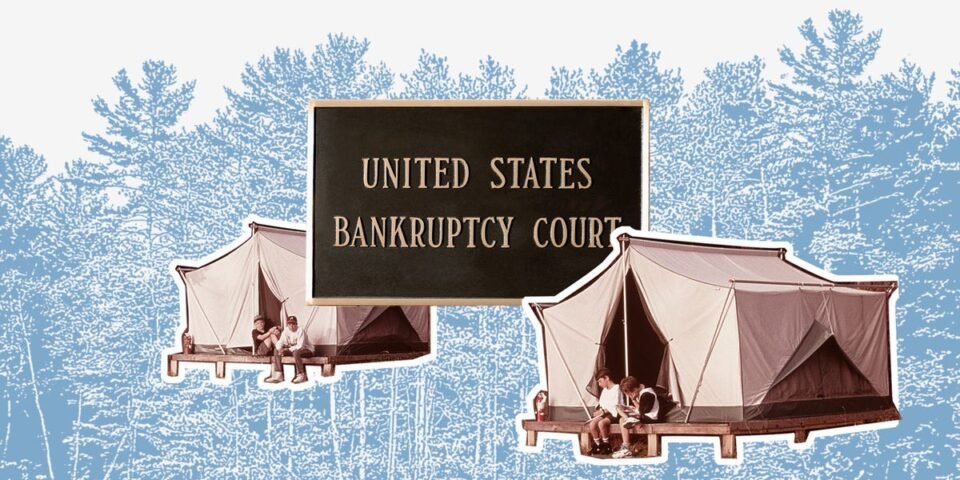
In early June, Pam Goldman, a mother from Maplewood, New Jersey, was gearing up to send her 12-year-old daughter to Camp Echo, an elite sleepaway camp that costs $13,000 for a seven-week stay, when she received a text message from a friend. It was a news article saying that the parent company of Camp Echo, which owns over two dozen other high-end summer camps, had filed for bankruptcy. “We had no idea that the camp didn’t own itself,” Goldman said. “The mom chats were buzzing.”
A few days later, Camp Echo sent out an email to parents who had already committed their children (and money) for the summer session. They explained that there was no cause for concern, and that they were still going to accept their kids later that month. Goldman dropped her daughter off for camp, but still confusion festered, and frantic parents went looking for answers. They scoured court documents, news stories, and social media posts. “We’ve all had to become lawyers over the past two weeks,” Goldman said. “It’s crazy.”
The revelations were fueled by allegations of fraud, theft, embezzlement, suffocating debt, and greed coming from the owners of the sleepaway camp empire that serves over 20,000 children annually and had come to include the summer mainstays of Manhattan’s ultra-wealthy. The fall-out is ongoing.
“It’s been nothing short of shocking,” Goldman said.

Could summer 2027 see numerous camps close?
Over the past decade, a swath of roughly two-dozen elite sleepaway camps had been purchased by Simad Holdings, a real estate investment corporation owned by Israeli brothers David and Michael Shabsels. By 2026, the brothers owned roughly 30 such camps.
But earlier this year, as wealthy families in the Greater New York City region prepared to send their children to their camp of choice in New York, Connecticut, or parts of New England, hidden financial machinations would soon put their annual ritual at risk. In December 2025, the Shabsels brothers tapped the Israeli bond market to raise $195 million, which was secured by 13 of the company’s summer camps.
But the brothers allegedly transferred $34 million to themselves—and in May missed their interest rate payments. Their bonds fell to junk status, and the Tel Aviv Stock Exchange halted its trading. Simad Holdings was instantly insolvent.

Outside the Tel Aviv Stock Exchange.
On June 4, they shocked the summer camp community by filing for Chapter 11 bankruptcy with between $500 million and $1 billion in liabilities. All of the summer camps within their portfolio were included in the bankruptcy filing. David and Michael Shabsels also filed for personal bankruptcy. According to The Real Deal, previous lawsuits suggest that the company had in the past relied on high-interest financing from private lenders, potentially contributing to their downfall.
“We were all blown away when we found out,” said Allison Aspis, a summer program advisor at Camp Experts, who consults roughly 75 well-off families living in the Upper East Side on where to send their kids for summer camp. “The fact that some of these camps are in danger of closing because of these two men is extremely upsetting to us.”
Beyond the tens of thousands of creditors, another question loomed: Summer was two weeks away; would the kids still be able to go? And if kids were already at camp, would they be sent home? “The big question was: Will they be able to operate through the middle of August?” Aspis said.

Boys learning archery at summer camp.
A flurry of activity has taken place in bankruptcy court to not only try and salvage some type of value from the camp assets, but to also keep them operational for families who had already committed the hefty fee—in some cases upwards of $20,000—to ship their kids off for the summer.
The bankruptcy judge overseeing the proceeding, Christine Gravelle, declared that the popular summer camps would be allowed to open in late June and operate unencumbered by allowing access to individual operating accounts for overhead expenses “and other emergent expenses necessary to open the camps to become operational,” she wrote. The failed company’s restructuring officer, Assaf Ravid, and individual camp directors, were given operational control over the camps.
News of the bankruptcy likewise sent potential buyers flocking, including media mogul David Zaslav, CEO of Warner Bros. Discovery, who made a $68 million stalking horse bid for Mohawk Day Camp, in Westchester County, where his children personally attended and which has been in operation for more than a century. The offer will be tested at a forthcoming auction.

Zaslav could be Mohawk Day Camp’s newest owner.
“This is a personal family investment that reflects our lifelong belief that summer camp can be a wonderful part of a child’s growth, and Mohawk’s history as a successful camp experience for so many kids, including our own,” Warner Bros. said in a statement to Town & Country. More deals are expected in the coming weeks as the Shabsels brothers’ camp empire is carved up and sold piece by piece.
Like Mohawk, Camp Echo has also become the target of a stalking horse bid. Nonprofit Ohel Children’s Home and Family Services made a $12 million bid to take over the camp. “The parties acknowledge that Buyer does not intend to continue the 2026 Camp Season operation under the existing brand,” they wrote in their bid. In response, dozens of concerned parents sent letters to the court, pleading with the judge to allow the current camp directors to instead purchase the century-old property.
In an unprecedented move, Judge Gravelle responded publicly, stating that the letters “have helped me better understand the perspectives of the parents, counselors, former campers, and other members of the camp community who care deeply about its future.” An auction was held on July 28, but the results have not yet been made public. A sale hearing will be held on August 4. The judge assured parents that their correspondence “will not be overlooked.”

Campers kayak with a counselor.
Despite the dire situation laid out in court filings, some camps reassured parents that there was nothing to worry about. “These are simply some behind-the-scenes matters that are being sorted out,” wrote Adam Wallach, director at Mohawk Day Camp, “but nothing that affects our campers, staff, or program.” Some camps are still asking for deposits to secure slots for the 2027 season, but parents are weary of putting money down, given the financial and legal precarity of the camps.
As for Pam Goldman, her daughter was able to stay at Camp Echo, but she broke her arm on July 19. “She’s been at home recovering, and all she does is complain about not being at camp,” Goldman said. “This is the most special, amazing home away from home.”


Ian Frisch is a journalist and documentary producer who lives in Brooklyn; his first book is Magic is Dead: My Journey Into the World’s Most Secretive Society of Magicians.