
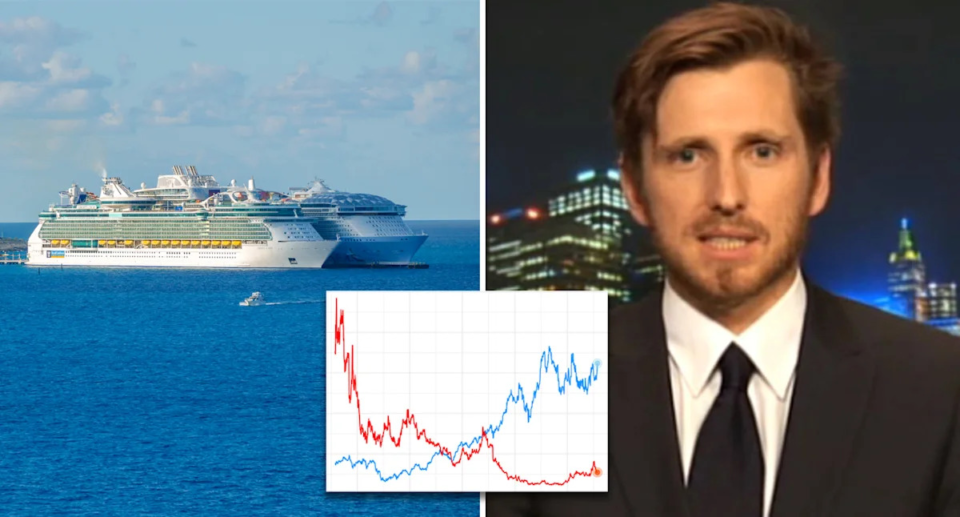
Let me take you back. It’s 2021. Five years ago precisely. The world is completely riven by a virus that has been not only killing people but is also mutating to become deadlier still.
You have two investment choices. You may invest in the company that just invented a vaccine for this virus. A US company called Moderna. Or you can invest in Royal Carribean Cruises, a Miami-based firm that owns floating pleasure-ships, which are at the time moored and empty.
What will you choose? The jab or the tub? I can tell you what I would have done, if I’d had a spare few grand in 2021. I would have bet on the brand new mRNA vaccine technology, and scoffed at the idea people would return to stay in tiny windowless rooms, eat at viral buffets and attend floating casinos.
I would have been horribly wrong.
More market madness from earnings season:
Here are the trajectories of those two investments since 30 July 2021, five years ago. Every dollar you put into Moderna would be worth $0.15 today. While every dollar you put into Royal Caribbean Cruises would be worth $4.21 today.

The above cross-over is striking. I want to emphasise that the cause is not merely that the cruise company was especially downtrodden in 2021. Its previous high was only $130, so it has made many fresh highs in recent years.
Cruises were literally banned in Australia until 2022. With the level of fear around viral transmission, it was hard to believe that the gangplanks would so soon bow under the weight of eager passengers clambering aboard. But that’s what we saw.
Ironically it was the vaccine industry that helped re-launch those ships. Once everyone got a level of immunity, normal economic activity began to come back. Moderna, however did not capture the economic benefit unleashed.
The economics of the end of lockdown were curious. An investor who owned only the vaccine company would have wanted Moderna to hold the rest of the economy to ransom. But these days so many investors are diversified across an entire index, indeed across several indices. For the average investor, if one company they own a piece of makes a big loss in order that the rest for the portfolio can profit, that’s a net win.
The lessons for retail investors
Sometimes we hype new technology. A new idea has “a moment” and everyone gets excited. But that does not always translate to fortunes for investors.