
Author | Nan Huang
Editor | Silai Yuan
36Kr has learned that OrcaTech, a marine embodied intelligence company, has recently completed a C-round financing of several hundred million RMB, with the total accumulated amount reaching 300 million RMB in half a year. This round is led by Xi’an High-Tech Investment, followed by Yuanhe Puhua and Sanyuan Capital. The raised funds will be mainly used for technical iteration of marine physical AI, scenario expansion of APAS, the general brain system for ships, and product advancement of C-end water leisure business.
The interval between this financing and the previous closing is only half a year. Since it officially launched its commercialization process in 2019, OrcaTech has received multiple rounds of capital support, with investors including Turing Venture Capital founded by Academician Yao Qizhi, XbotPark and HKX Fund under Professor Li Zexiang, Brizan Ventures under Professor Gao Bingqiang, Alibaba Entrepreneurs Fund, Snowcap Capital, and Yuanhe Chongyuan.
OrcaTech focuses on the marine embodied intelligence track, specializing in the R&D of ship autonomous driving technology and the industrial application of water embodied robots. Centering on the “AI for Boats” strategy, it has built a multi-body product architecture of “general brain + ontology terminal”. Its underlying layer is based on the full-stack self-developed marine physical AI, and the upper layer uses the ship intelligent driving system ORCA-APAS (Advanced Pilot Assistance System) to scale and reuse the intelligent driving capability for different ship types, different water areas and different application scenarios.
Founder and CEO Dr. Zhu Jiannan graduated from Northwestern Polytechnical University. During his time in school, he led the research on water unmanned driving technology, and later co-founded OrcaTech with partners Cheng Yuwei and Chi Yuhao. It is one of the world’s earliest teams engaged in the R&D of water unmanned driving. Many core members have worked in leading technology enterprises such as DJI and Huawei, with full-chain experience from algorithm R&D to hardware mass production. Its R&D personnel account for more than 70%, and have obtained more than 200 core patents in total.
OrcaTech is the only enterprise in China that has obtained four core certification certificates from China Classification Society at the same time, with the highest compliance level of full unmanned driving capability for ships. Up to now, the company has deployed more than 1,000 unmanned boats in 13 countries around the world, with a total unmanned navigation mileage of more than 2 million kilometers.
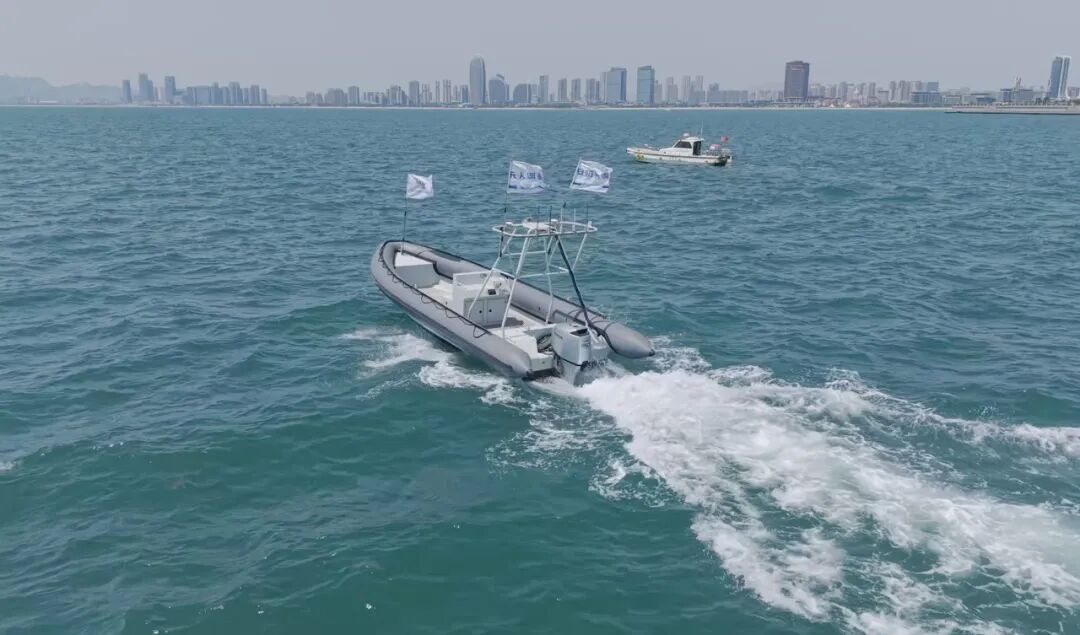
Ship intelligent driving system applied to offshore unmanned boat (Source/Enterprise)
The ocean is becoming a special field for the implementation of embodied intelligence.
The labor gap in marine operations is continuing to expand, and the high-risk attribute is becoming increasingly prominent. The latest data from BIMCO and the International Chamber of Shipping (ICS) shows that the global merchant fleet is facing a gap of about 40,000 certified senior seafarers in 2026; compared with 2021, the demand for senior seafarers has increased by 23.1%, and it is expected that about 120,000 additional senior seafarers will be needed by 2030.
At the same time, scenarios such as maritime inspection, wind power and oil & gas operation and maintenance, and offshore operations have long faced the dilemma of “difficulty in recruiting and retaining personnel”. Severe sea conditions, continuous on-duty and high-risk operation environments further amplify personnel safety and supply pressure.
“The demand for unmanned systems in marine operation scenarios has its unique value logic,” Zhu Jiannan, founder and CEO of OrcaTech, told 36Kr. Different from land robots, whose core logic is to use machines to assist and replace part of manpower to reduce costs and increase efficiency, the ocean scenario adds two rigid constraints of safety and personal risk on this basis.
“The ocean operation scenario is more in need of unmanned solutions, because of its high risk, high value, and ROI calculation. The only problem left is how to solve non-standard and special R&D problems. What the industry needs to do now is to move from demand consensus to product consensus, and then to product standardization and quantitative change,” Zhu Jiannan said.
Marine operations face a set of underlying constraints completely different from land scenarios. It has to deal with continuously changing wind, waves and currents, high salt spray corrosion, offshore communication occlusion, and dynamic safety risks caused by surge disturbance. This determines that marine intelligence cannot directly transplant the technical scheme of land unmanned driving, and must complete systematic reconstruction based on the physical laws of the sea surface.
This is exactly the core track that OrcaTech cuts into, promoting the transformation of marine operations from a manpower-driven mode to an intelligent operation paradigm dominated by AI embodied intelligence.
OrcaTech has built a complete closed loop of marine physical AI, forming full-stack capabilities of “technology R&D – product mass production – large-scale delivery – data return – algorithm iteration” from data flywheel, physical torso to embodied brain.
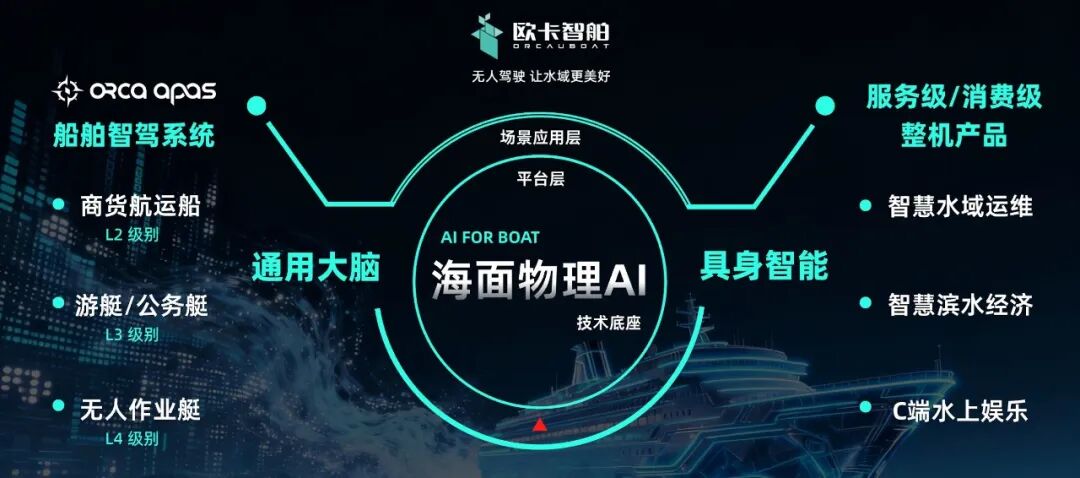
OrcaTech product architecture diagram (Source/Enterprise)
The underlying layer is the data flywheel. OrcaTech has accumulated a sample set of 50 million levels of water and sea surface, covering different water types, light conditions, wind and wave levels and seasonal changes, and has built the world’s first data set covering multi-modal sea surface autonomous driving and water garbage samples. The data is divided by category, including those for unmanned boats, shipping, inland rivers and lakes, forming full coverage of data elements.
The middle layer is the physical torso. At the level of core components, the team has independently developed key hardware such as millimeter wave radar and domain controller. Among them, the domain controller adopts the architecture design of multi-channel input and modular output, which can access data from different sources such as engines, millimeter wave radar, vision, lidar, sonar, and current meter, reserving 25 sensor interfaces, and the output end is unified as decision instructions and execution signals.
This means that no matter the customer is a cargo ship or a yacht, the underlying hardware interface is standardized, and the difference is mainly reflected in the type of input data. For example, a cargo ship may be connected with four propellers plus side thrusters and sonar, while a yacht only needs one or two propellers. Through system-level configuration switching, it can adapt to different needs from small boats to large commercial cargo ships.
The upper layer is the key to the whole solution — the embodied brain, namely the ship intelligent driving system ORCA-APAS. Relying on a complete algorithm link of perception and recognition, positioning and calculation, planning and decision-making, and motion control, this system can provide capabilities such as ship environment perception, autonomous navigation, active obstacle avoidance, and automatic berthing and unberthing.
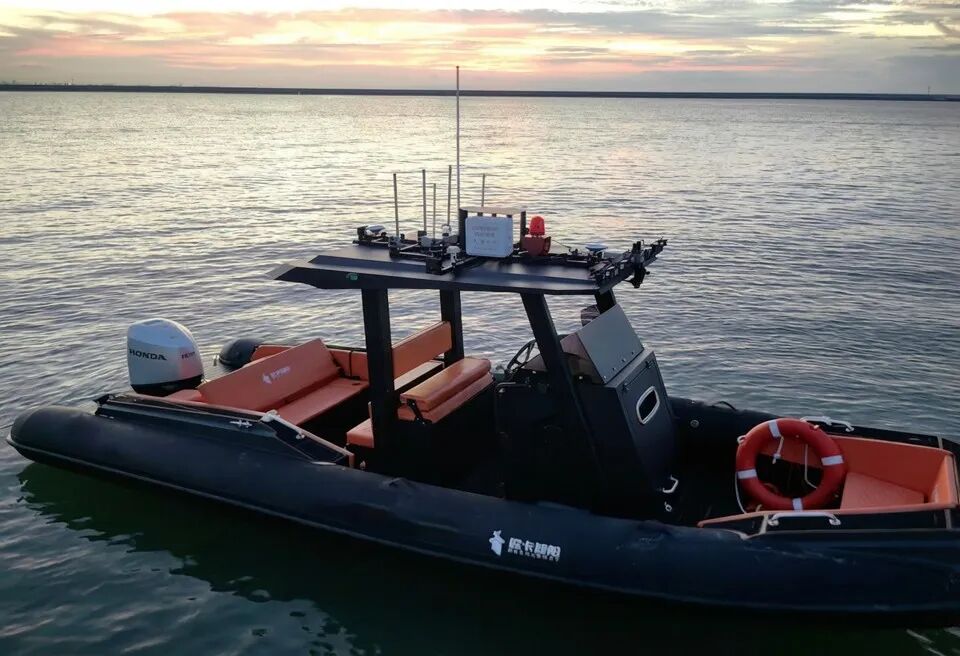
ORCA-APAS applied to offshore patrol boat (Source/Enterprise)
According to different intelligence levels and business scenarios, APAS is divided into three subsystems: A, B and C. System A focuses on full-unmanned special hull scenarios such as offshore wind power, public security coast guard, fishery administration and maritime affairs, covering full capabilities from remote control to fully autonomous operation; System B mainly serves small and medium-sized boats such as yachts and official boats, focusing on advanced assisted navigation experience; System C is oriented to large commercial cargo ships, with a focus on intelligent navigation and route optimization.
The core of this “one brain, multiple bodies” architecture lies in the cross-ship type reuse capability of the general brain. The same set of algorithm base adapts to different intelligence level requirements and application scenarios, realizing L2 to L4 level intelligent driving coverage for all water areas, all ship types, all speeds and all scenarios.
In terms of commercial implementation, OrcaTech has not chosen to expand all at once, but advances along a gradient path, starting from B-end scenarios to establish data and delivery closed loops, and then extending to C-end; it verifies technical stability in low-speed water areas, and then expands to high-speed and far-sea scenarios.
The B-end is currently the main source of revenue for OrcaTech. Focusing on smart water operation and maintenance, the company has formed a product matrix covering water cleaning, offshore operation and maintenance, environmental inspection and emergency rescue. From unmanned cleaning boats and unmanned mowing boats to water conservancy inspection boats and marine unmanned boats, the product line gradually extends along the scenario requirements. Actual measurement data from customers shows that the operation efficiency of its sanitation boats is 3 to 5 times that of manual work, and the comprehensive operation cost is reduced by more than 40%. Zhu Jiannan revealed to 36Kr that the repurchase rate of its sanitation boat business continues to increase, and the revenue has doubled compared with last year.
The smart waterfront economy is an extension of B-end capabilities to a wider range of scenarios. OrcaTech has launched three products named “Yang”, “Xi” and “Man”, forming a waterfront economy product matrix covering high-end, mid-range and mass consumer groups. Yang is a water super space with L4 level autonomous driving capability, Xi is a new energy intelligent cruise ship oriented to scenic spot sightseeing scenarios, and Man is a water camping platform focusing on hydrophilic leisure experience. At present, the intelligent cruise ships have entered 50 scenic spots, and the commercial closed loop of cultural tourism scenarios is gradually taking shape.
C-end water leisure is the latest layout direction of OrcaTech. The company targets the marine intelligent yacht category, and has recently completed the product debut at the Cannes Yachting Festival in France.
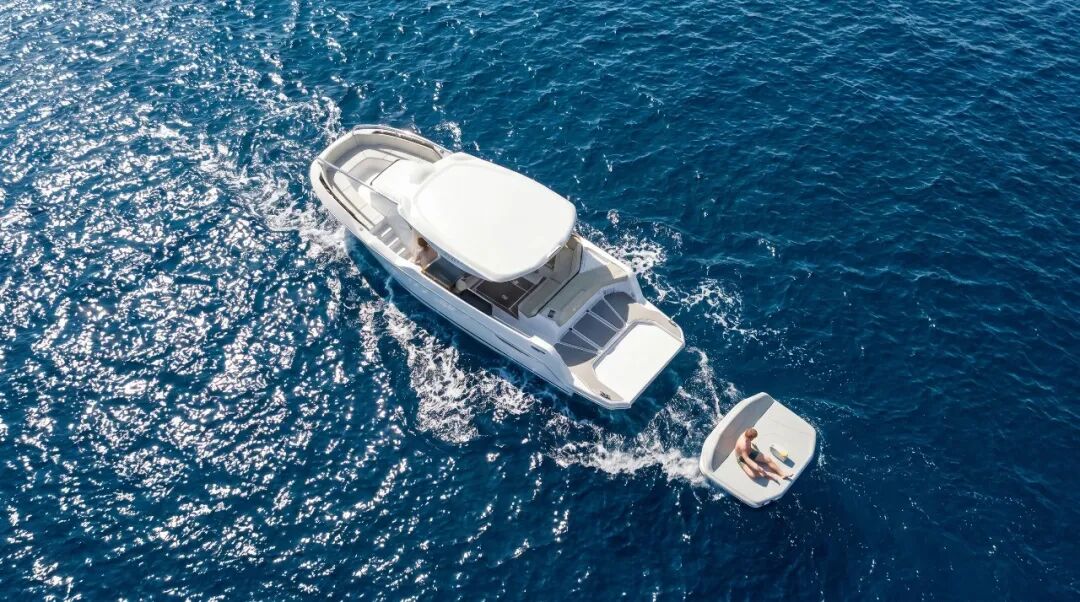
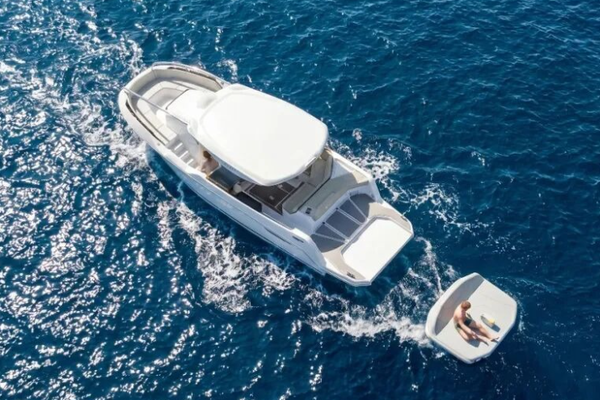
OrcaTech intelligent electric yacht (Source/Enterprise)
In addition to complete yachts, OrcaTech’s ship intelligent driving system APAS is also penetrating into more lightweight water entertainment hardware. The paddle board is one of the categories that has entered large-scale shipment.
The company has reached a cooperation with a leading North American paddle board brand, embedding the ship intelligent driving system APAS into its paddle board products. Through functions such as fixed navigation and speed control, and AutoParking, it can greatly lower the threshold of water operation, allowing entry-level users to get started quickly.
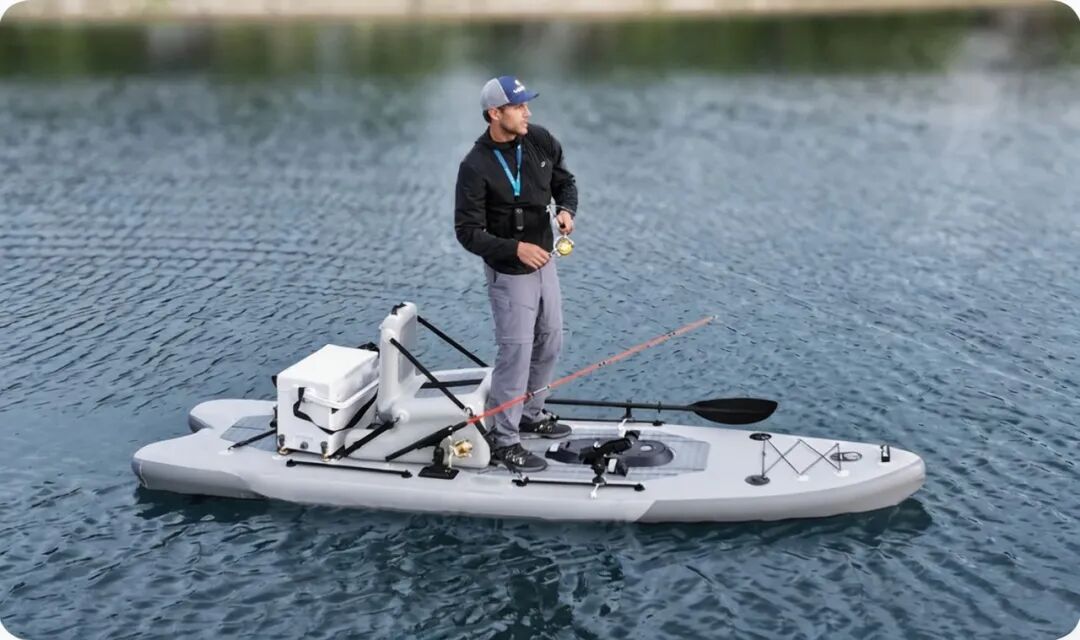
APAS applied to paddle board products (Source/Enterprise)
At present, OrcaTech is accelerating its global layout, and overseas business has become an important growth pole of the company. The company has reached cooperation with customers in Southeast Asia, the Netherlands and other countries and regions to provide intelligent driving solutions for local boats.
The core value of marine embodied intelligence is far from moving the land unmanned driving technology to the sea, but to redefine the logic of perception, decision-making and control based on the essential needs of the sea surface scenario.
OrcaTech takes marine physical AI as the base, uses the general brain to realize the reuse of intelligent driving capabilities across ship types and scenarios, and uses the ontology terminals to cover multiple scenarios from water operation and maintenance to waterfront economy. From cost reduction, efficiency improvement and safety substitution at the B-end, to the intelligent penetration of C-end water leisure equipment, OrcaTech is trying to build a complete closed loop from technology to product to commercialization in this special sea area.
The following is an excerpt from the interview between 36Kr and Zhu Jiannan, founder and CEO of OrcaTech (slightly edited):
36Kr: Based on the “one brain, multiple bodies” architecture, the ship intelligent driving system APAS needs to adapt to multiple ship types and water working conditions. From the perspective of model training and brain architecture, how do you balance the universality of the base and the special performance of each scenario?
Zhu Jiannan: This problem can be viewed from three levels: data universality, application layer scheduling, and hardware computing power grading.
First of all, the construction of the base universality comes from data and system architecture. The self-developed domain controller of OrcaTech is equipped with dual GPUs. Specifically, at the data collection stage, we make fine-grained labels according to water type, light condition, wind and wave level, and season. The data set covers multiple working conditions such as unmanned operation boats, merchant ships, inland rivers and lakes. In addition to multiple test bases in Hainan, Zhoushan, Huzhou, Xi’an and Nantong that continuously generate samples, real scene data is continuously used to train the algorithm.
On the application side, APAS can be further divided into three intelligent driving subsystems: A, B and C. System A serves full-unmanned special hulls such as offshore wind power, fishery administration and maritime affairs; System B is oriented to consumer water entertainment equipment such as paddle boards and yachts; System C adapts to inland river and ocean shipping. We will not develop a set of independent hardware for each scenario, but keep the general brain unchanged, and complete the adaptation by switching working modes, so as to realize capability reuse.
On this basis, it is necessary to deal with the difference in generalization difficulty brought by different working conditions. From low speed in inland rivers to high speed in far seas, environmental disturbance is increasing, and the difficulty of model generalization is gradually increasing. The low-speed scenarios of inland rivers and lakes are relatively friendly; under far sea and high sea conditions, the wave disturbance is strong, and the challenge to perception and control will increase sharply. For this reason, we have also graded the domain controller. The high computing power version of dual GPU can reach 100TOPS computing power for complex far sea working conditions; the low computing power version is 40TOPS, which meets the needs of low-speed scenarios in inland rivers.

Ship intelligent driving system applied to 226m ocean bulk carrier Jiatong (Source/Enterprise)
At present, this system can cover most ship types of 50 knots, and can also support far sea scenarios, which can meet most business needs at this stage. This combination of “general pre-training data base + software mode isolation + hardware computing power grading” is also our core means to alleviate the performance conflict caused by multi-domain data and balance general capabilities and scenario-specific performance.
36Kr: OrcaTech has laid out both ToB and ToC lines at the same time. From the perspective of commercial logic, what are the differences between these two types of business in value creation mode, payment subject and large-scale path?
Zhu Jiannan: The essential difference lies in different value propositions.
The core of ToB business logic is to use AI and autonomous driving as efficiency tools. Customers buy cost reduction, efficiency improvement and safety compliance. Most of the payers are operators, the decision-making chain is rational, and the ROI is calculated clearly. Due to the characteristics of marine operation scenarios such as high risk, high labor cost and high value output, it is naturally suitable for unm