
Mumbai, Maharashtra, 4th of August, 2026 : Motilal Oswal Financial Services Ltd. (MOFSL) has released its H1 2026 Precious Metals Report, highlighting a significant shift in the way global precious metals markets are responding to macroeconomic developments. According to the report, the first half of 2026 marked a departure from the long-held belief that geopolitical conflicts automatically strengthen gold prices, with inflation, interest rates and monetary policy emerging as the dominant drivers of precious metals.
The report notes that gold started 2026 on a strong footing, supported by tariff uncertainty, robust ETF inflows, sustained central bank purchases and expectations of multiple US Federal Reserve rate cuts. However, the narrative shifted during the second quarter as tariffs and the US-Iran conflict became inflationary rather than purely geopolitical events. Markets consequently repriced expectations towards a prolonged higher-for-longer interest rate environment, pushing real Treasury yields and the US dollar higher, thereby limiting gold’s traditional safe-haven appeal.
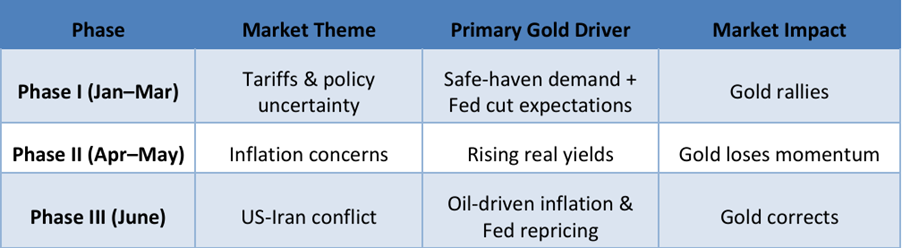
The report divides H1 2026 into three distinct phases. The first quarter was characterised by policy uncertainty and safe-haven buying, which supported gold prices. During April and May, inflation concerns gained prominence as tariffs increasingly translated into higher production costs and sticky inflation, reducing expectations of near-term rate cuts. By June, despite heightened geopolitical tensions arising from the US-Iran conflict, markets focused more on the inflationary consequences of higher oil prices and the resulting impact on monetary policy, leading to a correction in gold prices.
Source: MOFSL Commodities Half Yearly Report
Commenting on the report, Navneet Damani, Head of Research, Commodities, Motilal Oswal Financial Services Ltd., said:
“H1 2026 demonstrated that the relationship between war and gold has become increasingly conditional. Rather than reacting solely to geopolitical headlines, markets focused on how these events influenced inflation, real interest rates and monetary policy expectations. Rising real yields emerged as the key headwind for gold, outweighing traditional safe-haven demand despite elevated geopolitical tensions. This marks an important structural shift in the way investors need to assess precious metals going forward.”
The report also highlights several structural themes that shaped precious metals during the first half of the year. Tariffs transitioned from being viewed primarily as a growth risk to becoming a key source of inflation. Rising US fiscal deficits continued to provide long-term structural support for gold even as higher Treasury yields created short-term pressure. At the same time, the Bank of Japan’s gradual policy normalisation tightened global liquidity, while China remained an influential participant through reserve diversification, central bank purchases and sustained industrial demand for silver. Investment flows also diverged during the second quarter, with ETF outflows increasing even as central bank buying and Indian ETF investments remained resilient.
Manav Modi, Commodities Analyst, Motilal Oswal Financial Services Ltd., said:
“The first half of the year reinforced those macroeconomic fundamentals, not geopolitics, are increasingly determining the direction of precious metals. Inflation trajectory, Federal Reserve communication, global liquidity conditions, central bank demand and investment flows are expected to remain the key variables for gold and silver during H2 2026. While near-term volatility may persist, structural demand continues to support the long-term outlook for precious metals.”
Looking ahead, the report states that precious metals are expected to remain heavily influenced by macroeconomic developments during the second half of 2026. Inflation trends, the future path of US interest rates, fiscal sustainability, global liquidity conditions, China’s reserve diversification strategy, central bank demand, ETF flows and speculative positioning are expected to determine the trajectory of gold and silver.
For gold, the report indicates that while prices could witness strength over the medium term, uncertainty surrounding the interest-rate trajectory and developments in the Middle East may continue to exert pressure in the near term. The report highlights a staggered accumulation strategy for long-term investors, noting that gold could witness a correction of 6–8% from current levels before targeting US$4,800, followed by US$5,500+ over a 12–15 month horizon. On the domestic front, assuming USD/INR at 95.5, the report identifies accumulation levels between ₹1,33,000–₹1,30,000, with medium-term targets of ₹1,68,000 followed by ₹1,93,000.
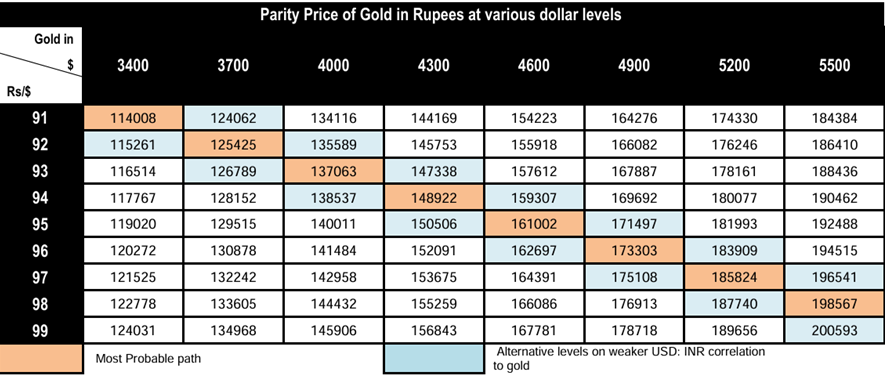
Caption: MOFSL’s H2 2026 gold accumulation and target framework.
Source: MOFSL Commodities Half Yearly Report
Gold’s long-term investment case remains intact, but the coming year calls for patience over impulse. Rather than chasing every price swing driven by headlines, investors should track two things that actually matter: the direction of US inflation and the Fed’s rate decisions under its new leadership. Until real interest rates start falling meaningfully, gold may stay range-bound or see further near-term corrections, with an estimated 6 to 8% decline from current levels possible. This makes a staggered accumulation strategy, buying in tranches on declines rather than in one lump sum, the most sensible approach instead of trying to time the bottom. For those with a 12 to 15 month horizon, current weakness should be viewed as an entry opportunity rather than a reason to exit, given gold’s structural support from central bank buying, fiscal deterioration in developed economies, and its enduring role as a currency debasement hedge. Silver investors should stay mindful of its added volatility, given its dual role as both a precious and industrial metal tied to electrification demand.
For Further Details, refer to the MOFSL Commodities Half Yearly Report here
Investment in securities market are subject to market risks, read all the related documents carefully before investing.
About Motilal Oswal Financial Services Limited
MOFSL is a financial services company. Its offerings include Wealth Management, Capital Markets (Institutional broking & Investment banking), Asset & Wealth Management (Asset Management, Private Equity & Wealth Management), Housing Finance & Equity based treasury investments. MOFSL employs 13,250+ employees serving to 13.6 mn+ clients via distribution reach in 550+ cities. MOFSL has Assets Under Advice (AUA) of Rs. ~6.5 Lakh Crs.
About The Author
