

- The World Platinum Investment Council (WPIC) forecasts that total 2026 platinum demand will fall 9% year on year to 7,674 koz but revised the projected deficit to 297 koz from 240 koz, showing that combined mine and recycled supply remains insufficient even at lower consumption.
- WPIC forecasts above-ground stocks will fall to 1,747 koz by the end of 2026, equivalent to just under three months of global demand and limiting the market’s capacity to absorb an unplanned smelter or shaft outage without higher prices.
- South African total mining production fell 4.0% year on year in June 2026, exceeding the consensus forecast for a 3.4% decline and showing broader mining contraction in the dominant platinum-producing jurisdiction, although the data do not isolate PGM output.
- Selected major producers are increasing distributions while maintaining production guidance, so stronger earnings have not yet produced a comparable increase in near-term supply.
- Peer disclosures identify five listed platinum group metals (PGM) development projects globally, limiting how quickly new mine supply can enter the market, while faster recycling could narrow the deficit before those projects reach production.
Falling Demand & Wider Platinum Deficit Increase Supply-Driven Price Risk
WPIC forecasts that total platinum demand will fall 9% year on year to 7,674 koz in 2026, mainly because the inflows into exchange stocks and exchange-traded funds (ETFs) that lifted 2025 demand are not forecast to recur. Despite the forecast demand decline, WPIC revised its 2026 deficit forecast to 297 koz from 240 koz, a 57 koz increase. A market deficit occurs when annual consumption exceeds combined mine and recycled supply. The revised balance shows that projected supply remains insufficient to meet demand even as consumption declines, increasing the price sensitivity to mine output and recycling volumes.
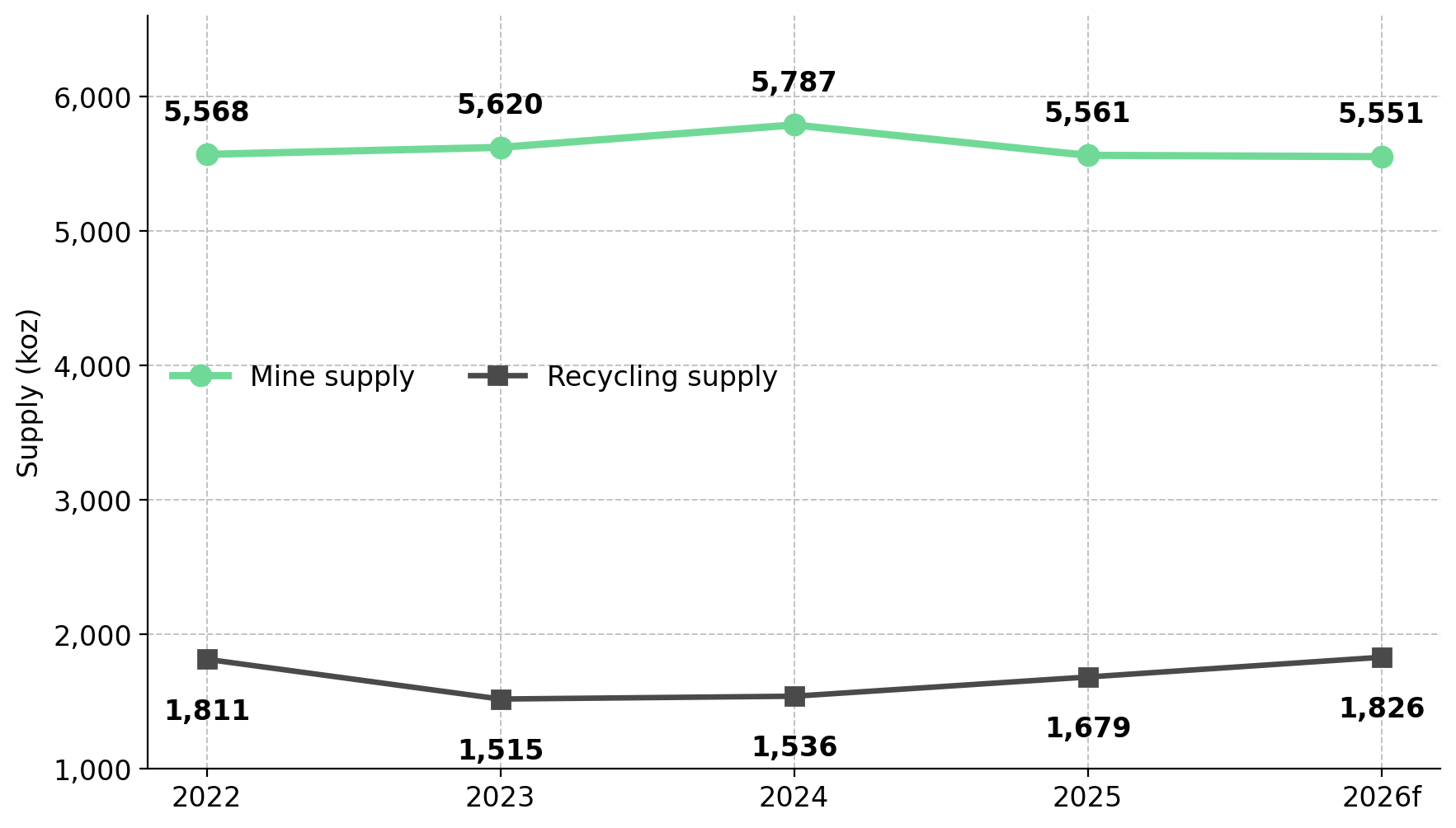
Johnson Matthey’s 2026 PGM Market Report forecasts a fourth consecutive annual platinum shortfall despite an 8% decline in demand, as lower mine shipments from South Africa and Russia are forecast to outweigh recovering automotive recycling and reduce combined mine and recycled supply. The report also forecasts deficits for ruthenium and iridium, showing that supply constraints extend to selected minor PGMs rather than platinum alone.
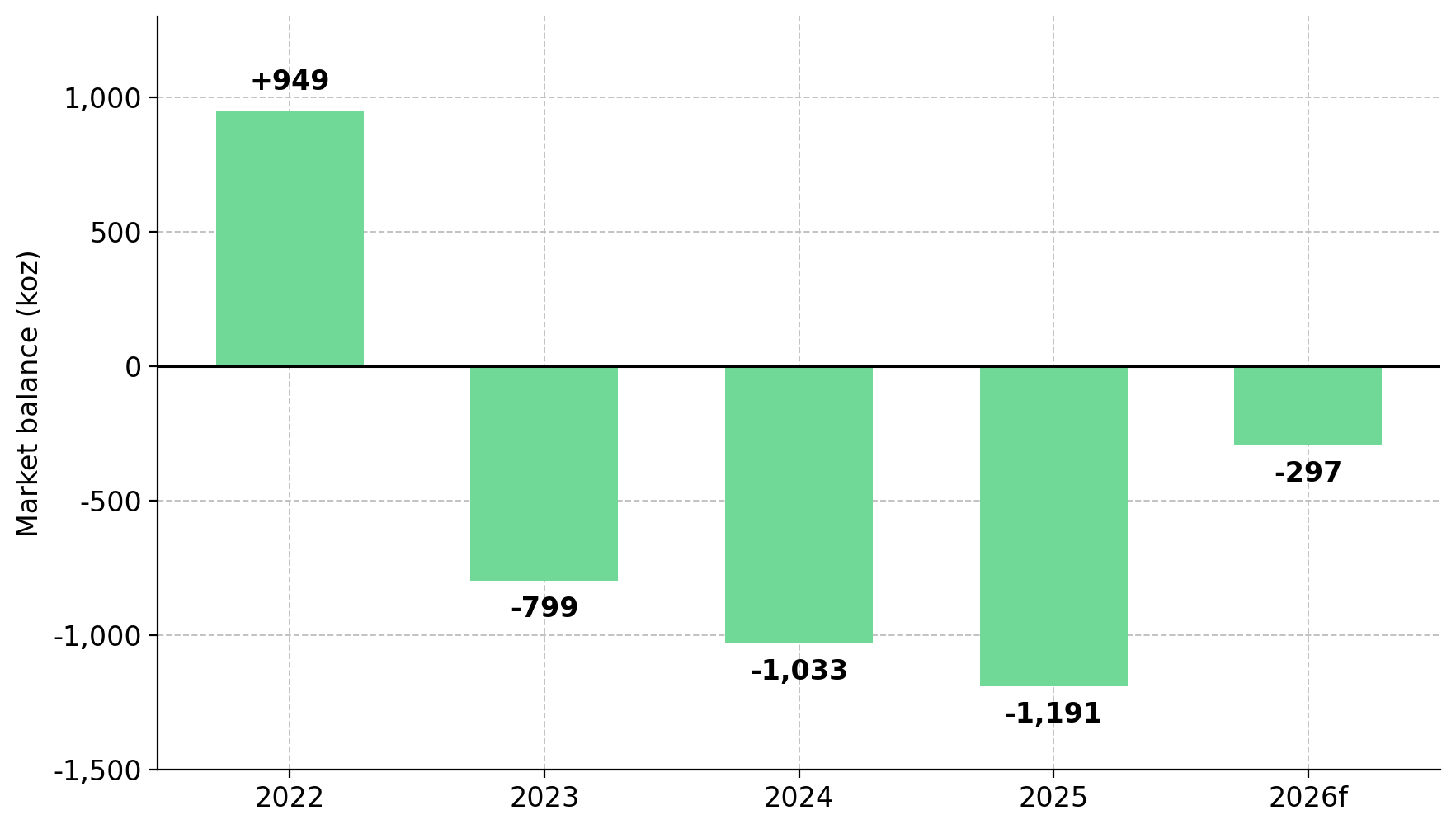
A demand-led deficit can narrow when the increase in consumption reverses, allowing existing supply to cover more demand. A supply-led deficit remains until mine output or recycling rises enough to cover consumption, while new mine production can require years of permitting, financing, and construction even after prices increase. Mine output, processing capacity, recycling volumes, and project timelines therefore deserve greater weight than automotive sales, jewelry fabrication, and ETF flows when assessing whether the platinum deficit can close. If platinum prices rise while total demand falls, treating the move as demand-driven could understate the price effects of mine outages, processing constraints, and project delays.
Four Years of Platinum Deficits Cut Cover Below Three Months, Raising Price Risk From Outages
WPIC forecasts above-ground stocks of 1,747 koz by the end of 2026, which Chief Executive Officer Trevor Raymond described as sufficient to cover just under three months of global demand. Above-ground stocks consist of previously mined metal held outside working inventory used for day-to-day operations and can be drawn down when consumption exceeds combined mine and recycled supply. Four consecutive annual deficits have reduced these stocks, which can rebuild only when combined mine and recycled supply exceeds consumption.
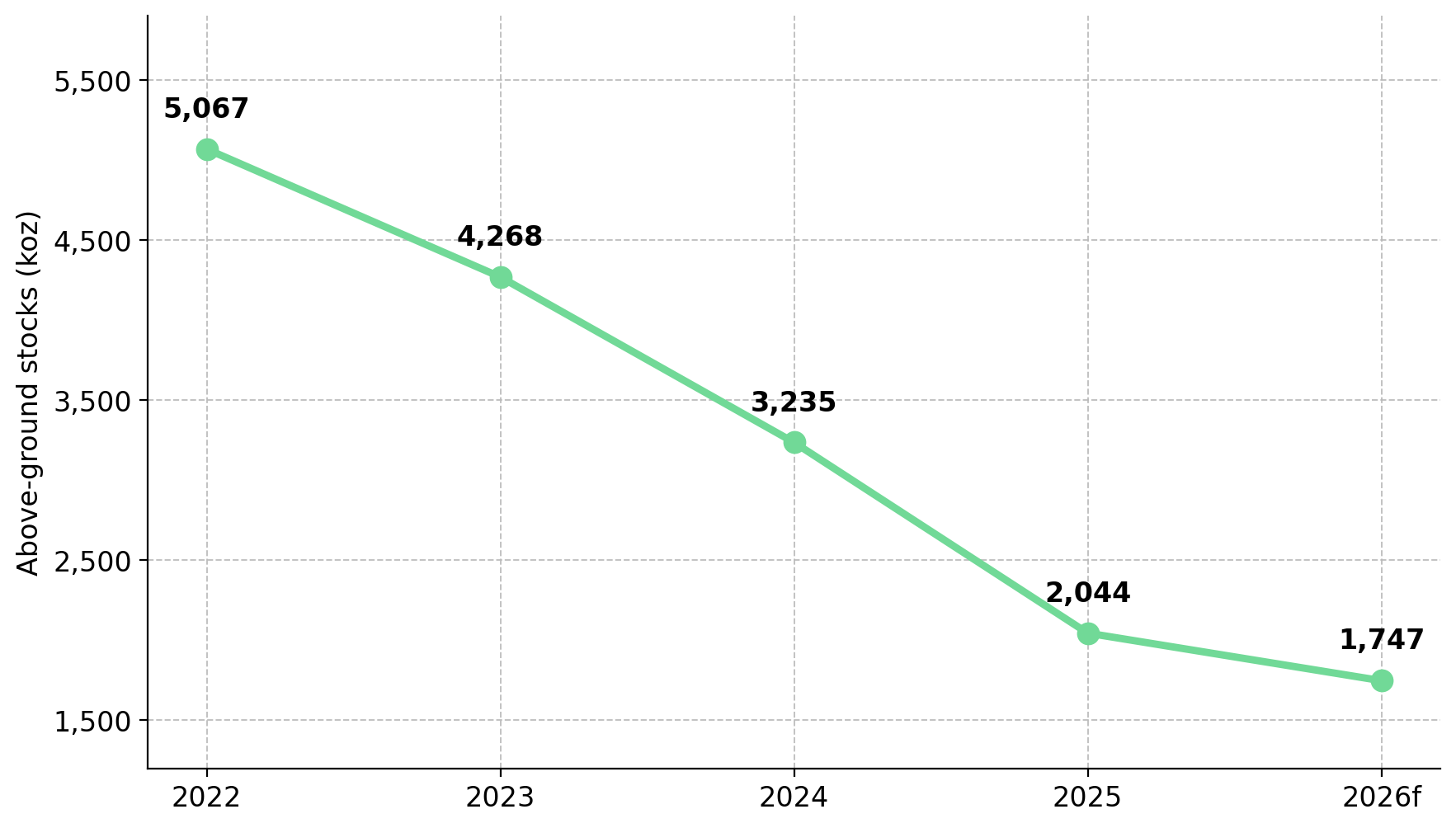
Larger inventories allow a supply interruption to be covered through stock drawdowns, reducing immediate pressure on spot prices. With above-ground stocks forecast at 1,747 koz, equivalent to just under three months of global demand, the same interruption can place greater upward pressure on spot prices and lease rates, the cost of borrowing physical metal for short periods. This limited buffer increases platinum’s price sensitivity to unplanned shaft or smelter outages in South Africa, its dominant supply jurisdiction.
Above-ground stocks cannot be measured directly because the estimate includes private holdings that are not publicly disclosed. The 1,747 koz forecast should therefore be treated as an estimate rather than a measured total. Revisions to supply and demand inputs in WPIC’s next quarterly report could change the assessed inventory buffer and platinum’s estimated price sensitivity to supply outages.
Stronger Rand & 7% Policy Rate Limit Funding for Replacement PGM Supply
The US Geological Survey’s (USGS) Mineral Commodity Summaries 2026 estimates that South Africa holds 63 million kilograms of PGM reserves, compared with a global total exceeding 76 million kilograms, making the country central to long-term supply. South African total mining production fell 4.0% year on year in June 2026 after a revised 5.1% decline in May, compared with the consensus forecast for a 3.4% decline. Because these figures cover all mined commodities, they show a broader contraction in South African production but do not independently establish that PGM mine output has failed to respond to higher prices.
South African producers sell PGMs in US dollars but pay wages, electricity, and consumables in rand, so exchange-rate changes affect their local-currency margins. The rand traded at 16.1350 per US dollar on August 13, 2026, near its strongest level in five months. A firmer rand reduces the local-currency benefit of higher dollar-denominated PGM prices, limiting the margin available for shaft deepening, smelter rebuilds, and new mine development. Domestic financing costs add pressure because the South African Reserve Bank (SARB) held its repo rate at 7.00% on July 23, 2026, following a 25 basis point increase on May 28, while 10-year government bonds yielded about 8.45%, raising the funding hurdle for capital-intensive mine and processing projects.
Higher PGM Earnings Raise Dividends While Selective Brownfield Investment Targets Supply Growth
Impala Platinum’s August 12, 2026 trading statement guided to headline earnings of R21.8 billion to R23.8 billion, up from R0.7 billion a year earlier, as revenue per six-element (6E) ounce rose 51% while production increased 5%. Valterra Platinum reported first-half headline earnings of R21.5 billion, a 21% decline in all-in sustaining cost (AISC) to $996 per three-element (3E) ounce, and a R57-per-share dividend equal to 70% of headline earnings, while maintaining production guidance of 3.0 million to 3.4 million ounces. Northam Platinum raised its minimum annual dividend payout from 25% to 40% of headline earnings on August 11, 2026, while reporting a 4.4% increase in own-operation PGM production to 938,754 ounces and outlining brownfield expansions under Vision 2031. Sibanye-Stillwater’s September 1 results will provide the next test of how stronger cash flow is divided between distributions and new capacity.
Higher prices and lower unit costs are increasing distributions, but Northam’s production growth and planned expansions show that some capital is also moving toward brownfield supply. Capital expenditure guidance, production targets, and payout ratios should be assessed together to determine whether higher PGM prices are funding enough replacement capacity to narrow the shortfall.
Resource Updates & Metallurgical Work Drive PGM Project Valuations
ValOre Metals is advancing its 100%-owned Pedra Branca PGM project, which hosts a 2.2 Moz inferred resource of palladium, platinum, and gold across seven near-surface zones. The company is targeting a resource update in the third quarter of 2026, followed by a preliminary economic assessment in the fourth quarter of 2026 and licensing and environmental work in the first quarter of 2027. These milestones could provide clearer evidence of Pedra Branca’s scale and development potential as the limited PGM pipeline delays new supply.
Thiago Diniz, Vice President of Exploration at ValOre Metals, outlines the metallurgical and exploration work supporting project advancement:
“We are currently working on a metallurgical program to deliver a preliminary economic assessment by the end of the year. While there’s still lots of exploration upside in our property, it’s a 51,000-hectare PGM district entirely controlled by ValOre. So we’re going to be advancing exploration as well in the near future.”
Thin Platinum Stocks, Mixed PGM Balances & Tariff Risk Split the 2027 Price Outlook
Platinum’s above-ground stocks are forecast to cover just under three months of global demand, leaving prices more sensitive to supply interruptions. Johnson Matthey also forecasts deficits for ruthenium and iridium, while 2026 marks the first commercial-scale use of iridium in proton exchange membrane electrolysis for hydrogen production, adding demand for a metal already forecast to be undersupplied.
Nornickel forecasts a global palladium surplus of 0.3 Moz in 2026 and 0.2 Moz in 2027 as Russian output rises toward approximately 2.7 Moz in 2027, supported by the Chernogorskoye deposit. Heraeus forecasts that rhodium will move from a small deficit into surplus in 2026 as higher recycling increases supply. These forecasts strengthen the supply-constrained case for platinum, ruthenium, and iridium but weaken it for palladium and rhodium. Valuing PGM producers as a single group could therefore overstate the upside from palladium and rhodium while understating the scarcity support for platinum, ruthenium, and iridium.
Proclamation 11001, issued January 14, 2026, directed negotiations over processed critical mineral imports and left tariffs or other measures available depending on the outcome. It required officials to provide the President with an update by July 13, 2026, but did not require public release, while the US critical minerals list includes platinum, palladium, rhodium, ruthenium, and iridium. Any future tariff could redirect trade flows and widen regional price premiums without immediately increasing global supply, making the policy more relevant to where metal is held and priced than to the size of the global shortfall.
The Investment Thesis for Platinum Group Metals
- Falling demand alongside a larger projected shortfall shows that supply remains insufficient even at lower consumption, increasing platinum’s price sensitivity to mine output, recycling volumes, and inventory cover.
- Above-ground inventory cover of just under three months limits the buffer available to absorb unplanned outages, increasing the likelihood that operational disruptions place upward pressure on spot prices rather than being fully covered by stock drawdowns.
- A firmer South African rand reduces local-currency revenue from dollar-denominated PGM sales, while a 7% policy rate raises financing costs, limiting the cash flow and borrowing capacity available for replacement projects.
- Selected producers are increasing distributions while maintaining volume guidance, so stronger earnings are supporting cash returns without adding replacement supply, increasing the potential value of funded pre-production projects that can advance toward construction.
- With only five listed PGM development projects identified globally, projects that secure funding, permits, and economic studies could benefit from limited replacement supply, although their valuations remain sensitive to PGM prices and execution risk.
- Resource conversion and first economic studies can support explorer and early-stage developer valuations by increasing resource confidence and enabling project cash flow modeling, while unfunded programs increase dilution and delay risks even when PGM prices rise.
Platinum’s 9% forecast demand decline alongside a deeper 297 koz shortfall shows that falling supply, rather than consumption growth, is driving the 2026 market balance. Limited inventory, tighter rand margins, higher distributions alongside selective brownfield investment, and long development timelines increase price sensitivity to operational disruptions. Producer valuations remain tied to basket prices, operating costs, dividends, and capital spending, while pre-production valuations depend on resource conversion, economic studies, financing, permits, and construction progress. The outlook weakens if recycling grows faster than mine supply contracts or if a weaker rand restores enough producer cash flow to accelerate capacity investment. Because early-stage projects remain volatile and frequently unfunded, exposure can result in a total loss of capital and should be sized accordingly.
TL;DR
Platinum’s projected 2026 deficit has widened to 297 koz even as demand is forecast to fall 9%, indicating that mine and recycled supply remain insufficient. Four consecutive deficits are forecast to reduce above-ground stocks to 1,747 koz, or less than three months of demand, increasing price sensitivity to mine and processing outages. South Africa remains central to supply, but a stronger rand and 7% policy rate raise the hurdle for replacement investment. Higher producer earnings are supporting dividends and selective brownfield growth, while development projects still face study, funding, permitting, and construction delays. Palladium and rhodium surpluses make the outlook uneven across the PGM complex.