
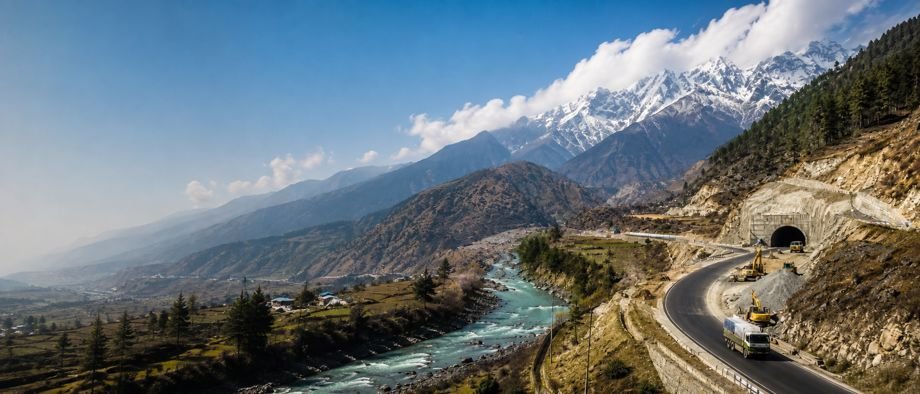
The Nepal-China Himalayan Corridor promises something governments across mountainous regions have long pursued: faster trade, stronger market access and deeper regional integration. However, in the Himalayas, connectivity is never only an economic question. Every new transport, energy or digital link must cross terrain shaped by ecological fragility, seismic risk and vulnerable mountain communities, making development choices unusually consequential.
In “Unraveling the SDGs-Oriented Way Forward for the Nepal–China Himalayan Corridor,” published in Land, authors Tao Song, Shiyu Wang and Zhouying Song examine how stakeholders think that future should be managed. Their analysis identifies five distinct priorities – green infrastructure, climate adaptation, inclusive bilateral growth, viable connectivity projects and local capacity building – revealing that the corridor’s success will depend not simply on expanding infrastructure, but on how effectively economic ambition is aligned with resilience, participation and governance.
A Corridor Where Economic Ambition Meets Himalayan Fragility
The Nepal-China Himalayan Corridor, formally associated with the Trans-Himalayan Multi-Dimensional Connectivity Network, is intended to strengthen links between China’s Tibet Autonomous Region, Nepal and wider South Asian markets. Its strategic value is already visible in growing trade: Tibet’s import-export trade with Nepal reached CNY 3.14 billion by October 2024, a 46.4% year-on-year increase.
However, the same geography that makes the corridor strategically important also makes its development unusually difficult. The route traverses an ecologically fragile and seismically active Himalayan landscape where infrastructure must contend with landslides, environmental sensitivity and disaster risk. Economic connectivity, therefore, cannot be separated from questions of ecological protection and resilience.
This is where the study moves beyond the conventional infrastructure debate. Rather than asking only whether the corridor should be built, it asks what kind of development pathway stakeholders believe should shape it, and how those choices affect progress across the Sustainable Development Goals. The researchers argue that corridor development can create synergies between growth, trade and poverty reduction, while simultaneously generating trade-offs involving biodiversity, climate risk and community participation.
To capture those tensions, the researchers used Q-methodology, a technique designed to identify shared patterns of opinion rather than measure public opinion at population scale. Thirty-two stakeholders participated, including local officials, entrepreneurs, civil-society representatives, journalists, ward representatives and planning actors, with data collected between March and September 2024. Five distinct perspectives emerged, together explaining 68% of the variation in stakeholder responses.
Five Development Visions Reveal the Corridor’s Real Trade-Offs
The first vision treats multidimensional connectivity as the principal engine of development. Supporters see transport, energy and digital infrastructure as capable of generating cascading benefits through greater trade, employment, economic growth and poverty reduction. But even within this infrastructure-positive perspective, respondents expressed concern over weak environmental safeguards and insufficient participation of local communities.
A second group reverses the order of priorities. For these stakeholders, strengthening climate adaptation among Himalayan communities and establishing cross-border ecological monitoring should come before large-scale infrastructure expansion. Their argument is not anti-development; it is that economic gains could prove fragile if connectivity increases ecological pressure or disaster vulnerability in a region already exposed to climate and geological risks.
The third perspective focuses on inclusive economic growth through bilateral cooperation. Its significance lies in shifting attention from the total volume of trade toward the distribution of corridor benefits. A connectivity project can raise aggregate economic activity while still leaving vulnerable or peripheral communities with limited access to jobs, markets and opportunity.
A fourth group is less concerned with broad visions than with delivery. These stakeholders emphasize tangible, technically viable projects and express frustration over slow infrastructure implementation. Their preference suggests that corridor credibility will increasingly depend on whether ambitious connectivity plans can be translated into projects that can be financed, implemented and evaluated rather than remaining primarily strategic commitments.
The fifth vision may be the least visible but could prove among the most consequential. It prioritizes institutional capacity, technology transfer and policy learning, arguing that durable development depends on Nepalese expertise and stronger governance rather than physical infrastructure alone. Only two participants aligned strongly with this perspective, which the authors suggest may reflect the tendency of corridor debates to privilege visible construction over slower institutional reform.
The Biggest Infrastructure Challenge May Be Governance
These five pathways do not necessarily require policymakers to choose one and reject the others. Infrastructure, ecological resilience, inclusive growth and institutional development can reinforce each other when they are deliberately integrated. The real danger lies in treating each objective as belonging to a separate policy silo.
For example, transport and energy projects can incorporate climate-risk assessments, environmental safeguards and ecological monitoring from the design stage. Connectivity investments can also be linked to local employment, knowledge transfer and community participation, allowing economic infrastructure to strengthen domestic capabilities rather than simply move goods more efficiently across borders.
The researchers argue that many corridor trade-offs can be managed through better planning, transparency, stronger institutions and meaningful stakeholder engagement. They also highlight the importance of policy coordination across regional, national and local levels, including inter-ministerial and multi-stakeholder forums capable of aligning infrastructure decisions with wider sustainability priorities.
Such coordination matters because corridors cut across sectors that governments often manage separately. Transport ministries may prioritize roads, economic agencies may focus on trade, environmental authorities may emphasize ecosystems and local administrations may concentrate on livelihoods. Without a framework that forces these priorities into the same decision-making process, development gains in one area can create costs elsewhere.
The study recommends differentiated but integrated policies: greener infrastructure for connectivity advocates, stronger adaptation and ecological monitoring for climate-focused stakeholders, equitable benefit-sharing for inclusive-growth proponents, feasible pilot projects for implementation-focused actors, and stronger technology transfer and institutional capacity for governance-oriented groups.
Why the Himalayan Corridor Matters Far Beyond Nepal and China
The Nepal-China case reflects a much wider development dilemma across the Global South. Economic corridors are increasingly used to overcome geographic isolation, reduce trade costs and attract investment, particularly in regions where weak connectivity has constrained development. However, the pressure to deliver visible infrastructure quickly can clash with slower objectives such as ecological resilience, institutional quality and community participation.
The study’s comparison with previous corridor research is revealing. Work on East African development corridors also identified tensions between infrastructure and sustainability, but the Himalayan study finds a more fragmented set of perspectives, including a clearer distinction between infrastructure-led and governance-centered pathways. The authors suggest that the region’s transboundary character and exceptional ecological fragility help explain that complexity.
There are important limits to how far the findings can be generalized. Q-methodology is designed to map viewpoints, not estimate how widespread each opinion is, and the study is based on 32 participants. The research also captures expectations about future corridor development rather than measuring the actual economic, social or environmental impact of completed projects.
As projects move from planning to implementation, researchers will need to test whether better connectivity actually produces the expected gains in employment, trade and local livelihoods, and whether ecological safeguards reduce environmental and disaster risks in practice. Comparative work across other Belt and Road corridors could also reveal whether the five pathways identified in the Himalayas represent a distinctive regional pattern or a broader feature of transboundary infrastructure development.