
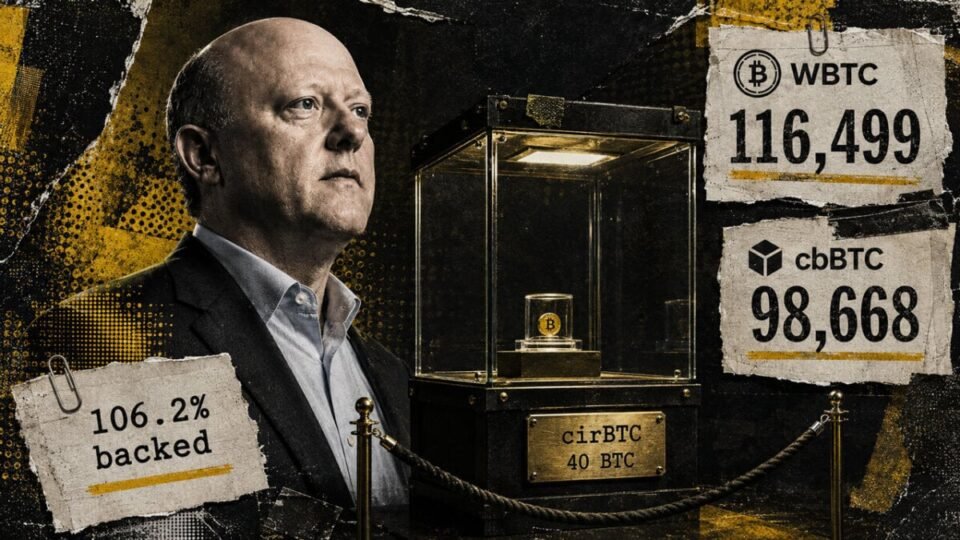
The circulating supplies of WBTC and cbBTC are approximately 2911 times and 2465 times that of cirBTC, respectively.
By Liam Akiba‑Wright
Translated by Luffy, Foresight News
Circle’s wrapped Bitcoin product, cirBTC, boasts strong institutional backing, yet its market size remains virtually negligible.
Circle has equipped cirBTC with segregated reserves, federally regulated custodians, direct minting and redemption channels for qualified enterprises, alongside the mature distribution infrastructure behind USDC. However, approximately 11 weeks after its Ethereum launch, disclosure data from Circle shows that cirBTC’s circulating supply stands at only 40.02450077 coins.
The same dashboard indicates that the reserve pool holds 42.5114162 BTC, yielding a reserve coverage ratio of approximately 106.2%, with a reserve buffer of 2.48691543 BTC held across 14 disclosed Bitcoin addresses. A circulating supply of merely 40 tokens exposes an awkward reality: Circle has built a highly credible, institutional-grade wrapped Bitcoin solution, but has virtually failed to establish a supporting market ecosystem.
cirBTC’s current status serves as a real-world test of Circle’s grand narrative. In Circle’s second-quarter earnings report, Jeremy Allaire stated that the company has built an “internet financial system platform.” This phrasing points to Circle’s entire business framework, encompassing trust charters, USDC, and the upcoming Arc network. Now, cirBTC must demonstrate whether this infrastructure can generate sufficient liquidity and protocol integrations to enable wrapped Bitcoin to function truly as collateral.
40 BTC Operates in a 100,000-Tier Market
cirBTC is Circle’s tokenized version of Bitcoin issued on Ethereum. WBTC and Coinbase’s cbBTC perform the same function, enabling Bitcoin assets to circulate within smart contract networks, yet cirBTC’s scale differs markedly from both.

cirBTC data is sourced from August 27, while WBTC and cbBTC transparency verification dates are set for August 29. cbBTC figures aggregate issuance across Ethereum, Base, Solana, and Arbitrum to avoid double-counting.
Circulating supply is just one metric for gauging wrapped token utility, but it equally reflects distribution capabilities. Every circulating token corresponds to genuine user demand for minting, purchasing, or deploying. Top competitors operate at a 100,000-token supply tier, providing exchanges and DeFi protocols with massive asset pools to build trading and lending markets.
Public on-chain data further widens the scale gap. As of August 29, DefiLlama data shows WBTC’s historical maximum lending exposure reached $3.12 billion, while cbBTC’s stood at $2.817 billion. These figures represent DefiLlama-recorded historical peaks, not real-time lending balances or market share.
CoinGecko data reveals that cirBTC lacks trackable 24-hour trading volume, liquidity, and on-chain transaction records. CoinGecko only aggregates publicly trackable activity, excluding private OTC trades. Nevertheless, the complete absence of public market data sufficiently indicates that cirBTC has yet to establish visible liquidity in mainstream public markets.
The community has submitted a public proposal to integrate cirBTC into Aave. However, the proposal remains pending, with formal collateral support, borrowing demand, and risk parameters not yet implemented. For institutions, such protocol integrations only hold practical value once markets can safely open positions, secure financing, and liquidate positions.
Circle’s Integrated Architecture Balances Trust Endorsement with Platform Control
cirBTC’s deployment comes with a rigorous and formal operational architecture, which precisely makes its low adoption rate particularly striking.
According to the cirBTC whitepaper, the issuing entity is Bermuda-based Circle International Limited, with underlying Bitcoin custodied by Circle National Trust. Circle Internet Financial, LLC provides Circle Mint services and related distribution channels. On Ethereum, cirBTC is an 8-decimal ERC‑20 token with contract address: 0x72DFB2E44f59C5AD2bAFE84314E5b99a7cd5075E, verifiable on Etherscan.
In July, Circle National Trust received final regulatory approval from the U.S. Office of the Comptroller of the Currency (OCC). While the charter applies to the national trust bank itself rather than granting separate financial product approval for cirBTC, this license confers highly credible custodial credentials: underlying Bitcoin is held by a federally chartered trust bank, complemented by a publicly accessible issuer reserve dashboard and direct minting/redeeming capabilities for qualified clients.
Circle Mint is exclusively available to accredited institutions, barring individual users. Secondary market participants can freely transfer the ERC‑20 token, but direct minting and redemption privileges remain restricted by institutional accreditation, jurisdictional regulations, and Circle’s compliance procedures.
This model appeals to regulated funds and corporations that prioritize predictable redemption counterparties. Simultaneously, however, primary market entry barriers are higher. WBTC and cbBTC are already deeply embedded within existing exchanges, wallets, and lending protocol networks. To leverage its trust advantages, cirBTC requires integration from dealers, market makers, various protocols, and custodial platforms.
Circle brings extensive experience in token distribution, positioning it well to meet this challenge. Its Q2 earnings report highlights a $73.3 billion USDC circulating supply and $14.8 trillion in total quarterly on-chain transaction volume, proving Circle’s capacity to operate large-scale token networks. Whether cirBTC secures demand hinges on whether major platforms and clients recognize the utility value of this Bitcoin derivative token.
Circle advocates for wrapped Bitcoin to maintain “strategic neutrality.” An official blog post notes that conflicts of interest arise if the operator of a wrapped asset simultaneously runs an exchange, DEX, or lending protocol. Under this definition, Circle can broadly distribute cirBTC without steering users toward its affiliated transactions or lending platforms.
Yet this neutrality applies commercially rather than architecturally. Key stages including issuance, custody, direct redemption, and distribution of cirBTC remain controlled by Circle-affiliated entities. USDC acts as dollar liquidity to pair-trade with cirBTC, while Circle is concurrently developing the Arc network, which will likely serve as a potential execution environment for cirBTC in the future.
Consequently, while Circle can maintain commercial neutrality toward third-party platforms, its entire business stack operates as a highly integrated unit. Institutions may view this centralized model as a clear advantage in defining rights and responsibilities, yet also worry about forming platform dependency. Ultimately, market adoption outcomes will determine which perspective prevails.
Current data suggests that relying solely on trust endorsements still struggles to disrupt the network effects established by legacy projects. Reserve dashboards only prove asset sufficiency; qualifying collateral requires broad acceptance, borrowing demand, sufficient trading depth, and low-cost redemption channels working in tandem.
The Arc Network: A Crucial Future Milestone for cirBTC
The Arc network aims to unify Circle’s custody operations, stablecoins, and cirBTC wrapped Bitcoin within a single settlement environment. Circle states that the Arc mainnet will officially launch on September 16, having already assembled over 100 builders, with a validator set comprising several major financial and payment institutions.
Data cited in this report cutoff on August 29, preceding Arc’s scheduled launch. The cirBTC documentation confirms support for the Arc testnet, while official mainnet compatibility remains unconfirmed.
Thus, Arc represents a future evaluation milestone rather than a current distribution achievement. Only when cirBTC becomes fully operational on the Arc mainnet, paired with USDC trading markets, institutional participants, and comprehensive lending/trading integrations, can the gap between cirBTC’s minting and practical adoption be bridged. If cirBTC’s circulation hovers around 40 tokens even after Arc goes live, it will be difficult to attribute Circle’s infrastructure-to-adoption disparity merely to being “in early days.”
For now, Circle’s reserve dashboard yields two simultaneous facts: the Bitcoin reserves backing cirBTC exceed the token supply issued; yet compared to mainstream competitors, virtually no users are actively minting or utilizing it.
Circle has successfully built institutional-grade infrastructure. cirBTC still needs to prove that users, trading platforms, and DeFi protocols are willing to integrate into this system.