
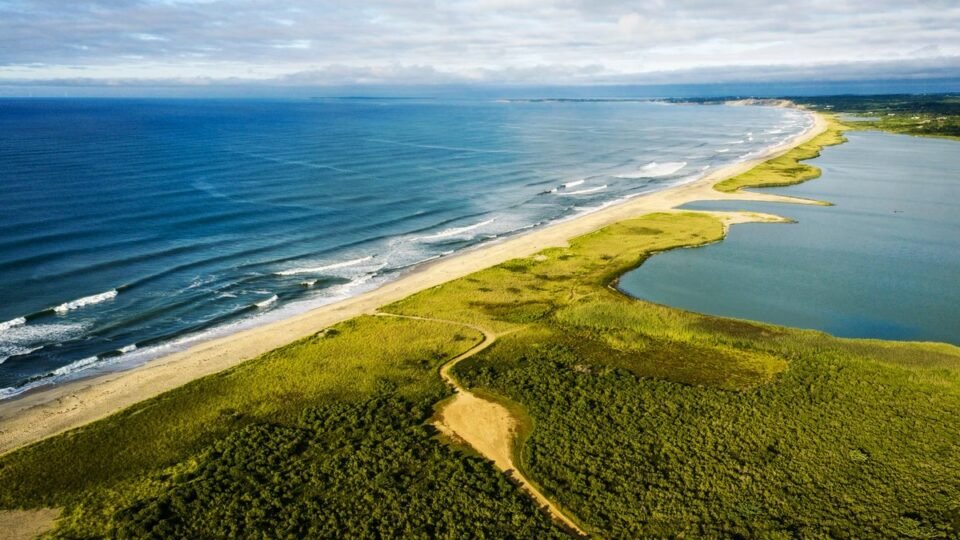
On a brilliant August afternoon, retired architect Tyler Smith hops into his “beach car”— a dented and sandy RAV4 with 130,000 miles on it—and maneuvers onto a grassy farm road on Martha’s Vineyard’s south shore.
It is less than a mile from his house to Black Point Beach in Chilmark. When we arrive he stops at a weathered wooden fence, uses a saw-toothed key to open a padlock, and swings open the gate before pulling into a nearly empty parking lot. We cross a boardwalk and step onto one of the Massachusetts island’s most coveted private beaches, where entry is limited to those with physical keys that can cost $400,000 or more.
When his now-adult kids were young, says Smith, 84, “we used to spend all day here, swimming and riding the surf.”


On Martha’s Vineyard, “beach keys” are the ultimate status symbol, giving affluent property owners entry to secluded stretches of sand that are off-limits to the masses. Keys come with deeded ownership to a sliver of non-buildable beachfront; they often stay in the same family for generations, though a handful sell on the open market each year.

Massachusetts, 2.5 miles (Camille Bressange/WSJ)
In recent years, prices for these keys have shot up thanks to wealthy buyers—seemingly undeterred by the threat of erosion—clamoring for privacy and convenience amid the island’s swelling popularity.
In 2003, a key to Quansoo Beach in Chilmark could be purchased for $200,000, said Abby Rabinovitz of Tea Lane Associates. Last year, one sold for $475,000, while a key at nearby Hancock Beach fetched $650,000, property records show. “There’s more demand than supply. Prices reflect that,” said Tea Lane’s Alexis Holden, who has two clients who have waited for “well over a year” for the opportunity to buy a Chilmark beach key. In “Strangers: A Memoir of Marriage,” Belle Burden said her ex-husband bought her a key to Black Point Beach as a birthday gift. After they divorced, she kept the key, which cost $310,000 in 2016, records show. Some keys come with rules saying they can never be sold at all.
But as property values on the island rise generally—a Herring Creek Farm home recently sold for a record $43 million—beach keys are increasingly out of reach for most. That frustrates some locals, who say affluent keyholders enjoy one of the island’s most valuable resources at the expense of the public.

Mike Peters, a retired National Grid worker from Albany, N.Y., has rented a place on Martha’s Vineyard every summer since the 1990s. He could never afford to buy a place, or key, of his own, he said. “For the common people, you just visit and go home. You can’t own a piece of it.”
Behind the gates
With 124 miles of shoreline, Martha’s Vineyard has more than two dozen public and private beaches, plus town beaches that are only open to residents.
Some states don’t allow private beaches, but Massachusetts does. On Martha’s Vineyard, key beaches emerged decades ago, when families who owned large swaths of oceanfront farmland divvied up beach lots and sold strips of land to neighbors and friends. Key beaches aren’t necessarily more beautiful than others, said Rabinovitz, but the big draw is their seclusion, quiet and easy parking. By contrast, public beaches and parking lots are often teeming with people.


Lisa Herrick, a clinical psychologist who lives primarily in Washington, D.C., inherited the key to a beach in Aquinnah from her parents. The beach has six or seven parking spots and is rarely crowded. “That’s one of the magical things about it,” said Herrick, who spent summers on the Vineyard as a kid. She and her husband paid $740,000 for a three-bedroom house on the island in 2016. Having a beach key, she said, “doesn’t feel like a club, because you don’t go there to socialize with other people—but it feels like an incredible thing to have.”


Julie Flanders, a 13th-generation Vineyarder and real-estate agent, said her family has had a key to Goff Beach in Aquinnah for generations. “It seems elitist maybe,” Flanders added, but the small island absorbs a “crush” of people in the summer. “It’s just management of traffic flow.”
Not many keys come up for sale each year, however. Rabinovitz said roughly 40 beach lots have sold since 2019. Some are included in home sales, however, and a key can add several hundred thousand dollars in value to a property.
In May, Smith and his brother Whit Smith decided to list their 46-acre property, which they own jointly, for $16 million. Tyler’s portion includes a two-bedroom house that he designed in the 1960s, plus two new studios. Included in the offering is Tyler’s beach key, which is likely worth $450,000 to $475,000, said Rabinovitz, the listing agent. Whit has his own key, which he is holding on to for now.
Higher key prices mirror the evolution of the Vineyard’s population, said filmmaker David Heilbroner, 69, who has a home in Chilmark and inherited a key to Hancock Beach. “Now people are building $20 million houses routinely,” he said, “so a $600,000 beach key is closer to a rounding error.”
Policing the beach
Each key beach has its own flavor, etiquette, and rules.
Some beaches give owners a new key each summer to prevent too many from circulating.
Herrick said in her beach association, keys cannot be sold. “My parents gave it to me; I will give it to our kids,” she said.
For the most part, keyholders self-police. They might politely ask trespassers if they are lost, although locals all seem to have stories about overbearing keyholders who kicked people off the beach. Black Point Beach Association has a handyman to maintain signs and locks; a warden monitors the beach to enforce its rules.
Many year-round residents resent the notion that wealthy second-home owners can purchase a piece of beach and prevent locals from using it, said Lisa Stewart, who moved to the island in the 1980s. Meanwhile, parking at public beaches has become a major issue as the island has gotten more crowded, said Stewart, who has sold real estate on the island and now works part time as a parking-lot attendant at Moshup Beach. “There’s beach stress related to it.”


Flanders said beach keys became more controversial as prices skyrocketed. “Island families had them forever. It was just a lifestyle thing,” she said. “When the pricing went up, it changed the perception.”
Heilbroner, a past president of the Hancock Beach Association, said the purpose of the association isn’t just to keep people out, but to preserve the beach. “It’s a very special place that deserves protection,” he said, adding: “There is the reality that the island is eroding.” A few years ago, when the beach parking lot came up for sale, the association bought it as a bulwark against the disappearing coastline, he said.
Heilbroner said he is both deeply appreciative—and uncomfortable—that he has access to a pristine beach while others don’t. “The starting line for everybody isn’t equal,” said Heilbroner. “Rich people can get a private beach and others can’t…I don’t pretend to be holier than anybody, I just do have these feelings.”
Discover more stories. Read the latest real estate news at The Wall Street Journal.
Get real estate news in your inbox