
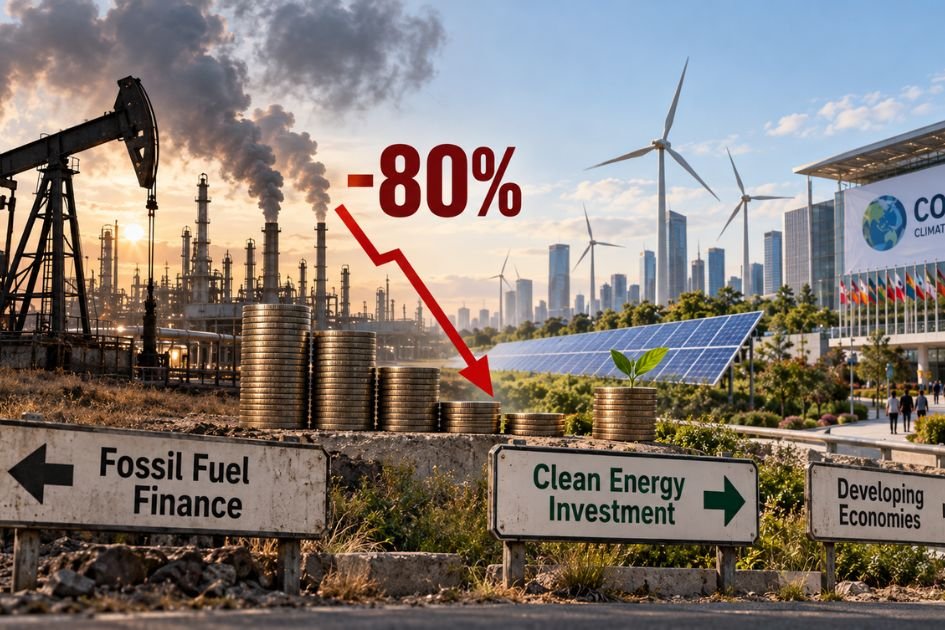
Export credit agencies remain a major source of fossil fuel support, while developing economies receive limited clean energy funding, raising concerns over financing priorities ahead of COP31.
Members of an international clean energy coalition have cut public financing for fossil fuels by as much as 80%, but less than half of the reduction has been redirected towards clean energy, with most support flowing to advanced economies, according to a new analysis released ahead of the COP31 climate summit.
International public finance for fossil fuels from members of the Clean Energy Transition Partnership (CETP) fell to $3.3 billion in 2025, representing an annual reduction of $8.5 billion to $13.2 billion compared with the 2019–2021 annual average before the partnership was launched.
The findings were published on October 27, 2026, in a report titled “Down But Not Out: Deep Cuts to Fossil Fuel Finance, Unfinished Business on Clean Energy”, jointly released by the International Institute for Sustainable Development (IISD), Oil Change International (OCI) and Friends of the Earth U.S.
CETP members have committed to ending direct international public finance for unabated fossil fuels and prioritising clean energy investment.
The assessment found that the coalition had continued reducing fossil fuel financing despite geopolitical tensions and ongoing global energy crises.
Eleven of the partnership’s 16 high-income signatories now have energy finance policies fully aligned with their commitments, up from 10 in last year’s progress report.
“The sustained reduction in fossil fuel finance shows that CETP members are delivering. That implementation record makes CETP one of the most successful climate coalitions,” said Adam McGibbon, campaign strategist at Oil Change International.
McGibbon urged South Korea, Japan and China, identified as the largest providers of international public finance for fossil fuels outside the partnership, to join CETP by COP31.
He said their participation could accelerate reductions in fossil fuel support and redirect billions of dollars in public financing towards clean energy.
Despite the overall decline, several CETP members continue to provide substantial support for fossil fuel projects.
Italy was the largest provider among members, supplying $6 billion between 2023 and 2025, followed by Germany with $2.5 billion and Switzerland with $1.6 billion.
Export credit agencies, which provide government-backed loans, insurance and guarantees for exports, accounted for 64% of CETP members’ fossil fuel financing in 2025.
The report identified these agencies as a priority for closing policy loopholes that continue to allow fossil fuel support.
While clean energy financing has increased, the pace of growth remains insufficient to offset the reduction in fossil fuel funding.
CETP members provided $5.6 billion in clean energy finance in 2025, an increase of 28% compared with the 2019–2021 annual average.
However, the analysis found that only 42% of the funding withdrawn from fossil fuels had been redirected towards clean energy.
By comparison, G20 countries outside CETP increased their clean energy financing by 36% over the same period.
The geographical distribution of financing also revealed a significant imbalance.
Emerging and developing economies received just 24% of CETP members’ clean energy finance in 2025, while advanced economies accounted for 71%.
Natalie Jones, senior policy adviser at IISD, said the partnership offered a model for addressing the financial incentives and economic dependencies that sustain fossil fuel consumption.
“Following April’s conference on transitioning away from fossil fuels in Santa Marta, Colombia, CETP offers a model for its ‘coalition of doers’ to tackle the financial incentives and macroeconomic dependencies that sustain fossil fuel use,” Jones said.
She called for COP31 climate finance negotiations, including the Veredas Dialogue, to build on the partnership’s progress and increase clean energy financing on fair terms for emerging and developing economies.
Jones also emphasised the need for additional climate finance owed to those countries.
The report highlighted the United States’ withdrawal from CETP in 2025 as an example of the risks associated with reversing fossil fuel financing restrictions.
In fiscal year 2025, the U.S. Export-Import Bank financed nearly $8 billion in fossil fuel projects, compared with $117.5 million for clean energy.
“The United States has shown what happens when a country leaves the Clean Energy Transition Partnership: its financing of fossil fuels skyrockets,” said Kate DeAngelis, economic policy deputy director at Friends of the Earth U.S.
She urged the U.S. Congress to restrict fossil fuel financing as it reauthorises the Export-Import Bank, arguing that such restrictions could prevent potentially tens of billions of dollars from flowing to the fossil fuel industry.
The report called on CETP members to maintain existing restrictions on fossil fuel finance, phase out domestic fossil fuel subsidies and expand clean energy financing without increasing unsustainable debt burdens.
It also recommended greater cooperation to share investment risks and ensure that members deliver their fair share of climate finance for emissions mitigation, adaptation and loss and damage.
The researchers said this support should come through new, predictable public financing, primarily in the form of grants.
Source: The International Institute for Sustainable Development