
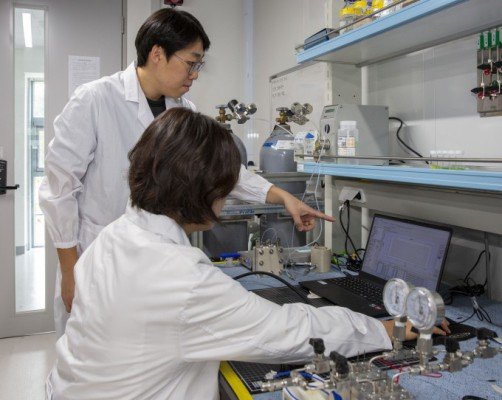
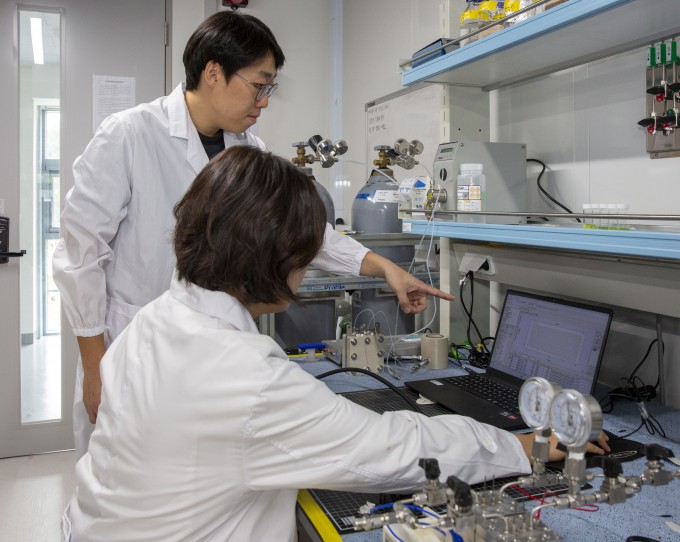
Researchers are testing the performance of the technology they developed. Provided by the Korea Institute of Energy Research
A domestic research team has succeeded in synthesizing eco-friendly ammonia with drastically reduced carbon emissions by using a new membrane-separation technology.
The Korea Institute of Energy Research (hereinafter KIER) announced on the 15th that a research team led by Senior Researcher Jae-Hyung Kim of the Clean Fuel Laboratory has demonstrated that a palladium membrane can selectively transport only hydrogen ions from water, and verified its performance by applying it to a green ammonia synthesis process. The study, carried out with support from the Global TOP Strategy Research Group program of the National Research Council of Science & Technology, was published in the June issue of the international journal Advanced Science.
In electrochemical devices, a separation membrane divides reactants, products, and solvents so that they do not mix, while allowing only ions required for the reaction to pass through. Polymer membranes such as ion-exchange membranes have mainly been used for this purpose.
Inside polymer membranes are small channels through which water flows, and ions move along these channels. The problem is a phenomenon called “crossover,” in which unnecessary molecules such as water pass through together when ions move, degrading the performance and stability of the electrochemical device. With conventional membranes, reducing crossover also slowed down the transport rate of ions.
The research team solved the crossover problem by using a palladium membrane, which has the property of absorbing hydrogen atoms, instead of a polymer membrane. Because the palladium membrane has virtually no gaps, it selectively absorbs hydrogen and transports it to the other side of the membrane, while preventing the movement of all other species.
When an electric field is applied, hydrogen ions on one surface of the palladium membrane are converted into hydrogen atoms and enter the metal. They then migrate through the interior of the palladium, reach the opposite side, convert back into hydrogen ions, and are released into the solution. Throughout this process, the solvents, reactants, and products on both sides of the membrane remain separated, blocked by the palladium membrane.
The team applied the developed palladium membrane to an electrochemical ammonia synthesis process through joint research with a group led by Professor Yoon-Jung Hwang at Seoul National University. Electrochemical ammonia synthesis is an eco-friendly technology that extracts hydrogen ions, the feedstock for ammonia synthesis, from water instead of fossil fuels and supplies the electricity needed for synthesis from renewable energy sources, thereby reducing carbon emissions.
For electrochemical ammonia synthesis, only hydrogen ions must be selectively delivered to the organic solvent phase where ammonia is actually formed, without any transfer of water. This is because even a small amount of water mixing into the reaction phase causes the synthesis performance to drop sharply. However, as there had been no technology capable of completely separating water from hydrogen ions, most processes instead used hydrogen gas directly rather than water.
Using the developed palladium membrane, the research team has, for the first time in Korea, successfully demonstrated electrochemical ammonia synthesis that directly uses water instead of hydrogen gas, thereby presenting a new research direction.
Senior Researcher Jae-Hyung Kim said, “Beyond ammonia synthesis, this technology can be applied to a variety of electrochemical devices that require strict separation of substances, and will help expand the technological possibilities.”
Copyright ⓒ DongA Science. All rights reserved.