
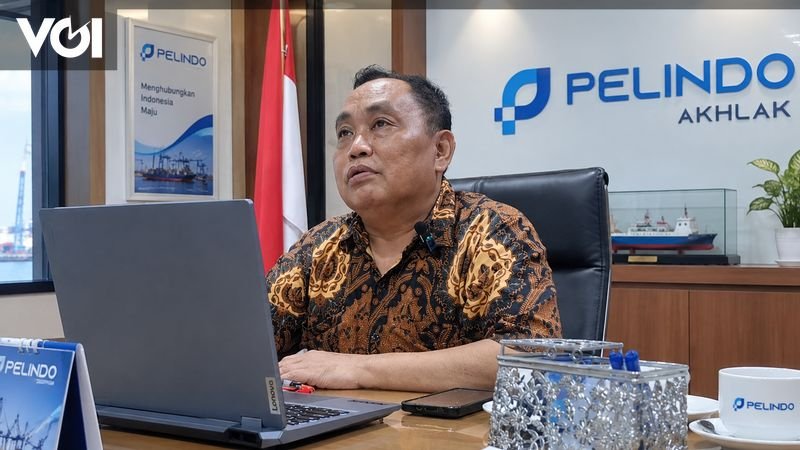
JAKARTA – Pelindo Commissioner Arief Poyuono sees that the investment landscape ahead of 2027 is undergoing a major transformation. Technological developments, changes in community needs, and global economic shifts are assessed to change the direction of investment while opening up new opportunities in a number of sectors.
In his view, Arief assessed that investors need to pay attention to these changes strategically because future investment opportunities are increasingly related to technological developments, sustainability, and innovation.
“By 2027, the investment landscape is undergoing a significant transformation driven by technological advances, changes in community needs, and global economic shifts,” said Arief.
According to Arief, this change in landscape not only presents opportunities, but also challenges for investors. He assessed the ability to adapt as one of the important factors in facing these changes.
“This landscape reflects innovation and adaptability, and presents challenges and opportunities for careful investors,” he said.
One of the sectors that is of concern to Arief is alternative investment. He said that the development of investment products is increasingly broad and is no longer only based on traditional stocks and bonds.
“The increasing supply of alternative investment is one of the most promising aspects of the financial landscape,” said Arief.
He gave an example of private credit and hybrid fund structures as part of the development of alternative investment products that are increasingly gaining attention.
“This alternative instrument offers an attractive option for investors who want to diversify beyond traditional stocks and bonds,” he said.
Arief assessed that the characteristics of alternative investments that do not always move in line with the market in general can be a consideration for investors when facing volatility.
“With the yield rate that is often not correlated with the market in general, this investment can serve as an effective means of hedging against market volatility,” he said.
According to him, the increasing attention to non-traditional assets also shows a change in investor expectations.
“This shift towards alternative investments indicates an increase in the acceptance and demand for non-traditional assets,” said Arief.
Apart from alternative investments, Arief highlighted the property sector related to sustainability. He saw the growth of small cities and increasing demand for environmentally friendly buildings as two trends worth paying attention to.
“The demand for environmentally friendly buildings is not just a passing trend, but has become a necessity,” he said.
Arief said changes in work and housing patterns also opened up new opportunities for investors. According to him, the trend of working remotely has made a number of small cities more attractive because they offer infrastructure development and lower living costs.
“This shift in housing patterns creates profitable opportunities for investors who are willing to take measured risks in emerging markets,” he said.
In the field of technology, Arief places digital twins as one of the developments that have the potential to provide investment opportunities. This technology is a digital replica of a physical system and can be applied in various sectors.
“Digital twin presents a strategic opportunity to invest at the intersection of technology and industry,” said Arief.
He assessed that the space for the application of this technology continues to grow, especially because of its ability to increase efficiency and reduce costs.
“Given the ability of digital twins to increase efficiency and reduce costs, the value proposition is very clear,” he said.
Arief also sees artificial intelligence, blockchain, and quantum computing as technologies that will play a key role in the development of investment.
“Artificial intelligence and machine learning have now been integrated in various sectors, ranging from health and finance to agriculture and transportation,” said Arief.
According to him, the ability of this technology to increase efficiency and support data-based decision-making makes artificial intelligence an important part of the future investment strategy.
“The impact of AI investment is very large, especially in sectors that require data-based decision-making capabilities,” he said.
For quantum computing, Arief admitted that the technology is still in the early stages of development. However, he sees a huge long-term potential as the technology and its commercial applications mature.
“Quantum computing gives an insight into the future of computing power,” said Arief.
Meanwhile, blockchain is considered to have a wider scope of use than cryptocurrencies. Arief sees that the technology can be applied to transactions as well as supply chain management.
“This technology goes beyond just cryptocurrencies; this technology offers a secure, transparent, and efficient solution for various types of transactions and supply chain management,” he said.
According to Arief, the investment opportunities of blockchain also include blockchain services as a service and decentralized financial platforms.
“Investment in blockchain innovation is not only aimed at taking advantage of cryptocurrencies,” he said.
Outside the technology sector, Arief places sustainability as one of the important foundations in future investment strategies. The government and companies, he said, are increasingly encouraging emission reductions and the use of renewable energy.
“Sustainability is not just a trend; it has become an integral component of global economic strategies,” said Arief.
He said that solar and wind energy projects were areas with investment opportunities as technology developed and costs fell.
“Solar and wind energy projects, supported by technological advances and cost reductions, present viable investment alternatives compared to traditional fossil fuels,” he said.
Arief also sees hydrogen fuel technology as one sector that should be considered. Hydrogen, according to him, has the potential to be a clean energy source and a carrier of the future energy.
“Hydrogen fuel, which is touted as having the potential to be a clean energy source, is now attracting investment interest thanks to its flexibility and abundant availability,” he said.
In addition to renewable energy and hydrogen, Arief highlighted the blue economy which focuses on the sustainable use of marine resources. He sees this sector as one of the areas that is increasingly gaining attention in global investment.
“Blue economy that focuses on the sustainable utilization of marine resources for economic growth, improved community welfare, and the health of marine ecosystems is increasingly strengthening as a promising global investment sector,” said Arief.
According to him, blue economic opportunities include sustainable fisheries, aquaculture, marine biotechnology, to marine energy.
“Sectors such as sustainable fisheries, aquaculture, marine biotechnology, and marine energy are very important for investors,” he said.
Arief sees the overall development showing the closer relationship between technology, sustainability, and investment. This change, according to him, makes future investment strategies more complex.
“The convergence of technology, sustainability, and innovation offers unique opportunities for investors to drive change while optimizing returns,” said Arief.
Therefore, he assessed that investors need to take an active role in reading these changes and not just be parties who follow market developments.
“Investors are required not only to be participants in this dynamic, but also to play an active role as designers in realizing a sustainable future,” said Arief.
Arief emphasized that the emerging investment opportunities still require careful study. According to him, diversification and the courage to take opportunities must go hand in hand with an understanding of risks and market conditions.
“As with any investment decision, due diligence and market insight remain key in navigating this dynamic environment,” said Arief.
The English, Chinese, Japanese, Arabic, and French versions are automatically generated by the AI. So there may still be inaccuracies in translating, please always see Indonesian as our main language.
(system supported by DigitalSiber.id)
Add VOI as a Preferred Source
Follow VOI news updates across Google.
+