
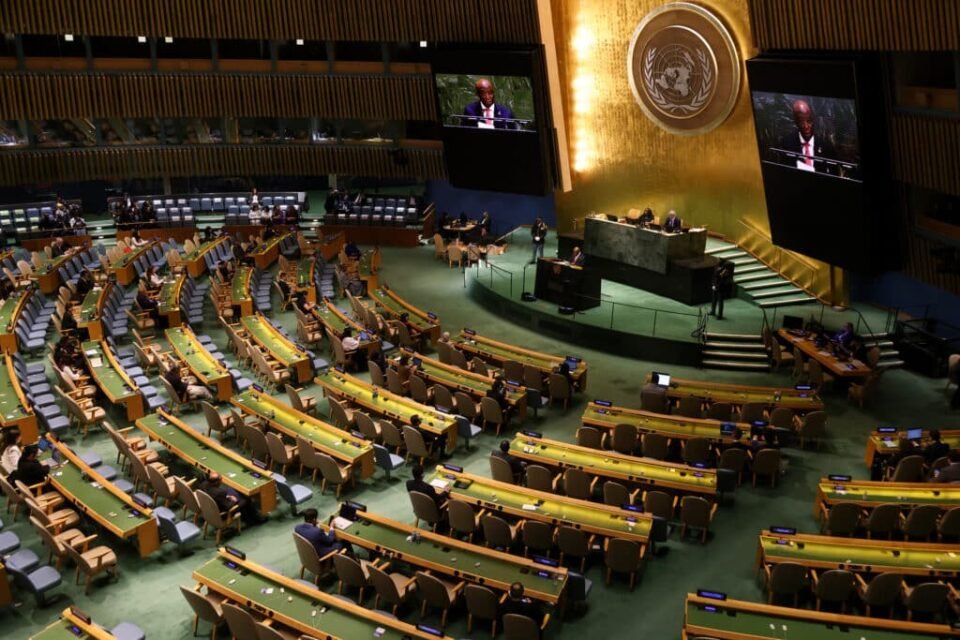
This week, leaders from African nations are gathering in New York for the 81st UN General Assembly (UNGA), either to give a speech, chair a round table, or shake hands with counterparts as they carry their concerns to a global audience.
Kenya’s William Ruto arrived in person with his wife Rachel. Ghana’s John Mahama has spent much of the year building toward this week. Nigeria, meanwhile, sent its vice president to speak on behalf of a president who has stayed home. South Africa arrives nursing a bruised relationship with Washington. The details differ, but the goal across the continent looks similar.
Africa wants to be taken seriously, not as a subject of the world’s problems but as a partner in solving them.
Kenya’s pitch for capital for investors in Washington
Ruto flew into New York carrying a shopping list worth trillions of shillings. His government wants investment in energy, manufacturing, agriculture and technology, and it wants that money to flow without adding to Kenya’s already heavy debt burden.
Its State House says Africa holds more than $4 trillion in domestic savings and assets, much of which remains outside productive long-term investment, and Ruto intends to argue that this capital should be unlocked and put to work at home rather than parked abroad.
Central to his trip is the planned East Africa Refinery in Lamu, a project expected to create more than 60,000 jobs and scheduled to break ground on September 30.
Ruto is co-chairing investment roundtables hosted by the Africa Finance Corporation and the Global Africa Business Initiative alongside Nigerian industrialist Aliko Dangote, and he has also promoted a National Infrastructure Fund that the government says could mobilise up to $40 billion without adding to public debt.

He is not shy about defending his record either.
Speaking to Kenyans in New York ahead of the summit, he insisted his government had steadied the ship. “I can tell you today with confidence that we have stabilized our economy,” he said.
His foreign affairs principal secretary, Korir Sing’oei, has framed the trip as something no country can afford to skip.
“These are heads of state-level negotiations. They cannot be delegated,” he said, adding that reform of the UN system, especially the Security Council, remains a priority for Nairobi.
South Africa’s standoff with Washington
Not every African leader is in New York chasing new friends. Cyril Ramaphosa is trying to manage an old friendship that has soured badly.
Earlier this month the US Secretary of State, Marco Rubio, announced visa restrictions against South African officials accused of involvement in race based discrimination and uncompensated land seizures.
Washington’s ambassador in Pretoria has warned the measures are only the first of several planned. Pretoria has rejected the accusations and called for the dispute to be handled through formal diplomatic channels instead.
Ramaphosa has tried to strike a tone of calm defiance.
“As the South African government, we continue to safeguard our sovereignty as a nation,” he told reporters this week, adding that Pretoria remained willing to keep talking to Washington despite the pressure.
It is not the first clash between the two governments this year. In November the US boycotted the G20 summit in Johannesburg over similar claims about the treatment of Afrikaner farmers, and Ramaphosa refused to hand the G20 presidency to a junior American official, calling the snub disrespectful.
Against that backdrop, the pull of other partners looks stronger than ever. Ramaphosa attended the BRICS summit in New Delhi earlier this month, where South Africa pushed for expanded trade within the bloc and continued reform of global financial institutions. Analysts see the timing as no accident.
With ties to Washington fraying, Pretoria has leaned further into its relationships with China, India and other members of the Global South, framing BRICS as a hedge against a Western partner that increasingly treats South Africa as a problem rather than a partner.
Mahama and the long shadow of the past
While Kenya talks about capital, Ghana is talking about history. Mahama arrives in New York as the African Union’s champion for reparations, a title he earned after leading a successful push at the UN earlier this year.
In March, the General Assembly adopted a resolution declaring the transatlantic slave trade the gravest crime against humanity, a motion adopted with an overwhelming majority of 123 member states voting in favour, while three voted against and 52 abstained.
For Mahama, the vote was not a symbolic gesture but the start of something longer.
“As we do more to correct historical wrongs, we are reasserting our full humanity,” he said earlier this year, describing the reparations agenda as a way of reigniting African dignity.

Ghana has since widened its ambitions, and at a conference in Accra in June it expanded the campaign to include indentured labour as a historical injustice.
The country has also set up a High-Level Advisory Council on Reparatory Justice, a Global Experts Panel on the Restitution of Cultural Heritage, and a Global Legal Panel on Reparatory Justice.
This week Ghana is expected to host a high-level side event during the General Assembly, bringing together the various panels to report on their progress. It is a slow and often unglamorous kind of diplomacy, built on committees and legal frameworks rather than headline speeches.
But Mahama seems to think the patience will pay off, and for a country whose coastline still holds the old slave forts of Cape Coast and Elmina, the cause carries a weight that goes beyond politics.
Nigeria’s wait for a seat at the table
Nigeria’s absence from New York this week says almost as much as its presence would have. President Bola Tinubu stayed in France for his vacation, sending Vice President Kashim Shettima to lead the delegation for a third year running. Opposition figures have criticised the move.
Former vice president Atiku Abubakar demanded a public explanation, arguing that a country of Nigeria’s size deserves its president in the room.
The government insists nothing is lost in translation. Nigeria’s ambassador to the UN, Jimoh Ibrahim, has promised the country will keep its usual standing, including its front row seat during the debate. The real message, though, is the same one Nigeria has repeated for years.
Abuja wants a permanent place on the UN Security Council, and it wants the rest of the world to accept that the body’s makeup no longer reflects reality.

Speaking for Tinubu at last year’s assembly, Shettima delivered the line that has become something of a national refrain. “Nigeria must have a permanent seat at the UN Security Council,” he said, arguing that the council should reflect the world as it is rather than as it was in 1945.
This year Nigeria is expected to press the same case, alongside calls for wider reform and more investment in sectors like solid minerals and technology, with Shettima scheduled to deliver the national statement on Thursday.
Whether or not Tinubu’s absence weakens that argument is a matter of debate in Abuja, but the demand itself is unlikely to soften.
A continent still waiting for its due
Strip away the individual agendas and a single thread runs through Africa’s presence at this year’s assembly. The continent wants a bigger say in decisions that already affect it deeply, from how global capital is allocated to how a superpower treats its citizens, to how the UN’s most powerful body is composed.
That frustration is not new, but it has hardened.
The African Union (AU) has spent two decades pushing what is known as the Ezulwini Consensus, a demand for two permanent seats and five non-permanent ones on an expanded Security Council.
The AU’s commission chairperson, Mahmoud Ali Youssouf, put the argument plainly earlier this year. “Africa is not asking for a favour,” he said, describing the continent’s exclusion as a historical injustice that needed correcting rather than a request awaiting approval.
Analysts who track the reform process are less optimistic about speed. Any change to the council requires amendments to the UN Charter and the agreement of all five permanent members, a bar so high that reform talks have run in circles for years without resolution.
Africa’s 54 votes give it real weight in the wider assembly, but weight in numbers has never guaranteed change in an institution built around veto power.
Still, something has shifted this year. Kenya is chasing investment with real numbers attached to real projects. South Africa is standing its ground against an old ally while quietly building new ones. Ghana has turned reparations from a slogan into a legal and diplomatic programme with its own institutions. Nigeria keeps its demand alive even without its president in the room.
None of these efforts will remake the global order by the end of the week. But together they show a continent that has stopped waiting quietly and started building its case, one summit at a time.